


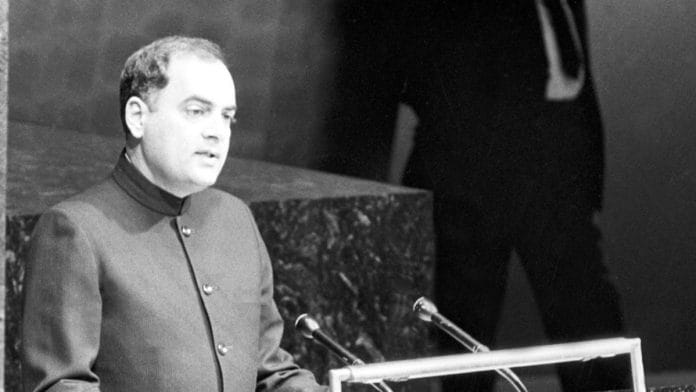
New Delhi: The Bofors controversy was one of the biggest political challenges of Rajiv Gandhi’s tenure as Prime Minister, and Sonia Gandhi, in her memoir, alleges that the Opposition campaign against her husband had the backing of a corporate house and some members of the Congress.
“A campaign launched by the Opposition was supported by a corporate house and some within the Congress Party,” Sonia writes in ‘Belonging: A Journey of Love’.
The controversy began in 1987 over the payment of commissions in the purchase of Bofors howitzer guns from Sweden. Sonia writes that Rajiv Gandhi had maintained that no agents were involved in arms purchases, but subsequent disclosures and inquiries established that agents had indeed been involved, opening the door to allegations of corruption.
Rajiv Gandhi was accused of receiving bribes from the Swedish firm. Sonia writes that the allegations turned into an ongoing media trial.
“Those close to us who had taken on a political role came to overreach themselves; when the inevitable rupture occurred, they turned hostile and hit back,” she writes.
Rajiv, she says, questioned his own judgment: “Had he been too trusting; should he have been more vigilant?” she writes.
Rajiv Gandhi sought an investigation by Swedish authorities and set up a Joint Parliamentary Committee (JPC), which included Opposition members, she adds. They walked out at the final stage when the findings failed to support their allegations, Sonia writes.
“The only place where I can now turn is Parliament.” Sonia writes, recalling Rajiv’s efforts to defend himself.
Sonia also recalls speaking in Parliament in October 1999, eight years after Rajiv’s assassination, after the CBI filed a charge sheet naming him an “absconder” under the then BJP government.
“An innocent man lies condemned without a trace of evidence, the guilty must be identified and punished,” she had said.
The Delhi High Court went on to quash all charges against Rajiv Gandhi on 4 February 2004.
(Edited by Viny Mishra)