





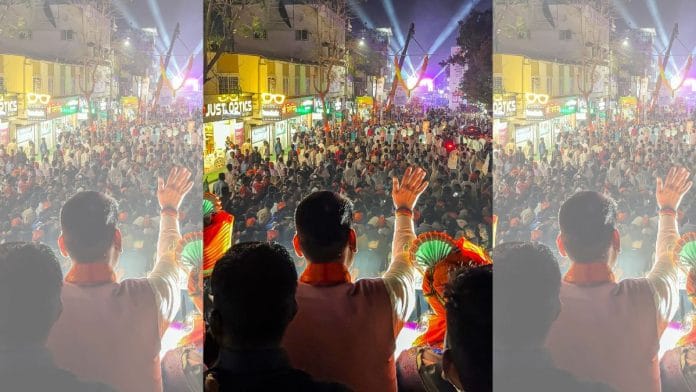



Mumbai: Despite an aggressive campaign by the Thackerays focussing on the sons of the soil, the BJP and the Eknath Shinde-led Shiv Sena secured a thumping victory in the Mumbai civic polls, with the BJP emerging as the number one party in the city.
According to the final tally that came in close to midnight, the Uddhav Thackeray-led Shiv Sena had won 65 wards, while its ally, the Raj Thackeray-led Maharashtra Navnirman Sena, won just six wards. The parties had also tied up with the Sharad Pawar-led Nationalist Congress Party, which secured victory in just one ward. Meanwhile, the BJP clinched a solid 89 wards while its ally Shinde-led Shiv Sena got 29. Deputy Chief Minister Ajit Pawar’s NCP is at a tally of three.
The AIMIM won eight, and two seats went to the Samajwadi Party.
The Brihanmumbai Municipal Corporation (BMC) has a total of 227 corporator wards.
“Gujarat has won, Maharashtra has lost,” said Arvind Nerkar, a former MLA of the Thackeray-led Shiv Sena.
“Gujaratis, Marwaris across Mumbai came out to vote in large numbers. The Marathi population also came out in large numbers, but Gujarati votes all consolidated with the BJP. The Marathi votes got divided among us, Congress, and Eknath Shinde. And then, the BJP also had power, the state machinery and resources with it.”
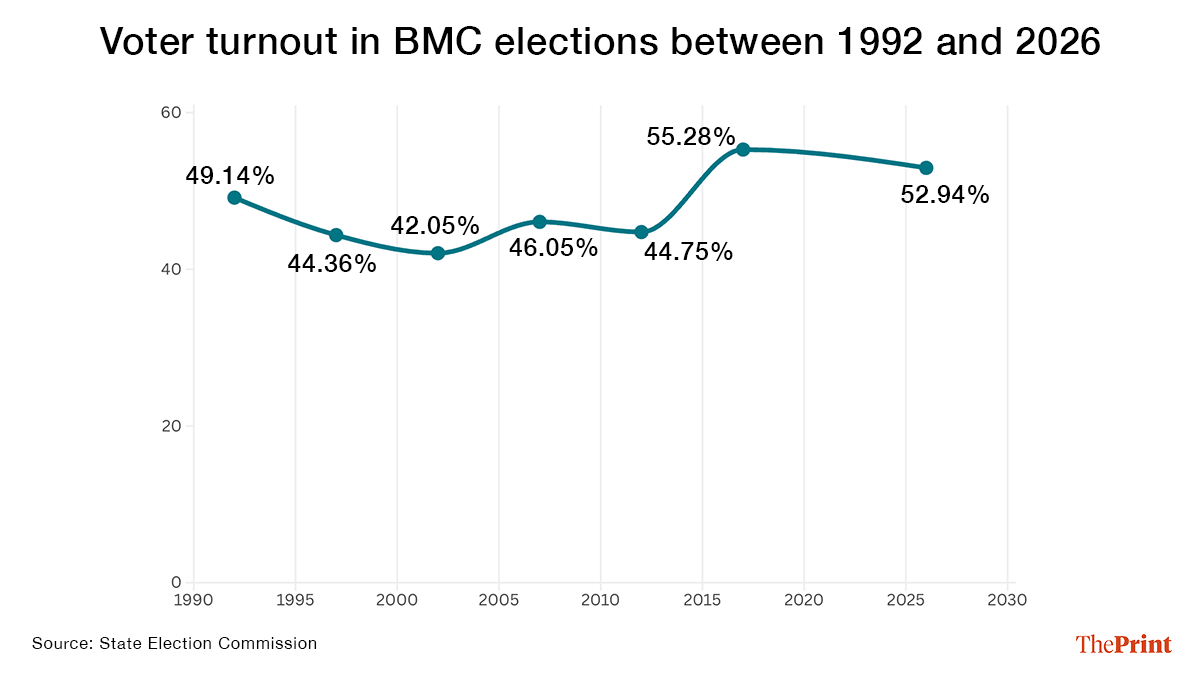
Overall, Mumbai recorded a voter turnout of 52.94 percent.
The Congress, meanwhile, is being further decimated with leads in about 22 of the 143 seats where it fielded candidates. In 2017, the previous election, the Congress had only 31 seats. This time, the Congress tied up with Prakash Ambedkar’s Vanchit Bahujan Aghadi.
Elections were held for the BMC, the country’s richest civic body, after a gap of nine years on 15 January. The term of the last general body had lapsed in 2022 after which the BMC was functioning under a state government-appointed administrator, the municipal commissioner.
Political analysts say, while the BJP has emerged at the top in Mumbai, the party still has limitations in Mumbai. It has not been able to meet several of the objectives that the party had set for itself, which is to decimate the Uddhav Thackeray-led Shiv Sena and establish power in the Mumbai civic body on its own strength.
“If we look at the tally of Eknath Shinde’s and Uddhav Thackeray’s Shiv Sena put together, it shows that the Shiv Sena’s politics as a whole still has space in the city. That space has not shrunk. In 2017, the undivided Shiv Sena had won 84 seats. This time, cumulatively both the Shiv Senas put together are winning something similar,” Sanjay Patil, researcher at Mumbai University’s politics and civics department, said.
“The BJP still needs the crutches of a Shiv Sena (the Eknath Shinde-led party) to have its mayor in the city.”
The second big takeaway is that the Thackeray brand still has a significant following in Mumbai, with the Uddhav Thackeray-led Shiv Sena being at the number 2 spot in Mumbai.
“The Thackeray brand hasn’t completely finished and BJP hasn’t entirely swept the city. Eknath Shinde’s Shiv Sena took a lot of former corporators from Uddhav Thackeray’s Shiv Sena, but was still not able to make significant gains. The verdict shows, in Mumbai, the real Shiv Sena is seen as the Thackerays,” political commentator Hemant Desai told ThePrint.
Also Read: Why Ajit Pawar’s battle in Pune brings up flashbacks of 2017 BJP-Shiv Sena fight in Mumbai
The run-up
The Uddhav Thackeray-led Shiv Sena considers the BMC as its home turf and the party has drawn considerable power and clout from the civic body over the years. The party has ruled the BMC for 25 consecutive years, twenty of which were in an alliance with the BJP.
In 2017, when the Shiv Sena was undivided, the BJP had attempted to wrest the BMC from its ally and contested independently in a shrill, acrimonious campaign. The Shiv Sena had won 84 wards, while the BJP ended up with 82 and supported the Sena from outside to install a mayor. The Congress won 31, the undivided NCP won nine and the MNS won seven.
The Shiv Sena split in 2022 and the NCP in 2023. The 2024 assembly election significantly weakened the position of the Uddhav Thackeray-led Shiv Sena, which won 10 seats of Mumbai’s 36 seats, while the BJP won 15.
Uddhav made up with his estranged cousin, Raj, to contest the election as an alliance in an attempt to consolidate the Marathi voters. Together, they spoke about how the present day’s situation is reminiscent of the Samyukta Maharashtra movement of the 1950s when Maharashtrians had to shed blood to ensure Mumbai is a part of the state, and that there was a real danger of the city going to Gujarat.
On the other hand, the BJP hammered out a seat-sharing formula with the Shinde-led Shiv Sena to appeal to Marathi voters while also trying to consolidate all Hindutva votes by accusing Uddhav of appeasing the Muslims and raising alarm over the alleged rise in the Muslim population of Mumbai.
This is an updated version of the report.
(Edited by Tony Rai)
Also Read: In a Maharashtra local election, a BJP-Congress tie-up, then a break-up, and now a situationship