





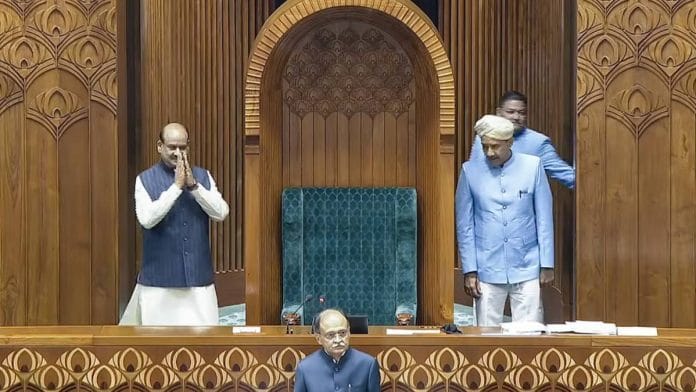



New Delhi: Om Birla Thursday defended his conduct as Lok Sabha Speaker, asserting that he allows every MP to speak under the laid-down rules, regardless of their position, a day after the Opposition-sponsored resolution seeking his removal over charges of bias and partiality was defeated by voice vote.
In his first appearance in the House more than a month after the Opposition submitted a notice expressing no confidence in him, Birla said he listened to every speech during the two-day discussion on the resolution and thanked both those who spoke in his support and those who were critical.
Birla is the third Speaker in independent India against whom the Lok Sabha has admitted a removal resolution and held discussions, a fact the BJP MP from Rajasthan’s Kota, serving his second consecutive term in office, mentioned in his speech.
“I have always tried to run the house with neutrality, discipline, balance and rules. I always try to uphold the decorum, dignity and respect of the House. Hence, on moral grounds, I kept myself away from the proceedings of the House ever since the notice was brought against me,” Birla said in a speech that lasted 30 minutes.
“I listened to every member intently over the last two days. I want to thank everyone who spoke either in support or were critical. The beauty of democracy lies in the fact that every voice and every point of view is given equal importance. The Speaker’s post does not belong to any individual but is a symbol of India’s democratic tradition,” he said.
Responding to the charge levelled against him in the resolution that he prevented Lok Sabha Leader of Opposition Rahul Gandhi from finishing his speech on the Motion of Thanks to the President’s Address, Birla said that no member enjoys any special privilege in the House.
“I want to make it clear that be it the Leader of the House or Leader of the Opposition or any minister, everyone is allowed to speak under the laid down rules and procedures. Some members argued that the LoP is above the rules of the House, and can speak on any issue, but I want to clarify that no one enjoys any such special privilege. I want to make it clear that the rules and procedures, determined by the House itself, are applicable on every member equally,” said Birla.
He cited three instances from the past to buttress his assertion.
In 1957, Atal Bihari Vajpayee was barred from displaying pictures on Jammu & Kashmir while making a speech, and was directed to present them to the Speaker first, Birla said, referring to two more episodes pertaining to the year 1958 in which MPs were asked to obtain the Speaker’s prior approval before referring to non-official records or papers.
Birla also rejected the Opposition’s allegation that microphones are often cut off abruptly when they speak, claiming that the Chair has no control over it.
He also defended his decision to request Prime Minister Narendra Modi not to attend the House proceedings on 4 February and respond to the discussion on the Motion of Thanks to the President’s Address, saying he had anticipated that “unexpected situations” could develop.
“I have always respected women MPs. But the manner in which some members crossed the well to the treasury side, raised slogans and displayed manners, an unexpected situation may have occurred. That’s why I had requested the PM not to come to the House. I did what was required to maintain the decorum of the House,” he said.
(Edited by Nida Fatima Siddiqui)