





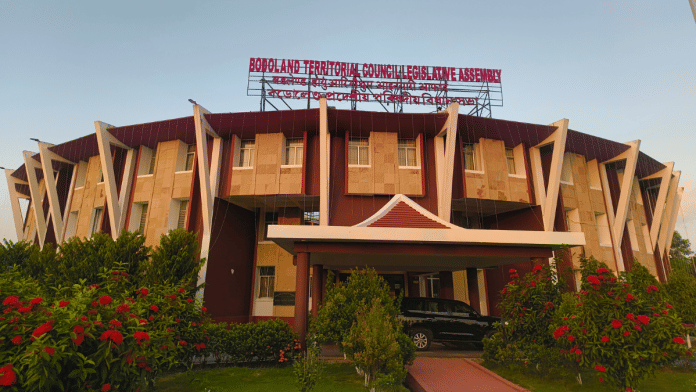



New Delhi: Spread across four districts, the Bodoland Territorial Region, with its 15 assembly constituencies, has emerged as a key electoral battleground ahead of the Assam state polls. Both the BJP and the Congress are courting regional forces in the BTR for potential alliances.
This comes against the backdrop of a political realignment in the region. The Hagrama Mohilary-led Bodoland People’s Front (BPF) swept the Bodoland Territorial Council (BTC) elections last September, dislodging the United People’s Party Liberal (UPPL)-BJP combine from power. It achieved this victory despite Chief Minister Himanta Biswa Sarma’s aggressive pre-election campaigning.
Now, Sarma is trying to retain both BPF and UPPL as National Democratic Alliance partners. The Congress, on the other hand, has made an outreach to the UPPL, sensing that the Pramod Boro-led party is upset with the BJP for its tie-up with Mohilary.
In October, Sarma inducted BPF MLA Charan Boro as a minister in his Cabinet.
Apart from the 15 seats under BTR, voters of the Bodo community play a role in determining the outcome of polls in at least 10 more seats. This is an aspect that both the national parties are aware of, leading to their expedited efforts to rope in regional partners.
The BTC is an autonomous council formed under the Sixth Schedule of the Constitution in 2003. Spread across the districts of Kokrajhar, Chirang, Baksa, and Udalguri, the BTR falls under the jurisdiction of this council.
The BTC was established following the signing of the Bodo Accord among the Hagrama Mohilary-led insurgent outfit, Bodo Liberation Tigers Force, the Centre, and the Assam government.
“It is no secret that the BJP would ideally want both the BPF and UPPL to contest the polls as NDA allies. The challenge is to get Hagrama Mohilary and Pramod Boro to agree to strike an understanding (between themselves). As of now, both remain in the NDA fold,” a senior leader of the BJP’s Assam unit said.
On his part, Mohilary has said that he is not averse to the idea of the UPPL being retained as an NDA partner during the assembly polls. His condition is the party getting tickets to contest from outside the BTR. In September last year, following the BPF’s victory in the council polls, Mohilary asserted that he would return to the NDA fold, but only if the BJP dropped UPPL.
However, he shifted from that position after Sarma offered the BPF a ministerial berth.
UPPL sources said that the suggestion that the party be given seats outside the BTR to contest from was “impractical”. Additionally, the sources said, the UPPL is yet to take a call on the overtures by the Congress.
As many as 19 non-Bodo communities, including Assamese, Koch-Rajbongshis, and Bengali-speaking Muslims, make up nearly 65 percent of the council’s population. The Bodo community is Assam’s largest tribal group, accounting for at least six percent of the state’s population.
“Contrary to perceptions, the BPF’s victory in the BTC polls was not due to the Bodos voting for him en masse, but due to the Muslims of the region warming up to Mohilary’s promise that he would not carry out eviction drives in areas under the jurisdiction of the BTC. If he now ties up with the BJP, we sense an opportunity to win some seats in the region, in case the UPPL comes on board,” a leader of the Congress’s Assam unit told ThePrint on the condition of anonymity.
In the 2021 Assam elections, the BJP-UPPL coalition won eight of the BTR’s former 11 seats. After delimitation, four new assembly seats were added to the BTR, taking the total to 15. The BJP won 60 of Assam’s 126 assembly constituencies in 2021. It was Sarma who had engineered the pact between the BJP and UPPL, dislodging the BPF from power in BTC.
(Edited by Madhurita Goswami)
Also Read: Oppn opts for caution even as scattered voices extend support to Umar, Sharjeel; Left sole exception