


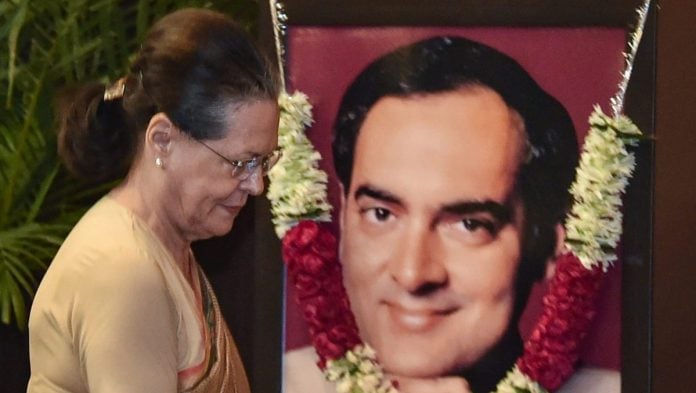
New Delhi: In her memoir ‘Belonging: A Journey of Love’, Sonia Gandhi has written about questioning Rajiv Gandhi over his government’s handling of the Shah Bano case, recalling how she confronted the then prime minister over allegations that he was sacrificing Muslim women’s interests.
Sonia says she was agitated by the controversy and by what she was reading in newspaper and magazine articles. Several prominent women activists, including Muslim women, had spoken out in favour of Shah Bano’s right to maintenance.
“I argued with him and questioned him: The papers are accusing you of sacrificing Muslim women’s interests. What’s going on? Why are you letting this happen?” she writes.
Rajiv told her he was trying to deal fairly with what he considered a complicated situation. “Wouldn’t I defend women’s rights—don’t you know me?” he replied, in what Sonia describes as “a slightly irritated tone”.
He explained that he was looking for a way to address the problem of Shah Bano and other women like her without putting “in jeopardy the entire edifice of Muslim Personal Law”, Sonia writes in her memoir.
“The compromise he accepted did, in fact, strike a balance between religious beliefs and gender justice, and it also gave Muslim women a more fair and reasonable portion than the pitiful monthly amount of Rs 179.2 awarded by the court to Shah Bano.”
The decision came under fire from both sides. Sonia writes that the legal amendment overturning the Supreme Court’s decision was “a political step that was widely criticised”.
“The BJP predictably accused the government of indulging in ‘vote-bank politics’—a capitulation to the conservative elements of Muslim society,” she writes in her memoir.
Sonia also points to the Supreme Court’s 2001 ruling, which upheld the constitutional validity of the 1986 Muslim Women (Protection of Rights on Divorce) Act, while interpreting its provisions to ensure divorced Muslim women received fair and reasonable provision beyond the iddat period.
(Edited by Viny Mishra)