








Thiruvananthapuram: When a Kerala court Saturday convicted LDF legislator Antony Raju in the 1990 evidence-tampering case, the verdict stood out for two reasons. The conviction and the consequent disqualification of Raju was a blow to the ruling Left Democratic Front (LDF). The case also stood out because it presents the rare instance of a lawyer being convicted for tampering with evidence.
“An advocate, who is expected to uphold the sanctity of the justice delivery system, cannot be permitted to subvert it from within,” the Judicial First Class Magistrate Court, Nedumangad, said, handing three years of imprisonment to Raju. The 36-year-old case pertains to the tampering of key material evidence: the underwear worn by an Australian arrested in a drug case. It had led to the acquittal of the accused. Raju was the counsel of the arrested Australian.
According to the verdict, the first accused, the clerk in charge of the property section at the Thiruvananthapuram Judicial Second Class Magistrate Court, conspired with Raju, seized the evidence without permission and resubmitted it after altering it. The item was then forwarded as a genuine item by the clerk.
Raju and court clerk K.S. Jose were found guilty under Sections 193 (fabricating false evidence), 409 (criminal breach of trust by a public servant), 465 (forgery), and Sections 120B and 201 (criminal conspiracy and causing disappearance of evidence) of the erstwhile Indian Penal Code (IPC).
The acts, the court said, can only be considered as a sequence of events “consciously designed to achieve the common object of saving an offender from the clutches of the law.”
A Janadhipathya Kerala Congress (JKC) MLA, Raju was earlier associated with the Kerala Congress (M) but rebelled in the run-up to the 2016 polls, accusing late K.M. Mani of functioning unilaterally.
Raju was the transport minister in the second Pinarayi Vijayan government until the cabinet reshuffle in 2023. With the conviction, the MLA was disqualified from his post, just months ahead of the Kerala polls.
ThePrint reached out to Raju and LDF convener T.P. Ramakrishnan over calls for comment, but no response was received till the publishing of this report.
On Saturday, Raju told the media that the case was an example of an innocent person being punished.
“My lawyer and I appeared in court without missing any hearings. During the A.K. Antony regime, a final report (vigilance) stating my innocence was submitted to the court. Even now, the prosecution didn’t produce any new evidence. Let the law take its course,” he said outside the court.
A ‘bomb’ during trial
Hailing from a coastal community in Thiruvananthapuram, Raju started his political career in college from the student unit of Kerala Congress (Mani), or KC (M). The law graduate started practicing as a junior lawyer after enrolling with the State Bar Council in 1982. His political entry began from the KC (M), then an ally of the LDF, contesting Thiruvananthapuram in 1996.
It was reported that his involvement in the evidence tampering case made the LDF deny him a seat in 2006. Though fielded again in 2016, he lost to his rival.
Five years on, he won from Thiruvananthapuram by 7,089 votes against incumbent Congress MLA S. Sivakumar. This time, the sole winner from his party, Raju was inducted into the Pinarayi Vijayan cabinet as the transport minister, until the 2023 cabinet reshuffle.
“In a political environment like Thiruvananthapuram, this is not something a Kerala Congress worker can dream of. My candidature was unexpected, the ministerial post too,” Raju told Malayalam news channel Malayala Manorama in a short interview after he was inducted into the cabinet.
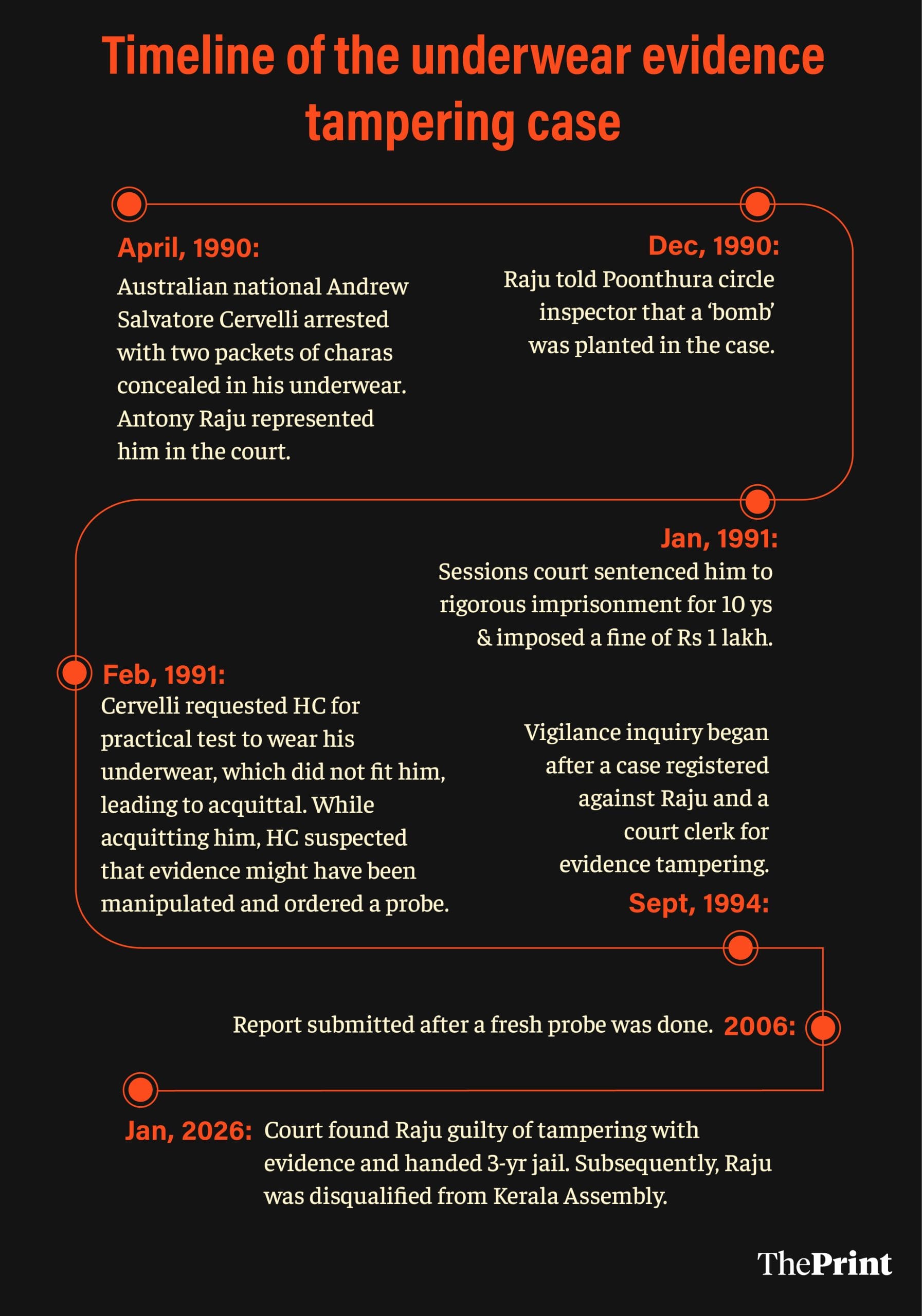
The case he is convicted in dates back to when Raju was a practising lawyer. In April 1990, Australian national Andrew Salvatore Cervelli was arrested under the Narcotic Drugs and Psychotropic Substances (NDPS) Act, 1985, after two packets of charas were found concealed in his underwear at the Thiruvananthapuram airport.
Circle Inspector of Poonthura K.K. Jayamohan took over the probe after the case was registered at the Valiyathura police station. The underwear was produced before the judicial second class magistrate court-II in the same month as the prime evidence.
In January 1991, the sessions court convicted Cervelli and sentenced him to rigorous imprisonment for 10 years and imposed a fine of Rs 1 lakh.
However, during the appeal hearing at the Kerala High Court in February 1991, he requested a practical test to wear the underwear, which did not fit him, leading to his acquittal. While acquitting him, the HC flagged the suspicion that the evidence could have been manipulated and ordered a separate investigation.
Shortly after this, a separate case was registered against Raju and the court clerk for evidence tampering, with a vigilance inquiry beginning in September 1994.
However, the investigation did not formally progress for years as investigating officers kept changing; one officer recommended handing over the probe to another agency, while another cited health reasons. A fresh investigation eventually began, and a report was submitted in 2006.
The evidence that proved the MLA guilty was his own spirited revelations to an investigator and the forensic analysis of the item.
In its verdict, the court noted that the underwear, as described by the prosecution witness, the Circle Inspector of Police, Poonthura, who investigated the original NDPS case, was wearing dark blue, baniyan-cloth-stitched, worn-out underwear.
It bore a printed label indicating the size as ‘180–90’, fitting a waist of 85–90 cm, and was made of cotton polyester. However, the forensic analysis produced before the court suggested that some stitches were from a different garment, and that the label was cut and reused.
The subsequent probe and forensic analysis of signatures on court documents revealed that Raju accessed the underwear through Jose, who was the property clerk at the time, without permission, for over four months, from 9 August 1990 to 5 December 1990. While returning the evidence, Raju claimed he obtained it by “mistake”.
It was also noted that in December 1990, Raju told the Poonthura circle inspector that a ‘bomb’ had been planted in the case and that it would explode once the trial was over, finishing the case. When the officer questioned him further, Raju reportedly replied, “you may wait and see,” the judge noted.
The court noted that the first accused (Jose) also failed to adduce any evidence or explain why he delivered the evidence to the second accused. “The prosecution has successfully proved beyond a reasonable doubt that the accused committed the offences charged,” it said.
(Edited by Tony Rai)