



A high-stakes geopolitical debate is erupting on India’s remote southern frontier. The Great Nicobar Project, an Rs 81,000 crore development plan, has the potential to become India’s ultimate shield against Chinese expansion in the Indian Ocean Region.
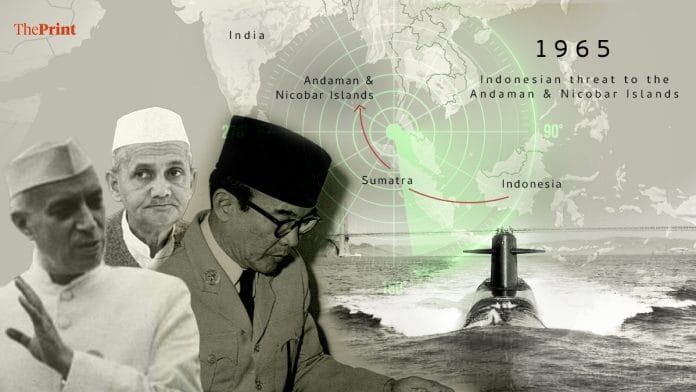
But six decades before the proposed project became a flashpoint in India’s strategic debates, another controversy surrounded the Andaman and Nicobar Islands, one that has all but disappeared from public memory. During the 1965 India-Pakistan war, Indonesia, under President Sukarno, briefly entertained an extraordinary idea: that the Andaman and Nicobar Islands were an extension of Sumatra and could be wrested from India.
Two years before, British MP Lord Ogmore, while drawing alarmed comparisons between Sukarno and Italian dictator Mussolini, had noted in a House of Lords debate: “It is rather bold of him to call [Indian Ocean] the Indonesian Ocean.”
Indonesia’s menacing threat sent shockwaves through India’s diplomatic and military establishment. At the height of the war, New Delhi feared that a hostile China-Pakistan-Indonesia nexus could open a second maritime front in the Bay of Bengal.
Was it a sudden turn of events that caught India by surprise? Or was it the culmination of a series of micro-developments that had steadily worsened relations between India and Indonesia?
After all, this was the very country that had once stood shoulder to shoulder with India.
“Your country and your people are linked to us by ties of blood and culture which date back to the very beginning of our history. The word ‘India’ must necessarily always be part of our life for it forms the first two syllables of the name we have chosen for our land and our race—it is the ‘Indo’ in Indonesia,” Sukarno, the country’s first president, wrote in a letter to Prime Minister Jawaharlal Nehru on 19 August 1946.
Yet less than two decades later, Indonesia had swung firmly behind Pakistan in the middle of a war.
“Down with India, the servants of imperialists” and “Kill Shastri” echoed through the streets of Jakarta. The language of “ties of blood and culture” had turned into something far more ominous. In September 1965, Indonesia’s Foreign Minister Subandrio was openly hostile, declaring that “it is the obligation of all nations belonging to the new emerging forces to help Pakistan, against Indian aggression.”
From Bandung brotherhood to bitterness
For more than a decade after independence, India and Indonesia shared an ironclad bond, forged from the ashes of imperial rule. When Dutch imperialists threatened to reassert control over Indonesia after the Second World War, India emerged as one of Jakarta’s strongest international supporters. PM Nehru supported Indonesia diplomatically and materially, championing Indonesian sovereignty on the global stage.
Indonesia was not oblivious to that support. Shortly after the Dutch recognised Indonesian sovereignty, Sukarno remarked, “On the eve of the rebirth of our nation, I am trying vainly to measure the gratitude of the Indonesian people to India and to her Prime Minister personally for the unflinching and brotherly support in our struggle in the past.”
By 1951, this brotherhood had been set in stone through a historic Treaty of Friendship, promising “perpetual peace and unalterable friendship.” As newly independent nations carrying fresh wounds of colonial rule, India and Indonesia became architects of a new world order. They pioneered Afro-Asian solidarity at the 1955 Bandung Conference — a watershed moment in India-Indonesia relations — with both countries championing anti-colonialism, non-alignment, and a bulwark against Western military blocs.
As Lalita Prasad Singh noted in an article titled Dynamics of Indian-Indonesian Relations: “Indonesia followed India’s lead by accepting the policy of nonalignment. India, in turn, introduced Indonesia to some formal and informal groupings of states such as the Colombo Powers (1954).”
Beneath the rhetoric of solidarity, however, differences were beginning to emerge by the late 1950s.
How did two countries in such perfect sync strike a discordant note within a decade?
Schisms began with something that had seen the two countries formalise their friendship in the first place — the Bandung conference. Nehru’s refusal to back Sukarno’s call for a second conference did not sit well with the Indonesian president. As a counterblast, Sukarno rejected Nehru’s primacy within the non-aligned world and began to oppose the Indian PM at every opportunity. Sukarno was driven by assertive regional and maritime ambitions and militant anti-colonial rhetoric, which stood in sharp contrast with the more cautious diplomacy associated with Nehru, Josip Broz Tito of Yugoslavia, and Gamal Abdel Nasser of Egypt.
“By the early 1960s, Sukarno was facing growing domestic discontent in Indonesia. The economy was under severe strain, inflation was soaring and food shortages had triggered widespread unrest,” said Gautam Kumar Jha, Assistant Professor of Indonesian Studies at Jawaharlal Nehru University.
The growing crisis at home pushed Sukarno toward increasingly ambitious political experimentation.
“Desperate to retain power, Sukarno advanced his Guided Democracy framework alongside the NASAKOM doctrine, seeking to balance secular nationalists, the Indonesian Communist Party (PKI), and political Islamist forces under a broader national ideological umbrella. It was a gamble that failed spectacularly, triggering the overthrow of his regime,” Jha said.
Within little more than a decade, one of Asia’s closest postcolonial partnerships had begun to fray. The final blow, however, would come from elsewhere.
Also read: From 1st R-Day to Jakarta rooting for Pakistan in 1965 war, the ups & downs in India-Indonesia ties
Pakistan’s opening in Jakarta
Anti-India sentiment was already high in Indonesia in the wake of the Asian games fiasco and New Delhi’s support for the Malaysian cause. As India’s standing in Jakarta declined, Pakistan masterfully stepped in — recalibrating its approach, reducing its excessive dependence on Western alliances, and forging closer ties with Afro-Asian countries, particularly China.
BD Arora, in his paper Pakistan’s role in India-Indonesia relations during the Soekarno era,” argues that given “Sukarno’s doctrine of struggle of the New Emerging Forces (NEFO) against the Old Established Forces (OLDEFO),” Pakistan gave Sukarno exactly what India denied him: full endorsement of Indonesia’s demand for a second Bandung conference, and unwavering support for Indonesia’s West Irian cause and the “Crush Malaysia” campaign.
“Pakistan was perceived in Indonesia as far more sensitive and receptive to Indonesian concerns. Its unconditional moral and material support on issues such as West Irian and Konfrontasi resonated deeply in Jakarta,” explained Muhammad Waffaa Kharisma, Researcher at the Centre for Strategic and International Studies (CSIS) in Jakarta. “India, meanwhile, was increasingly viewed as aligned with Britain, Australia, and New Zealand during the Konfrontasi period, leading sections of the Indonesian establishment to see New Delhi as a ‘collaborator with NECOLIM powers.’” He emphasises, however, that “such sentiments were largely products of the geopolitical climate of the 1950s and 1960s and bear little resonance in contemporary Indonesia, where relations with India today are among the strongest in decades.”
Jha concurs that two factors widened the gulf of mistrust: “New Delhi’s support for the formation of the Federation of Malaysia with the inclusion of Singapore, Sarawak and Sabah in September 1963 [Singapore exited in 1965], and sustained anti-India narratives amplified through the Pakistani press.” The result? Thousands of protesters stoned the Indian Embassy, waving banners reading “India and Malaysia are Necolim Siamese Twins.”
Pakistani newspapers, particularly Dawn, praised Sukarno as a “revolutionary anti-colonial leader” while portraying India as an expansionist, “neo-imperialist” power bullying smaller neighbours.
“Pakistani press, much like today, played a pivotal role in turning the winds in its favour vis-à-vis India. Through relentless India-bashing and an overtly pro-Indonesian posture, the Pakistani media successfully burnished Pakistan’s image in Indonesian eyes,” said Jha.
A major breakthrough in the Indonesia-Pakistan relationship came in April 1964, when a joint communique saw Jakarta pivot from its earlier neutrality on Kashmir, calling for “an early solution of this dispute in accordance with the people of the state and other provisions as envisaged in the Security Council resolutions,” as Arora notes.
The inroads Pakistan made in the hearts and minds of Indonesians would serve it well when war with India came.
Jakarta turns against India
The year 1965 is largely remembered in India for the war with Pakistan. What has faded from popular memory is the anti-India fury simultaneously ripping through Indonesia.
Thousands of Indonesian youth and students of Nahdlatul Ulama — the world’s largest Islamic organisation, founded in Indonesia in 1926 — flooded the streets carrying banners that read: “Down with the Indian Imperialists,” “Go home India,” and “Crush India”. By this time, Indonesia had decisively swung behind Pakistan. Violent demonstrations engulfed Jakarta. Indian shops and restaurants were looted, triggering deep resentment and outrage in New Delhi.
Around 4,000 protesters stormed the Indian embassy in Jakarta, wrecking furniture, shattering windows, and ripping apart the Indian national flag.
Subandrio hailed the embassy attack as “revolutionary” and described it as emerging “in condemnation of India as an aggressor against Kashmir and Pakistan.” Sukarno publicly expressed his sympathy, declaring that the “prayers of the Indonesian people are dedicated to the people in Pakistan who are fighting fiercely to maintain the sovereignty and freedom of their country and people.”
Anti-India sentiment was no longer confined to diplomatic circles. It had spilled onto the streets and was being cheered from the highest offices in Jakarta.
Tit-for-tat protests rang through both capitals. In Delhi, demonstrators staged protests outside the Indonesian Embassy, burning effigies of Sukarno. The perceived insult to India’s national honour sparked uproar in Parliament. Opposition leaders staged protests and demanded that New Delhi sever diplomatic ties and recall the Indian mission. However, External Affairs Minister Swaran Singh rejected those demands, arguing it would “not be in our interest to do so.”
Every day the headlines blared the new reality. An editorial in The Indian Express titled, “Dictator’s Axis” reported that Sukarno had offered to send 5,000 volunteers to bolster Pakistan’s war efforts. Another headline — “Jakarta aid for Pindi blocked” — revealed that Jakarta had urged Ceylon, a friendly commonwealth nation, to grant access to its airports to ferry Indonesian personnel to Pakistan. Reports of direct military assistance followed. An article in The Hindu dated 20 September 1965 carried the headline “Indo Planes in East Pakistan.” As Arora notes, “a flotilla of six Russian-built craft, including two submarines, was lent to the Pakistan Navy.”
Indonesia’s Ambassador to Pakistan, Brigadier-General Roekmito Hendraningrat, stated at the inauguration of the Indonesian Consulate in Dacca on 1 August 1965 that “the Indonesian Government and the 105 million Indonesian people are giving full political and moral support without any reservations.” For New Delhi, the implications were alarming. Swaran Singh issued a stern warning that active hostility from Indonesia “in alliance with China and Pakistan would be regarded as aggression against India and will be dealt” with accordingly.
India fears a second front
Indian Ambassador to the United States Braj Kumar Nehru rushed to meet President Lyndon Johnson on 9 September 1965. He described a clear Chinese-Pakistani-Indonesian understanding designed “to put a triple squeeze on us.” If China entered the conflict, he asked, what would India do? “India thought the Indonesian contribution might be to take the Andaman and Nicobar Islands. India couldn’t stop this; it had no navy,” Nehru told the President.
Johnson’s reply was blunt: this was “giving us grey hairs right now.”
The Andaman scare
Sitting astride the eastern approaches to the Indian Ocean and close to the Malacca Strait, the Andaman and Nicobar Islands — India’s “unsinkable aircraft carrier” — occupied a strategic position far beyond their size. Given the proximity of the archipelago to Sumatra, Indonesia’s westernmost province, fears of Indonesian incursions were more real than distant speculation.
And Indonesia had the capability to act. Admiral Arun Prakash, former Chief of the Naval Staff of India, recalled the scale of Indonesia’s maritime ambitions.
“President Sukarno had declared that the Indian Ocean should be called the ‘Indonesian Ocean’. The Indonesian Navy had reportedly printed charts referring to it as the Indonesian Ocean,” he said. “By the early 1960s, Indonesia had acquired a fairly formidable naval capability from the Soviets, including cruisers, submarines, and missile boats, well before the Indian Navy began its own major build-up. Around 1961-62, the Indonesian Navy was viewed as a significant regional force. Indonesia did eventually offer Pakistan a submarine and a patrol boat during the 1965 war, though by the time they reached Karachi, a ceasefire had already come into effect.”
Apprehensions of a possible Indonesian takeover of the islands permeated the halls of power as well as military ranks. In Parliament, Col. Bashir Hussain Zaidi, member of the Rajya Sabha, sounded the alarm about “dangers to [the] Andaman and Nicobar Islands,” pointing specifically to Indonesia’s lethal submarine fleet. MP HV Kamath was more direct: “Though the Defence Minister is not admitting to it, it was clear that the submarine noticed near the Nicobar Islands belonged to Indonesia.”
Such apprehensions were not baseless. As Ristian Atriandi Supriyanto noted in his paper The Indo-Indonesia Defense relationship: Towards a Convergent Mandala: “The Indonesian Air Force agreed to transfer both MIG-15s and 19s, whereas the Navy despatched two submarines, two Komar-class missile boats and two Jaguar class torpedo boats to Pakistan. This situation only led to demonstration flights over the islands but, combined with Sukarno’s declared ideas of an “Indonesian Ocean”, caused justifiable alarm in India.”
Andaman and Nicobar: Extension of Sumatra?
Was there any substance behind these fears? One account from the Pakistani side suggests there was.
Air Marshal Asghar Khan, in his memoir The First Round, recounts a conversation with Indonesian Naval chief Admiral Martadinata, where the latter asked him: “Don’t you want us to take over the Andaman Islands? A look at the map will show that the Andaman and Nicobar Islands are an extension of Sumatra, and are in any case, between East Pakistan and Indonesia. What right have the Indians to be there? In any case, the Indonesian Navy will immediately commence patrols of the approaches to these islands.”
Many argue these alleged claims were an offhand remark made in the heat of a rapidly escalating war rather than a genuine strategic objective. Muhammad Waffaa offered a more measured reading: “These claims over the islands were less about genuine territorial ambition and more about a calculated attempt to unsettle India — a strategic gamble to stretch Indian military resources, divide its strategic attention, and compel New Delhi to prepare simultaneously for threats from both western and eastern maritime frontiers.”
Indonesian officials’ assertions about Andaman and Nicobar Islands were in line with the pattern of grandiose and aggressive maritime posturing. Similar assertive statements had been made toward other regional neighbours, including Papua New Guinea, bringing Jakarta into growing confrontation with Australia. In January 1964, when President Johnson’s special representative and US Attorney-General visited Indonesia, the chairman of PKI Dipa Nusantara Aidit had called the Indian Ocean as “Indonesian Ocean”, as noted by BD Arora in India, Indonesia and the emergence of Malaysia. “Let us continue to crush Malaysia and to drive out the Seventh Fleet from the Indonesian Ocean,” he had said.
In his book Transition to Triumph: History of the Indian Navy, 1965-1975, Vice Admiral Gulab Mohanlal Hiranandani quotes Admiral Bhaskar Sadashiv Soman as offering a revealing glimpse from within the Indian naval establishment.
“After the Indo-Chinese conflict in 1962, the defence of the Andaman and Nicobar Islands was left entirely to me….I felt a little nervous about these islands….Whether eventually it proved itself I do not know but prior to that, Soekarno (Sukarno) was reported to have been keeping an eye on the Bay islands,” the former Chief of Naval Staff recalled to Hiranandani.
“I also had some intelligence on the presence of some Indonesian ships at Karachi and knew that any operation undertaken by the combined naval forces of Pakistan and Indonesia would neither be against the Indian Fleet nor the Indian mainland. It was most likely to be for the capture of the Andaman and Nicobar Islands.” He goes on to add: “I was quite convinced in my mind that the Indonesian Navy, knowing full well that only a small force of sailors in khaki uniform was present on these islands, could make an attempt to capture the Nicobar Island despite the then pretty poor state of Indonesia’s Navy.”
These fears were consequential. As David Brewster writes in The Relationship between India and Indonesia: An Evolving Security Partnership?: “Indonesian President Sukarno even briefly considered seizing the Andaman and Nicobar Islands from India as a way of showing support for Pakistan.”
The perceived threat shaped India’s entire wartime naval posture.
“In fact, the Indonesian threat to the Andaman Islands was a key reason why the Indian Navy remained in the Bay of Bengal during the 1965 war and failed to take offensive action against Pakistan,” Brewster notes.
Yet the feared Indonesian move never materialised. The ceasefire between India and Pakistan came before Indonesia could act. But the more complete answer lay in what happened inside Indonesia itself. On 30 September 1965 — as the war was winding down — a coup attempt convulsed Jakarta. Major General Suharto moved to suppress it and steadily stripped Sukarno of power, becoming president by 1967.
As Brewster notes, Sukarno’s maritime challenge to India — over the Indian Ocean and the Andaman Islands — was aborted entirely because the coup forced Jakarta to pull its navy back and drop its aggressive posture. The officers who had been loudest in their hostility toward India, among them Admiral Martadinata, the same man who had spoken of seizing the Andamans, and Air Marshal Omar Dani, were swept out in the purge that followed. Sukarno’s confrontational foreign policy collapsed with his regime. The “Indonesian Ocean” was eventually forgotten.
India’s outpost in the Indo-Pacific
Today, relations between India and Indonesia have sailed far beyond the turbulence of the 1960s, evolving into a robust Comprehensive Strategic Partnership. Sharing centuries-old civilisational ties and common concerns in the Indo-Pacific, both countries now view each other as key maritime partners — collaborating on maritime security, connectivity, counterterrorism, and maintaining a free, open, rules-based Indo-Pacific order.
Bilateral trade has risen from $4.3 billion in 2005-06 to nearly $30 billion in 2023-24. Defence exercises such as Garuda Shakti and Samudra Shakti and coordinated patrols deepen engagement across multiple fronts. Indonesia’s official entry into BRICS in 2025 has given fresh momentum to the partnership, opening avenues for deeper strategic cooperation and a shared voice on global platforms.
The controversy of 1965 surrounding India’s “unsinkable aircraft carrier” is yet another reminder that the Great Nicobar Project is not simply an island development initiative. In an era where maritime power increasingly shapes geopolitical influence, the Islands are no longer remote frontiers but strategic assets. The Great Nicobar Project signals that India is no longer just watching the Indo-Pacific — it is ready to command it.
(Edited by Prashant Dixit)
An interesting piece that offers a fascinating historical perspective on current events. I wasn’t aware of this episode involving Indonesia and the Andaman Islands during the 1965 war.
Now India wants to sell Bramhos to Indonesia.
Never believe muslims.
Thanks for this article.
It has a Praveen Swami tint to it.
I like The Print for these kind of quality journalism and contextual articles.
Good use of my subscription money!