






Thousands of students and youth from across the country flooded the capital’s streets, turning them into a sea of placards, slogans and defiance. Through tear gas and repeated lathi charges, protesters emerged bruised and bandaged but unbowed, chanting “Dharmendra Pradhan Istifa Do” and “Inquilab Zindabad.” Days of protests, arrests and public outrage eventually forced the Narendra Modi government’s hand, leading to Education Minister Pradhan’s resignation.
Student and youth-led movements have long served as India’s touchstone of public dissent. Yet this was neither the first such agitation nor will it be the last. Half a century earlier, another generation of students poured into the country’s streets. The economy was struggling, corruption had become endemic and faith in democratic institutions was steadily fraying.
A dismissive remark by Sanjay Gandhi reflected the establishment’s attitude towards the country’s youth. Within months, student protests that began in Gujarat spread across India, drawing Jayaprakash Narayan into what became the historic JP Movement.
How did a movement that began with students protesting rising prices and corruption in Gujarat grow into a nationwide agitation that challenged Indira Gandhi, one of India’s most powerful Prime Ministers? And how did Jayaprakash Narayan, a 72-year-old Gandhian who had long withdrawn from active politics, become the face of a movement that would eventually reshape Indian politics?
Beginning of the storm
The late 1960s was a period of intense political volatility. India had lost two Prime Ministers—Jawaharlal Nehru and Lal Bahadur Shastri—in quick succession. As the country mourned, the Congress had little time to grieve. A succession battle unfolded within the party.
Morarji Desai once again staked his claim, but the powerful Congress Syndicate, a powerful cabal of old guards, was determined to preserve its influence. They chose Indira Gandhi, Nehru’s daughter. They saw her as young and docile, a marionette who would be easier to control. They were mistaken.
Gandhi knew her position was precarious. The Syndicate had elevated her to office and could just as easily remove her. She had to break free and chart an independent course.
Her answer was socialism.
“The prime minister now sought to mark out her own identity by presenting herself as a socialist. This was done on the advice of P. N. Haksar,” wrote historian Ramachandra Guha.
She survived her first electoral test in 1967, securing a reduced majority, and quickly became all about action. She unveiled her socialist agendas one by one – bank nationalisation, abolition of the privy purse, and minimum wages for rural and industrial labour.
Her sweeping 1971 election victory proved beyond doubt that she wasn’t the goongi gudiya everyone expected her to be and she became the dominant force in Indian politics.
Yet that growing authority also brought growing criticism. Allegations of nepotism surrounded Sanjay Gandhi’s Maruti project, which received rapid licences and land allotments of 297 acres in Gurgaon. This was followed by the 24th and 25th Constitutional Amendments, which expanded executive power, curtailed property rights, and overrode Supreme Court rulings.
The breaking point came in 1973.
Wrecking the long-standing tradition of seniority, Gandhi appointed Justice AN Ray as Chief Justice of India, who was fourth in seniority. The open challenge to judicial independence didn’t sit well with the nation. And among its most vocal critics was Jayaprakash Narayan.
The gathering storm
The controversy over judicial independence was only one strand of a wider unravelling. Indira Gandhi’s popularity, which had peaked after her 1971 victory, began to wane rapidly.
“By 1973, resentment had taken root. By 1975, she faced intense public discontent—and it was in that climate that the Emergency was imposed,” said Ashutosh Varshney, Political Scientist, to ThePrint.
Successive droughts in 1972 and 1973 ravaged the economy.
After the 1973 oil shock, said Varshney, global inflation surged as oil prices quadrupled. In India, the attempted nationalisation of the foodgrains trade drove up food prices.
“The twin shocks of soaring oil and food prices fuelled widespread public anger,” said Varshney.
As Bimal Prasad and Sujata Prasad wrote in The Dream of Revolution: A Biography of Jayaprakash Narayan, nearly three-quarters of the population lacked assured work, and industrial unrest was mounting.
Yet the strongest challenge to the government did not emerge from the opposition quarters, but from students from the very birthplace of Mohandas Gandhi.
First sparks
The first sparks were lit in Gujarat, then governed by the Congress under Chimanbhai Patel.
“Students at the LD College of Engineering in Ahmedabad clashed with the administration…setting fire to the college canteen,” wrote the Prasad duo.
What began in December 1973 as protests against a hike in hostel mess fees quickly snowballed into a statewide agitation.
Massive riots engulfed Ahmedabad, Surat and Rajkot. Students soon broadened their demands to include action against corruption, hoarding, soaring prices and political misrule. The CRPF, BSF and eventually the Army were deployed. More than a hundred people were killed and thousands injured.
As the crackdown intensified, the movement spread far beyond campuses. Workers, traders, professionals and ordinary citizens joined the youth vanguard, including a young student activist named Narendra Damodardas Modi.
Flash mobs looted banks, vandalised public transport, burned government offices and gheraoed MLAs to force their resignations.
With it emerged a full-scale movement for political cleansing – the Nav Nirman Movement – a movement for regeneration. The demands became unmistakably political: the resignation of Chimanbhai Patel, whom the angry streets openly dubbed “Chiman Chor.”
With the beginning of February, the first rays of victory emerged. On 4 February 1974, Union Law Minister HR Gokhale was dispatched to assess the crisis. But fresh riots erupted, and Morarji Desai began a fast unto death.
“Because of his hunger strike, Indira Gandhi had to dismiss the Gujarat government,” retired IAS officer MG Devasahayam told ThePrint.
Chimanbhai Patel resigned and President’s Rule was imposed.
In a press statement on 16 March 1974, Jayaprakash Narayan congratulated the students of Gujarat.
“I do wish the Government of India has learnt some sensible lessons from its sad experience of mishandling people’s agitation and misreading their mind,” he said.
Bihar catches fire
The unrest soon spread beyond Gujarat’s frontiers, igniting another Congress-ruled state – Bihar.
The state had been plagued by political instability, frequent defections and fragile governments, wrote Guha. Inspired by Gujarat, students across Bihar turned campuses into battlegrounds. Their demands rang contemporary tunes – systemic educational reform, soaring inflation, unemployment, and the immediate resignation of Chief Minister Abdul Ghafoor.
Ideological fault lines divided the movement. Left-led organisations mobilised under the Bihar Chhatra Naujawan Sangharsh Morcha, while the Akhil Bharatiya Vidyarthi Parishad (ABVP), the student wing of the Rashtriya Swayamsevak Sangh (RSS), and other groups formed the Chhatra Sangharsh Samiti (CSS).
Among its young activists were future political heavyweights, including Lalu Prasad Yadav, Nitish Kumar, Ravi Shankar Prasad and Sharad Yadav.
On 18 March 1974, the CSS marched to the Bihar Assembly in Patna. When police stopped the procession, the protesters set fire to government offices, Food Corporation of India (FCI) warehouse and the offices of two newspapers – Searchlight and Pradeep, wrote Guha. Police responded with brutal force and opened fire on the crowd.
It proved to be a turning point and gave the movement its leader, which it had lacked until then.
“JP had long withdrawn from active politics. At 72, living in Sarvodaya Ashram and was known for his integrity and indifference to power. He had even declined Jawaharlal Nehru’s offer to become Deputy Prime Minister, his second in command,” said Devasahayam.
The tragedy deeply shook JP. In a statement issued two days later, he wrote, “It is Bihar’s very soul that is torn and bleeding today.” Calling the events “a monumental failure of administration,” he urged Ghafoor to resign.
At the request of the CSS, JP agreed to lead the movement. But there was one condition: it had to remain completely peaceful.
A nostalgia of the days of freedom struggle emerged. He called upon the youth to boycott classes for a year to awaken the nation’s political consciousness.
By the end of March, all hell had broken loose. Hunger strikes, midnight campus meetings, and statewide bandhs completely transformed the movement.
The change was visible even in JP’s personal relationship with Indira Gandhi, with his letters shifting from “Dear Indu” to “Dear Indiraji.”
Accusing Gandhi of “living in a fool’s paradise,” JP led a silent procession through Patna on 8 April against police brutality. Thousands joined with their lips taped, hands tied behind their backs. Wherever they went, people showered them with rose and marigold petals.
“JP had exceptional organisational capacity and moral authority. He was a great speaker and intellectual,” said Devasahayam.
A call for Sampoorna Kranti
Things were escalating rapidly. In May 1974, a 20-day railway strike led by socialist leader George Fernandes brought the nation to a halt, forcing the government to once again seek the Army’s help.
Amid the growing unrest, India detonated its first successful nuclear test, code-named Smiling Buddha, in Pokhran. It stirred patriotic pride, but did little to divert attention away from Bihar.
Many in government described the movement as Opposition-fuelled mischief. JP, however, disagreed.
Writing in Everyman weekly magazine on 25 May 1974, he argued that the movement sprang from “long-standing grievances” ignored for years. Though “unconstitutional,” he insisted, it was “not anti-democratic,” and wrote, “What are the people to do when constitutional methods…fail to respond to their will… If this loss of faith…persists, we would soon have a dictatorship in this country.”
The defining moment came on 5 June 1974 at Gandhi Maidan in Patna. Before a massive gathering, JP gave the call for “Total Revolution” – Sampoorna Kranti, to restore the unfulfilled promises of the freedom struggle. It was then that young Lalu Prasad Yadav gave the title of “Loknayak” to JP.
He carried a bundle of five million signatures from across Bihar demanding the Assembly’s dissolution and handed it over to the governor.
Within days, he launched a satyagraha. The atmosphere increasingly became reminiscent of the freedom struggle. By August, a more militant phase unfolded, with no-tax campaigns, picketing of liquor shops and appeals to farmers to withhold state levies.
As incidents of violent protests became rampant, JP repeatedly urged the restive crowd to show restraint, warning that “for one act of violence, the government is prepared to commit a hundred atrocities.”
On 2 October, over 50,000 people gathered at Rajghat in Delhi to march through its streets. A delegation led by independence activist JB Kripalani met Gandhi to dismiss the Bihar ministry. The Prime Minister, however, remained unmoved.
It was on 1 November 1974 that Indira Gandhi and JP finally met in Delhi. Gandhi offered him a deal: she would dismiss the Bihar ministry, but only if similar demands were not raised elsewhere. JP rejected the compromise outright.
Three days later, Patna resembled a city under siege – barricades, suspended trains and aerial patrols over the Ganges. Defying the blockade, thousands crossed the Ganga on makeshift banana-stump rafts to reach Gandhi Maidan, wrote Prasad.
On 4 November, JP led a massive procession through Patna, only to find a wall of armed police in front of the Income Tax office building. As JP marched forward through the thick clouds of tear gas, the seventy-two-year-old, gaunt JP was struck by police lathis.
Unmindful of his injuries, JP marched on.
Everyman, on 16 November wrote, “JP was, for the first time in free India, a victim of police repression.”
Uproar in Parliament
On 11 November 1974, the battle in Bihar shifted from the streets to Parliament.
Moving an adjournment motion, Shyamnandan Misra, who had witnessed the events of 4 November firsthand, delivered a fiery speech.
Calling Jayaprakash Narayan “a rebirth of Mahatma Gandhi,” he said, “It is a tragedy… that Mrs. Gandhi, who bears the name of Gandhi…has moved away farthest from Mahatma Gandhi and his principles.”
He reminded Parliament that no label could diminish JP’s moral stature. He could be called “a fascist” or “a CIA agent,” but “he is enthroned in the hearts of millions of the people of this country.”
Even as “there was a rain of lathi blows… and tear-gas shells were being fired,” said Misra, the feeble leader walked from one barricade to the next. And the protesters too marched on with “feet that do not falter.”
Misra questioned why armed forces “constituted for protecting the borders of India” were being used against the people of Bihar. The state’s “sixty million people,” he argued, had become “a non-violent force” that the government “would not be able to deal with.”
He likened the crackdown to a “Deva-Asura Sangram” and gave one of the most stinging arguments, “Someone might have physically killed Mahatma Gandhi, but you have spiritually killed Mahatma Gandhi.”
Bihar, he said, had been transformed into “a vast jail and concentration camp.” People were prevented from traveling, “boats are seized and sunk in the Ganges…Raids were carried at the dead of the night,” and “peaceful citizens… are lifted from their beds… to unknown destinations.”
The government’s operation, he said, had been executed with “great authoritarian precision.” “A dictator had planned it to perfection. You are not a democrat… it could be done only by a dictator,” he added.
The debate quickly escalated into a fierce ideological battle. More parliamentarians rallied behind Misra.
“The whole country should apologise to Jayaprakashji. He is the greatest moral leader of the country at the moment,” said Samar Guha. Drawing a chilling historical parallel, Guha warned, “You are creating a situation when many more Bhagat Singhs will be produced.”
Samar Mukherjee labelled the government’s military response as nothing short of “preparation for a total civil war” against just and legitimate mass protests.
Then stood up, H K L Bhagat, an Indira Gandhi loyalist. He launched a sharp counteroffensive against the opposition.
Pointing at the wild charges at the Prime Minister, Bhagat said, this shows “that the present leadership of this country stands for democracy…tolerance.” But, he added, “the Prime Minister does not believe in the democracy of the street.”
Bhagat turned the tables and asked the opposition, “what was JP trying to do on November 4?….Was it the police invading Patna, or was Shri Jayaprakash trying to invade Patna with his supporters?” The government, he argued, was trapped in a Catch-22 – criticised whether it acted or stood aside.
“What should we have done? Stood there with garlands to welcome Shri Jayaprakash?” he asked.
The movement, he claimed, had degenerated into “lawlessness, chaos and violence.” Calling Indira Gandhi “the greatest living democrat,” Bhagat gave a last chilling warning, “Enemies of democracy are sitting on that side. If fascism comes to this country, they will be the first to be tied to the lamp-post.”
The countdown to Emergency
The new year opened with fresh turmoil.
In the first week of January 1975, Lalit Narayan Mishra, a close aide of Gandhi, was assassinated in Bihar. Though the killers were unknown, Gandhi immediately blamed the “cult of violence, intimidation and coercion” fostered by JP’s movement, as Khushwant Singh wrote in The New York Times on 30 March 1975.
The accusation did little to weaken JP’s resolve. The movement reached the capital on 6 March with JP’s “People’s March” to Parliament. Despite government bans on buses, thousands flocked into Delhi. They were housed in a tented camp outside the Red Fort, wrote Guha, now named ‘Jayaprakash Nagar’.
Leading an estimated one to three lakh people in an open jeep, JP headed an eight-kilometre procession to the Boat Club lawns. It was one of the largest demonstrations Delhi had ever witnessed.
As silence descended over the multitude, JP said, “I do not go about setting fires all over the country—the fire is already smouldering under the rulers’ seats.” He folded his hands in gratitude. As he took his leave, the crowd broke into roaring chants of “Long live Jaya Prakash Narayan!”
Less than two weeks later, on 18 March, JP returned to Patna to lead a march marking the movement’s first anniversary.
As the movement gathered momentum, Gandhi was fighting for her own political survival.
On 12 June 1975, Justice Jagmohanlal Sinha of the Allahabad High Court declared Gandhi’s 1971 election as null and void.
In a statement issued the same day, JP hailed Justice Sinha as a “symbol of judicial independence,” and called Gandhi’s decision to remain in office as “most shameful and cynical performance… against all public decency and democratic practice.”
While many Congress leaders advised resignation, Sanjay Gandhi and West Bengal Chief Minister Siddhartha Shankar Ray, advised otherwise.
A decision was made, and executed with remarkable urgency.
On the night of 25 June 1975, President Fakhruddin Ali Ahmed, acting on the Prime Minister’s command, proclaimed a National Emergency.
Overnight, India changed. The press was gagged, civil liberties suspended, and opposition leaders, including JP and Morarji Desai, were arrested.
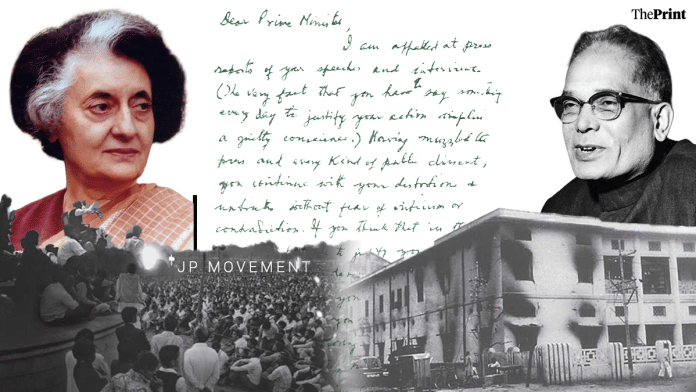
Writing on July 21, 1975, from a hospital room turned prison in Chandigarh, JP wrote a letter to Gandhi, which said, “Having muzzled the press and every kind of public dissent, you continue with your distortions and untruths…If you think that in this way you will be able to justify yourself in the public eye….you are sorely mistaken.”
Rejecting allegations that the movement sought to paralyse the government, he called them “a figment of your imagination thought up to justify your totalitarian measures.”
Saying that he is an old man, he concluded with words of advice, he said, “Please do not destroy the foundations that the Fathers of the Nation, including your noble father, had laid down….You inherited a great tradition…and a working democracy. Do not leave behind a miserable wreck of all that. It would take a long time to put all that together again.”
The JP Movement never sought the Emergency, it demanded political reforms, says Varshney.
Yet, after 21 excruciating months, Gandhi called for fresh elections on January 18, 1977. Within days, the Jana Sangh, Bharatiya Lok Dal, Congress (O) and Socialist Party united under a common banner. On 23 January, in the presence of Jayaprakash Narayan, the Janata Party was formally launched.
The JP Movement became a historic watershed, says Varsney, because the regime chose total repression over reform.
A massive “Janata Wave” swept through the nation. Indira Gandhi was ousted and the first non-Congress government took power at the Centre.
(Edited by Prashant Dixit)