





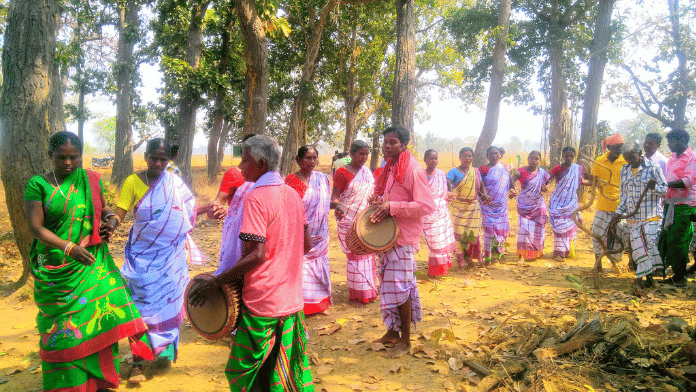



Living amidst a Bengali upper caste majority in the settlement of Santragachi, for the Santal migrants, the notion of a Bengali bhadralok holds certain hegemony. Therefore, positing the Santal sense of self vis-a-vis the bhadralok is a useful lens for understanding the Santal dilemmas with regard to their experiences of inclusion and exclusion in the city.
The first-generation respondents expressed that their quest to define ‘who they are’ or ‘who is a Santal’ never occurred to them till they shifted to the city. For the respondents their educational attainments were significant in paving the way to develop this conscious sense of who they are and why there is a need to recognise, protect and uphold their indigenous self in the city. It is evident from their observations that, in spite of living for more than 40 years in an urban settlement and interacting with the metropolis and the larger Bengali society, they maintained a strong sense of segregation and exclusivity. This seemed to have arisen from their experiences of being excluded by the Bengali bhadralok community, a perception that emerged being educated migrants who voluntarily moved to the city.
Some of the experiences are interesting. Sanatan Mandi, retired government employee, a first-generation Santal, describes his encounters:
‘Every year during the time of Durga puja, the most celebrated festival of the bhadralok’s of Kolkata, we visit the ‘para’ (locality) pandal. We even give ‘chanda’ (donation) for organizing the puja and for the community feast even though it is not our festival. But when I expressed my interest to become a member of the puja organising committee, the bhadralok in the committee either ignored or remained silent about my proposal’.
That ‘an outsider always remains an outsider’, as expressed by Sanatan Mandi, is the general feeling among most of the first-generation respondents of Santragachi. Mandi added, ‘Santal families in the settlement were never allowed to serve ‘bhog prosaad’ (food given to the deity) during the community eating of the bhog on Durga Puja days. Even though there were no direct objections/oppositions from the bhadralok so far eating the bhog together with Bengali families were concerned, but Santals serving bhog prosaad is unacceptable to them. The possible thought might be that, Santals serving the prosaad might pollute the purity/sacredness of Durga maa’s bhog’. As shared by the Santal respondents, they have always experienced a subtle disallowance from the bhadralok when the Santal families expressed their willingness to participate in the core puja rituals and customs like ‘pushpanjali’ (flowers dedicated to the goddess through prayers) or ‘sandhaya aarati’ (lamp moved in a clockwise direction in front of the goddess by the priest after the sunset). They seem to be only allowed to participate in the cultural activities organised during the puja days.
However, across the two generations, the respondents noted that during the cultural programs at the time of the Durga Puja days, it was mostly the children from the bhadralok community who were encouraged by the committee members to participate and perform. Even if children of the Santal families are involved, they were not encouraged to perform their indigenous songs or dances. Instead, they were asked to perform Rabindra Sangeet or Nazrul Geeti. Dances performed too either had to be Rabindrik or classical based. ‘Abritti’ (recitation) was only encouraged in Bengali and not in any other language.
Similar experience is recounted by a Santal migrant that happened at the time of Saraswati puja, another popular festival of the bhadralok. Jyotsna Kisku, a first-generation female respondent, recalled her daughter’s experience of Saraswati Puja that was celebrated in her school. Jyotsna shared that seeing her Bengali friends participating in the puja, her daughter was enthusiastic to engage in the rituals too. She got up early and went to school wearing a yellow sari as the school instructed every child to wear a yellow-coloured ethnic wear as per the Bengali tradition. She involved herself in the preparations of the puja. Yet, the Bengali teachers did not appreciate her involvement in the ‘pushpanjali’ ritual. Teachers also expressed their discomfort when she kept her books and pencils in front of the goddess as is the traditional practice that she did following her Bengali friends. Books were kept to seek blessings from Maa, the Goddess of knowledge and wisdom. Teachers told her daughter that she was a Santal and that performing such ritual is not compulsory for her indirectly hinting that she may not keep her books near the idol. Jyotsna wondered: ‘where does it say that Maa Saraswati, is only of the Bengalis?’.
Besides these popular pujas, a number of other festivals were celebrated by the bhadralok community like ‘Rabindra Jayanti’ (Rabindranath Tagore’s birthday) and ‘Poila Boishak’ (Bengali New year) where Santals had similar subtle experiences of exclusion if not open or direct rejection. In spite of the fact that this tribal group has its own cultural space in Santragachi, the above narratives revealed the tribal community’s efforts of accommodating the Bengali culture to gain their social acceptability in the city. Yet they are made to feel as an outsider by the dominant bhadralok even after decades of cohabitation in the settlement.
 This excerpt from ‘City, Marginality and Education:Tribal Migrants in Kolkata’ by Ruchira Das has been published with permission from Springer Nature.