





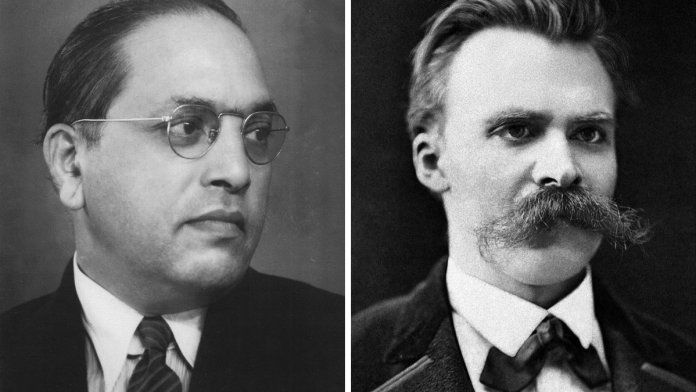



“It would seem that the question is easy to answer.” Martin Heidegger begins the investigation of his question “Who is Nietzsche’s Zarathustra?”, with this statement. One of the most influential philosophers of phenomenology and metaphysics, Heidegger observes that the text Thus Spoke Zarathustra (1883–1885) already yields a clear sense of the identity of Zarathustra—he is a teacher of eternal recurrence and the Übermensch or the superman, two central teachings of Nietzsche’s most well-known book. Against the fanatically violent certitudes of his Nazi contemporaries, who sought in Nietzsche the philosophical ingredients of a type of politics that makes “sheer caprice the law [and] titanic rage the rule”, Heidegger presents Nietzsche’s Zarathustra as embodying the spirit of freedom from revenge.
Our question is the following: Who is Nietzsche’s Chandala? The word “Chandala”—which Nietzsche appropriates from the Manusmriti—features intermittently in his late works, Twilight of the Idols (1889) and The Antichrist (1895), and his correspondences and unpublished notebooks (Nachlass) from the latter half of the 1880s. In Twilight of the Idols, a polemical text that vows to philosophize with the hammer, Nietzsche defines the Chandala as the “non-caste man, the hotch-potch man”. On surveying his texts, one gets the sense that the names “Zarathustra” and “Chandala” carry different priorities in Nietzsche’s thinking. Indeed, he spends far less time and space discussing the Chandala. While Zarathustra becomes the mouthpiece of Nietzsche’s philosophy of the superman, the name “Chandala” signifies a marginal concern. …
Ancient Persia and India: Zarathustra and Manu
Before we dive into this inquiry, a brief detour is necessary to indicate the precise parallelism, i.e., the difference in similarity, of our path and Heidegger’s, in reading Nietzsche. First, Heidegger cares little for the empirical–historical figure of Zoroaster or Zarathustra, the Persian prophet and founder of the religion of Zoroastrianism. There is no mention of the historical Zarathustra in Heidegger’s analysis, even for the potentially interesting purpose of comparing him with Nietzsche’s version. Heidegger’s interpretation makes it seem as if Nietzsche’s use of the name Zarathustra was somehow accidental. Such an inference is untenable for our purpose. Although our central question is investigating Nietzsche’s Chandala, references to the historical figure of the Chandala as they occur in the canonical discourse of Hinduism and in the everyday life of caste in India are unavoidable. These references mark crucial points of semantic divergence and convergence that are useful in revealing the tensions inherent in Nietzsche’s interpretation of the Manusmriti. Thinking both with and against Heidegger, it appears that such figures with the names “Zarathustra” and “Chandala” are thoroughly transfigured by Nietzsche; these names take on a life of their own in his writings, over and against their “original” contexts of ancient Persia and India. To understand and appreciate the nature and intent of this “transfiguration”, I shall compare Nietzsche’s usages of the Chandala with the historical meanings of this term.
Second, Heidegger is primarily interested in how his question—Who is Nietzsche’s Zarathustra?—implicates the essence of Nietzsche’s thinking. It follows from Heidegger’s procedure that a single question is capable of reaching and evaluating the core. Given that it is Nietzsche’s philosophy and not mere curiosity-mongering about a forlorn Persian prophet that is the subject of Heidegger’s question, his engagement with the name “Zarathustra” becomes philosophical, rather than historical or philological. This explains Heidegger’s indifference to the historical context of the emergence of Zoroastrianism or the multiple linguistic avenues through which the name Zarathustra reaches Nietzsche.
Our own question attempts to reach the same point of Nietzsche’s “core” teaching. As much as we show some interest in pointing towards the resonances and dissonances of Nietzsche’s Chandala with the historical Chandala as outlined in the Manusmriti, we are not concerned with pointing out the inaccuracies of Nietzsche’s interpretation of this text. This exercise has been extensively undertaken by various scholars. Annemarie Etter and David Smith highlight the unreliability of Louis Jacolliot’s translation of the Manusmriti, some of whose mistakes crept into Nietzsche’s writings. In Twilight of the Idols, Nietzsche mentions that the Chandala were “forbidden to write from left to right or to use their right hand in writing”. The source of this misinformation was Jacolliot’s 1876 book Les Legislateurs Religieux: Manou-Moise-Mahomet; the Manusmriti does not mention this particular prohibition. Smith further points out that Nietzsche’s knowledge of Indian literature was sketchy at best. Hindu texts that were popular among German philosophers in the nineteenth century include Kalidasa’s Sanskrit play Sakuntala, the epics Ramayana and Mahabharata, and the Vedas, the oldest of Sanskrit texts. Except for a Rig Vedic hymn used as an epigraph in Daybreak (on the suggestion of his friend, German author and composer Heinrich Köselitz, aka Peter Gast), Nietzsche’s writings do not reveal a substantive knowledge of and engagement with Indian texts. David Smith says, “[T]he only extensive Indian text that he chose unprompted to read for himself was … Louis Jacolliot’s version of the Laws of Manu”.
Hence, we ask—does Nietzsche’s misinterpretation and misreading of the Manusmriti reveal a fundamental aspect of his thinking as such?
Nietzsche’s use of the term Chandala assumes a “generic usability”, not limited or defined by the text of the Manusmriti or the context of the caste system in the subcontinent. The Chandala decontextualizes itself in the writings of Nietzsche and becomes available for usages that are not semantically bound to the text and context from where it is appropriated. A similar decontextualization occurs with the use, misuse, and abuse of the word “Pariah”. This word has become an academic and journalistic metaphor for exclusion as such.
The task here is to explore the philosophical implications of Nietzsche’s interpretation, and indeed, his misinterpretation of the Manusmriti as a starting point to understand his thought in a potentially new light. My proposition is that certain decisive conceptual concerns break out in Nietzsche’s usage of “Chandala”. That it is philosophically thought-provoking beyond the absurd exotic fascination for a famed Western thinker having read an esoteric religious text from ancient India. On the count of accuracy, scholars like Etter, Doniger, Figueira, and Smith may well give Nietzsche “a straight F” for his poor “historical comprehension” of the Manusmriti. And yet, we see that in the Occident, it is Nietzsche and only Nietzsche who has “creatively transformed” the ideas found in the Manusmriti.
Nietzsche’s Concept of the Chandala
Previous analyses of Nietzsche’s interpretation of the Manusmriti have focused on tracing references in his writings to determine the extent of the text’s influence upon his thinking. Our concern is not in assessing the magnitude of influence. Instead, we will test Nietzschean philosophy against his interpretation of the Manusmriti. By testing, we mean that we will take this singular aspect of his thought to its limit, on its own terms, and shake loose whatever conceptual implications that come apart. Can the Manusmriti shed light on unforeseen aspects of Nietzsche’s thinking? Conversely, can Nietzsche illuminate unforeseen aspects of the Manusmriti?
Dorothy Figueira writes that “[a]n examination of Nietzsche’s references to Manu quickly reveals what he found so captivating. Nietzsche’s reading of Manu focused exclusively on caste and its relationship to breeding (Züchtung).” Although correct, this inference does not clarify what caste itself means for Nietzsche. Figueira suggests that Nietzsche’s fascination with the caste system aligns with his fascination for “medieval Europe and ancient Rome”. In my view, Nietzsche thinks of caste conceptually and ascribes a generic usability to it in his writings.
Such an attribution is related to but not limited by the actual practices of caste and untouchability extant in the Indian subcontinent. The generic usability that Nietzsche finds in caste goes beyond its specific sociological and historical implications in Indian society. Instead, he perceives caste as demonstrating a theory of what he terms the “order of rank [Rangordnung]”. Nietzsche’s interest in this category stems from his quest for a system of social hierarchy that, in his view, was fast fading in Europe due to the egalitarian impulses inaugurated by Christianity. It is this generic theoretical potential of caste as a hierarchical system that confers legitimacy and sanctity to rank that captivated Nietzsche.
But where does the Chandala fit in this purported order of rank? If Nietzsche conceives of caste as a generic conceptual schema, it would imply that he uses the Chandala conceptually too. For him, the Chandala represented the deterioration of the caste order of rank. What Nietzsche calls “the concept of the Chandala” [der Begriff Tschandala] is clarified in this note, written in 1888, from his unpublished notebooks [Nachlass]:
One must not confuse this: the Sudras, a servant race: probably a lower kind of people that were found in situ where these Aryans gained a foothold.
But the concept of the Chandala expresses the degeneration of all castes [Degenerirten aller Kasten aus], the permanent phlegm [die Auswurfstoffe in Permanenz], which in turn reproduce among themselves.
The Chandala is not one rank among other ranks that are orderable in a descending hierarchy; they are beyond the pale of the caste order. The Shudras, on the other hand, represent an orderable element for Nietzsche, occupying a determinate place in the “fourfold” system of caste hierarchy for Nietzsche. The Chandala—as a “concept” [Begriff]—represents dis-order or “degeneration”, because the Chandalas neither occupy a determinate place in the caste order, nor do they have a stake in the order’s preservation. Their origin is marked by an illegitimate “mixture” constituting a violation of the fourfold system of hierarchy, as stated in the Manusmriti.
Nietzsche takes this mythical origin of the Chandala at face value. He also does not refer to the creation myth outlined in the Manusmriti which stipulates that the four varnas of Brahmins, Kshatriyas, Vaishyas, and Shudras originate from the mouth, arms, thighs, and feet of the creator respectively. Nevertheless, it is important to analyze this myth as a useful heuristic device. What it stipulates is precisely a fourfold order of rank as inscribed in the divine body of the sacrificial creator: The Manusmriti is emphatic about the existence of only four classes, there being no fifth. How then does one understand the frequent references to the Chandala in the Manusmriti?
The answer lies in the denial inscribed within the latter part of this crucial verse which lists the four classes. Verse 10.4 in the Manusmriti states, “Three classes—Brahmin, Ksatriya, and Vaisya—are twice-born; the fourth, Sudra, has a single birth. There is no fifth”. The very fact that Manu had to deny the status of an unnamed fifth class of people reveals the cracks in his schema. The theory of varnasamkara (mixing of classes) was meant precisely to explain the origin and existence of a mass of human beings whose ritual or class status is indeterminate in the mythical fourfold hierarchy.
In the Manusmriti, the Chandala are not attributed any divine origin. They are the result of human folly. The Manusmriti locates the Chandala’s origins in the prohibited act of sexual intercourse between a Brahmin woman and a Shudra man. The offspring of such intercourse cannot be reconciled back into the four originary classes: The order functions under the presupposition that each class would only reproduce within itself. The Chandala occupies the limit of classification in Manu’s fourfold system, representing an unresolvable human transgression, underlining the reproductive limits of the divine creator’s body. So, the composers of the Manusmriti recognized the real existence of the Chandala outside the order of the imaginary divine body of the creator. At the same time, the theory of varnasamkara postulates the real existence of the Chandala as emerging from the deviant (and defiant) human act of sexual miscegenation, terming them as creatures “born from an evil womb”.
Importantly, the supposedly pure womb here does not belong to the real body of a woman, but rather to the divine—the imaginary body of the male creator. This divine body constitutes multiple reproductive organs, with his head being as much of a womb as his feet—ranked, however, in a descending order of value: “A man is said to be purer above the navel. Therefore, the Self-existent One has declared, the mouth is his purest part. Because he arose from the loftiest part of the body, because he is the eldest, and because he retains the Veda, the Brahmin is by Law the lord of this whole creation.”
A rational interpretation of this creation myth suggests that Manu was acutely aware of the contingencies of human transgression. This is evident in the second verse of the first chapter of the lawbook, where a group of acolytes ask Manu: “Please, Lord, tell us precisely and in the proper order the Laws of all the social classes, as well as of those born in between”. This awareness of the imperfection and the inoperative nature of the divine order of rank is advanced at the very moment that the outline of creation is proposed. In the same chapter, those born in between two classes are referred to as the “mixed classes” or “confused classes”. Elsewhere, Manu says: “When men violate the wives of others, the king should disfigure their bodies with punishments that inspire terror and then execute them; for such violations give rise to the mixing of social classes among the people, creating deviation from the Law that tears out the very root and leads to the destruction of everything”. These apocalyptic warnings underscore the stakes involved in the maintenance of the divine order of rank and the need to minimize possible human transgressions against it, while at the same time unwittingly acknowledging a society where such transgressions were prevalent.
So far, our discussion of the Manusmriti helps explain Nietzsche’s fascination with the theoretical potential of caste as an order of rank. Nietzsche latches on to the name Chandala for his purposes of devising a critique of modern Europe and Christian morality. He contends that the peculiar “phlegmatic” characteristic of “degeneration” contained within the concept of the Chandala has made “society” impossible, insofar as society, like the body, needs definite classes/organs for orderly functioning:
Theory of exhaustion. Vice, the mentally ill (resp., the artists, the criminals, the anarchists)—these are not the oppressed classes but the scum of previous societies of all classes. … Realizing that all our classes are permeated by these elements, we understand that modern society is no “society,” no “body,” but a sick conglomerate of Chandalas—a society that no longer has the strength to excrete.
The sense of indeterminacy of rank and status in this passage is reminiscent of Manu’s references to the “mixed” or “confused classes”. Manu gives a theological justification for how the Chandala signifies a breakdown in the order of rank. Nietzsche’s rationale, however, is physiological. His urge to “re-establish order of rank” can only be understood against the backdrop of his anxiety about a mass of people who cannot be located as a determinate—even if as an oppressed—group within a social hierarchy.
This mass so overwhelmingly overdetermines the workings of modern Europe in Nietzsche’s estimation that society itself has become “sick” and constipated, its “body” no longer possessing the strength of “digestion” and “excretion”. Such physiological metaphors, equating the Chandala with phlegm and excreta, form crucial evidence of the extent to which Nietzsche’s language is determined by the racial biologism of its time. This immediately appeals to the genocidal fantasies of far-right ideologues—forever raising the question of Nietzsche’s political legacy—and unfavorably implicates Nietzsche’s conceptual concerns regarding ressentiment.
Nietzsche saw European society rendering itself impossible through the presence of unclassifiable masses in existent social and political hierarchy. In this time, when the newly established bourgeois society was seemingly teetering at its limits, he considered democracy as a feckless system that would descend into anarchy. So, his desire to “re-establish order of rank” in modern Europe acquires greater clarity. The caste system served as a significant point of reference for his conception of the order of rank. He believed that the highest caste, Brahmins, were liberated from the obligations of being political rulers and engaging in social service, allowing them to pursue more “spiritual” matters. Nietzsche often explicitly advocated for a new “aristocracy” in Europe, justifying the ends of a hierarchical social order by enabling a select group of individuals to enjoy the greatest degree of artistic and creative freedom.
As a member of this new Nietzschean hierarchy, and historically removed from the context of the caste system, Nietzsche’s “Chandala” nevertheless bears a definite relation to the disparaging intent with which it is used, both in the canonical discourse of Hinduism and in the everyday life of caste in India.
This is an edited excerpt where the academic notes and references have been removed.
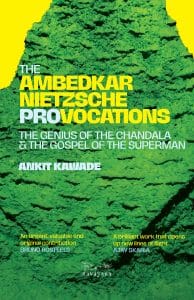 This excerpt from ‘The Ambedkar–Nietzsche Provocations’ by Ankit Kawade has been published with permission from Navayana.