








ON THE NIGHT OF JANUARY 31, 2018, the spies, the analysts, the technicians, and the operations chiefs of the Mossad, the State of Israel’s fabled intelligence arm, were gathered inside the agency’s state-of-the-art situation room on the outskirts of Tel Aviv to oversee an operation that they all knew could turn out to be momentous for their country—or, if things went awry, disastrous. Yossi Cohen, the dapper chief of the agency, dressed in his usual crisply ironed white shirt, sat at a desk, keeping his eye on the time, while the whole room was in a state of tense expectation, waiting for him to give the order for one of the Mossad’s most audacious operations to begin. On the surrounding walls, an array of plasma screens glimmered, as if waiting for the satellite video feed of the operation to appear on them, providing a real-time view of what was taking place on the ground hundreds of miles away. Cohen and dozens of Mossad agents had been working for days, almost without sleep. The moment had arrived.
At exactly 10:31 p.m., Cohen said, “Execute,” carefully enunciating each of the syllables of the command, which set in motion a Mossad team poised for action in Iran, specifically in the Shirobad industrial neighborhood on the southern outskirts of Iran’s capital, Tehran. Shirobad wasn’t the kind of place you would imagine as the scene of a spy drama with international consequences. It was just a drab zone of corrugated-iron-roofed warehouses stretching as far as the eye could see. But on that night, two dozen selected Mossad operatives—most likely a mix of Israeli agents and Iranians opposed to the Islamic Republic’s theocratic regime—were propelled into a swift, well-rehearsed motion. While Cohen watched the clock back in Israel, they broke into one of the warehouses, used high-temperature blow torches to penetrate a series of steel vaults, and began to remove files, physical and electronic, that contained the entire record of Iran’s strenuous effort to become a nuclear-armed power going back to its beginnings nearly thirty years before.
Cohen watched the clock because time was of the essence. The team in Iran had exactly six and a half hours to nd the vast amount of material they needed, load it onto trucks, and make their escape, or they would be discovered, and the mission, with all its months of meticulous planning—data analysis, risky intelligence gathering by agents inltrated into Iran, and more—would come to naught, and two dozen lives could be lost to the tender mercies of Iranian justice.
It was a long night stretching into morning, but as the Mossad’s top people watched on their screens in Israel, the team in Shirobad walked out of the warehouse with half a ton of hard files and compact discs—perhaps the largest physical heist of intelligence materials from an enemy capital in the history of espionage. Within hours, they were racing toward Iran’s border, their movements camouflaged by empty trucks, decoys being driven on fake routes in several fake directions. Back in the situation room outside Tel Aviv, a sense of triumph mingled with a sense of relief. All that planning, money spent, and months of surveillance were paying off.
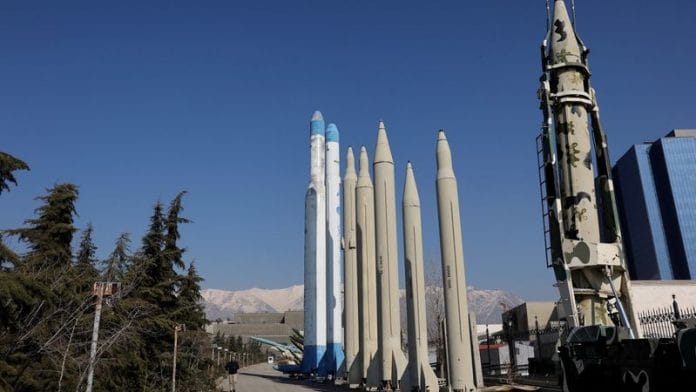
Back in Tehran, Supreme Leader Ayatollah Ali Khamenei and Mohsen Fakhrizadeh, who had served for decades as his nuclear weapons chief, hadn’t a clue about what was going on in Shirobad, where they had secretly moved the archive precisely to keep it out of the hands of the Zionist enemy, the U.S., and the IAEA.
Also read: How Khomeini sidelined secular, Leftist, nationalist allies to make Iran an Islamic Republic
The Mossad’s decision to go after Iran’s nuclear archives had been made two years earlier, in January 2016. Cohen, newly appointed as the Mossad’s chief, was summoned to the office of Prime Minister Benjamin Netanyahu, in the glass-paned inner sanctum known as the “aquarium” on one of the lower floors of a drab 1950s-era building in Jerusalem. The setting was not new to Cohen. He had been the prime minister’s national security adviser since 2013. But now things were different. He was no longer just an adviser. He was now running one of the world’s most powerful intelligence agencies.
“We need not only to convince the world that Iran lied about its nuclear weapons program—we need to show the world,” Netanyahu told Cohen. The Mossad director understood exactly what his prime minister meant. The year before, in 2015, the United States and five other major world powers had, after a long and dicult negotiation, signed what its proponents believed to be a historic agreement with Iran by which Tehran agreed to limit its eorts to enrich uranium and give up its eorts to make a nuclear bomb, in exchange for a relaxation of the sanctions that had been imposed on the country by the U.N., led by the Europeans and the U.S.
Netanyahu, whether rightly or wrongly, thought the deal was a disaster. Among other things, he objected to an expiration date that was built into the agreement, such that in just ten years, some of the restrictions on Iran’s nuclear enrichment program would be relaxed and they would end entirely by 2030, just fifteen years later, after which Iran would be legally entitled to fully resume its nuclear development program. Aside from that specific issue, Netanyahu simply didn’t trust the Iranians to live up to their obligations. In addition to that, the signing of the deal had an immediate, very undesirable practical consequence for Israel. Its nonstop, aggressive, no-holds-barred program of sabotage, assassinations, and cyberattacks that it had been conducting against Iran’s nuclear program for years would have to be severely toned down, or risk angering the country’s indispensable ally, the United States. For all those reasons, Netanyahu and Cohen wanted evidence that would undermine the agreement and enable them to resume covert actions. That’s why they wanted the archive. They believed it would demonstrate beyond any doubt that Iran had lied outrageously in the past about its nuclear activities—saying, for example, that they were only for civilian uses while concealing the military dimension from U.N. inspectors—and couldn’t be trusted not to lie in the future.
Immediately after the meeting with Netanyahu, Cohen met with his top spymasters to begin planning to steal the archive. Among them was his deputy, Ehud Lavi, who had previously led the Mossad’s Caesarea unit, which operates agents in enemy territory and runs a squad known as Kidon that carries out targeted killings. Also involved were David “Dadi” Barnea, a graduate of the Israel Defense Forces’ elite special forces’ General Staff Reconnaissance Regiment, Sayeret Matkal, and head of the Tzomet division, which recruits and handles sources; and Dr. Eyal Hulata, a PhD physicist who was head of the Mossad’s technology division.
Following these meetings, Cohen returned to Netanyahu to present the plan to infiltrate a Mossad team into Iran and to steal the archive.
“Do they have a copy?” Netanyahu asked. The question had to do with the risk of the operation versus the benefit. If there was no electronic backup, Israel would both expose Iran’s lies and deprive it of documents critical to its nuclear program, a double win, and therefore more justification for the risk.
“I don’t know,” Cohen replied, “but they are so sure that nobody knows about this archive that they may not have made a copy.”
“You think they didn’t put all this information on computerized files?” the prime minister continued.
Cohen responded, “Not if they believed that we could get at such computer les [using hacking capabilities]. Maybe they thought that hiding [only] the original paper files is the best defense.”
The prime minister was pleased with what he heard.
He approved the mission.
 This excerpt from ‘Target Tehran’ by Yonah Jeremy Bob and Ilan Evyatar has been published with permission from Simon & Schuster.