





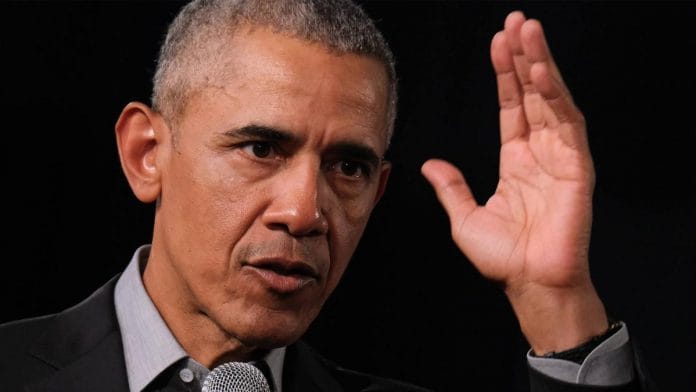


During Barack Obama’s presidential campaign, he signaled putting a greater emphasis on diplomacy toward Iran, and in his inaugural speech he ad dressed the Iranians directly, saying, “We will extend a hand if you are willing to unclench your fist.” Four days later, Burns sent Hillary Clinton, the new secretary of state, a memo outlining his vision for a new strategy toward Iran. He argued that the United States should strongly curtail Iran’s acquisition of nuclear weapons as a threat to American interests but set a tone of respect while negoti ating directly with Iran. “Our basic goal should be to seek a long-term basis for coexisting with Iranian influence while limiting Iranian excess, to change Iran’s behavior but not its regime,” he wrote. He also convinced Clinton that the United States should take advantage of Iran’s unstable economy and diplomatic isolation while maintaining strong ties with its allies in Israel and the Persian Gulf who would be wary of a rapprochement with the Islamic Republic.
Obama began with small steps, videotaping a conciliatory message to the Iranian people in March 2009 for Nowruz, the Iranian new year, stressing his wish for respectful engagement. In May, he sent a letter to Ayatollah Khamenei echoing these sentiments, stressing that while he opposed Iran having a nuclear weapon, he supported a peaceful nuclear program and would not pursue regime change. Khamenei’s response was encouraging, but soon there were set backs. Repression and unrest followed Iran’s 2009 presidential election, which was seemingly rigged in favor of President Ahmadinejad. And in September, Western intelligence sources uncovered an Iranian nuclear site at Fordow with the capacity to enrich enough uranium for one or two bombs a year.
On October 1, Burns met with Iran’s chief nuclear negotiator, Saeed Jalili, and laid out a proposal (developed in concert with the IAEA and the Russians) under which Iran would trade some of its stockpile of 20 percent enriched uranium, which could be used for nuclear weapons, for enriched nuclear material that could be used for medical research. But while Jalili seemed receptive, in a follow-up meeting the Iranians balked. At the same time, Iran was taking ominous steps toward nuclear armament. By May 2010, the Iranians had enriched enough uranium that giving up half would still leave them enough for one bomb, weakening the P5+1’s negotiating position.
In response, the United States worked to put pressure on Iran through increased sanctions. In June, the Security Council passed Resolution 1929, which cut Iran off from the global financial system and limited purchases of Iranian oil. At the same time, the United States negotiated a deal with Saudi Arabia to ramp up oil production and helped China, India, South Korea, and Japan make new deals to replace Iranian oil imports.
As so often happens with economic sanctions, they were tactically successful at weakening Iran’s economy, but by themselves they could not achieve the strategic goal of ending Iran’s nuclear program. At a summit in Istanbul in January 2011, the Iranians demanded that their right to enrich uranium be recognized and all sanctions against them dropped before any talks on their nuclear program could be initiated. Subsequent negotiations over the next two years witnessed the same defiant tone, with Jalili—now Iran’s foreign minister—deliberately slowing the pace of negotiations with long diatribes about the historical wrongs inflicted on Iran and without practical solutions for moving forward. Official talks decisively stalled.
Meanwhile, Iran’s nuclear program continued. By the end of 2012, Iran had amassed enough enriched uranium to make six bombs and was advancing its rocketry technology. Israel believed that military strikes to destroy Iran’s nuclear infrastructure would be necessary to stop its program, but President Obama disagreed, reasoning that military strikes would set it back by three years at most and lead the Iranians to move their efforts underground, where no attacks could reach. He was also concerned that a military strike would permanently close all diplomatic channels.
Another direction was taken. The United States, in collaboration with Israel, released the “Stuxnet” computer virus into the Iranian nuclear pro gram’s computer system in 2011, crashing their centrifuges and delaying their program. This was far from a permanent solution; cyberwarfare would only kick the can down the road. A new approach was needed.
This came from Sultan Qaboos bin Said of Oman, who enjoyed good relations with Iran, the other Gulf Arab states, and the United States. Qaboos was concerned about instability in the region and had long acted as an intermediary. In 2009, three American hikers were arrested by the Iranians, suspected as spies for having strayed across the Iraq-Iran border. Qaboos and one of his key diplomats, Salem Ismaily, used their connections in Tehran to get the imprisoned hikers freed, essentially paying the hikers’ bail. Then, in an unusual act of back channel diplomacy by a sitting U.S. senator, John Kerry, chair of the Senate Foreign Relations Committee, met with Ismaily ostensibly regarding the hikers; however, much of their discussion concerned Omani mediation in the nuclear talks. Their successful intervention to free the hikers proved to Kerry, and to the Obama administration, that Qaboos’s influence could deliver results in Tehran. With the administration’s consent, Kerry met with Qaboos in December 2011 to open a secret back-channel with Iran. Qaboos told Kerry that an opportunity for renewed diplomacy existed because Khamenei had transferred oversight of the nuclear program from the hardliners in the National Security Council to Ali Salehi, the “godfather of Iran’s nuclear program,” whose stature in Iran was unimpeachable and who favored diplomacy with the West. Most important, the supreme leader trusted him. After another visit from Kerry on January 3, 2012, Qaboos agreed to explore the back-channel directly with the Iranians.
Returning from Tehran, Qaboos felt the supreme leader was open to a secret U.S.-Iranian channel on the nuclear issue in Muscat facilitated by the Omanis. A low-level exploratory meeting was arranged for early July. This meeting foundered on Iranian insistence that it had the right under the Non-Proliferation Treaty to nuclear enrichment for peaceful purposes. The United States argued that Iran had the right to import enriched uranium from other countries but not to enrich uranium itself. Iran jealously guarded its right to enrich; having had its supply cut off after the Islamic Revolution, it did not want to rely on the good will of other countries. But the back-channel talks made two lasting positive contributions: they convinced reformers like Hassan Rouhani, soon to be elected president of Iran, that the United States was serious about negotiating in good faith, and they helped move the United States to a new position that was accepting of some level of Iranian uranium enrichment.
The United States changed its position because it was backed into a strategic corner. Obama and several key figures in Israel, such as Mossad chief Meir Dagan, believed that a military attack would only embolden the Iranians and give them justification for pursuing a nuclear weapon. Moreover, the other P5+1 countries were already in favor of allowing limited Iranian enrichment. It was becoming increasingly clear to the United States that any opportunity to exert influence on the direction of Iran’s nuclear program would require giving Iran this concession. Iran bristled at the idea of America demanding that it not be allowed to do what other sovereign nations were allowed to do—a position with broad support among the Iranian people.
Obama’s approach to Iran was part of a shift in focus of U.S. foreign policy from the Middle East to a “pivot to Asia.” Overextended in the Middle East with Iraq and Afghanistan, the administration needed to end conflict with Iran but could not do so with the Islamic Republic so close to a bomb. Within the administration, Vice President Joe Biden observed that the United States was faced with a choice of unpalatable alternatives: bombing Iran, accepting Iran as an eventual nuclear-armed state, or accepting limited enrichment through diplomacy.
Under this strategic calculus, Obama began preparations for another set of back-channel negotiations with the Iranians. In March 2013, an American delegation led by William Burns, now deputy secretary of state, traveled to Muscat with instructions to tell the Iranians that the United States was open to limited enrichment. He laid out the new U.S. position to an Iranian delegation led by Ali Asghar Khaji, the deputy foreign minister. The United States was pre pared to accept some limited Iranian enrichment and was not seeking regime change, but for any settlement lifting sanctions and accepting a peaceful Iranian nuclear program, Iran would have to take serious steps to build confidence in the international community that its nuclear program could not be turned to military ends. Khaji’s response was harsh, employing threatening language to state that all options were on the table. He took umbrage at the U.S. reference to carrots and sticks: “Iranians are not donkeys!” He also pushed for more beyond an acceptance of limited Iranian enrichment; he wanted the United States to formally recognize that Iran had a right to peaceful enrichment, as opposed to being a concession from the United States, which Burns was not prepared to grant. Still, the administration found reason to be optimistic. Concrete policy was now being discussed through this back-channel, making it a more productive avenue than the formal P5+1 talks.
The Iranian presidential election in June 2013 changed things dramatically. Hassan Rouhani won on a platform of rebuilding Iran’s ties to the rest of the world and solving the nuclear issue through negotiation. His appoint ment of Javad Zarif (an able diplomat educated in the United States) as foreign minister and Ali Salehi as head of the nuclear program reinforced his desire to negotiate.106 Zarif’s close ties to Ayatollah Khamenei meant that the United States could be confident in his authority to make deals on behalf of the top level of Iranian decision-makers, a major liability with the Iranian negotiators during the hostage crisis. As Burns reflected, another positive factor for Khamenei was that the United States had initially reached out under the presidency of Ahmadinejad, meaning the supreme leader was less inclined to see the United States as taking advantage of a more moderate president.
Rouhani convinced Khamenei that negotiating was necessary for Iran to
gain relief from the sanctions, without which the country might see a return of the unrest of 2009. Rob Malley, a key member of the Obama team, believed that the Iranians saw U.S. acceptance of limited enrichment as a realistic diplomatic objective. For the first time, both sides had the mutuality of interests essential to a successful negotiation: the United States had no other viable alter native to limit Iran’s nuclear program, and Iran could not afford a continuation of punishing economic sanctions. Two days after his inauguration, Rouhani declared that Iran was open to the resumption of the P5+1 talks. He also quietly asked Sultan Qaboos to restart the back-channel talks in Muscat.
It is often crucial in international negotiations to break talks into digestible bits and not swing for a home run. Burns and his team planned two phases of negotiation: first, an interim agreement freezing Iran’s nuclear development in exchange for the suspension of new sanctions (to relieve the time pressure facing both sides); then a second phase in which the United States would seek a reduction of Iran’s stock of enriched uranium in exchange for limited sanctions relief, while imposing inspections on the nuclear program to set a precedent for a permanent inspection regime.
In Muscat that September, Burns and his team quickly built a personal rapport with Iran’s lead negotiators, Majid Ravanchi and Abbas Araghchi, two seasoned diplomats with Western educations, who conducted the talks in English. The Iranians quickly agreed to the two-phase approach,but there was no shortage of contentious points. The Iranians wanted all $18 billion of their frozen oil revenues released in exchange for concessions; the United States placed the maximum at $4 billion. The Iranians were unsure whether the Obama administration could commit to sanctions relief, given Congress’s control over such matters; Burns assured them that the United States would “stick to (the agreement) scrupulously.” But common ground had been reached; the Iranians were open to some form of freezing and rollback of their nuclear program in exchange for some form of sanctions relief.
Shortly thereafter, Burns and a young colleague, Jake Sullivan (one of the negotiators at the initial Muscat talks the year before), met with Araghchi and Ravanchi during the annual UN General Assembly meeting in New York, bringing into the back-channel Undersecretary of State Wendy Sherman, who had been representing the United States in the P5+1 talks, so she could build a rapport with Araghchi and Ravanchi.
On September 26, Kerry and Zarif met publicly as part of a P5+1 meeting and later privately to discuss their mutual optimism at the progress of the back-channel talks; this was the highest-level contact of U.S. and Iranian government officials since the 1970s. It was soon to be outdone when Obama and Rouhani talked over the phone as Rouhani drove to the airport from the United Nations. This exchange between the two presidents sent a strong signal to the public and established the personal rapport that would bring the talks to a successful conclusion.
In October, Burns and Sherman were back in Muscat to meet with Ravanchi and Araghchi, and within two days the parties arrived at a draft interim agreement. At this point Sherman proposed that it was time to merge the back-channel with the official P5+1 talks; the Iranians agreed. She then revealed the existence of the back-channel and the progress made toward an interim deal. Sherman also announced that the United States had accepted limited Iranian uranium enrichment in exchange for intrusive inspections by the IAEA. The reaction of the P5+1 delegates was one of annoyance for having been frozen out of the back-channel talks, but acceptance. When Zarif was presented with an updated draft, arrived at through careful negotiation among the P5+1, he was upset and told Kerry he was doubtful the harsher terms would be accepted in Tehran.
Over the coming weeks, significant progress was made on the final issues. On November 20, Burns, Sullivan, and Sherman, joined by Catherine Ashton from the European Union, arrived in Geneva for new talks with Araghchi and Ravanchi. They compromised on language regarding Iran’s “right” to enrich; Iran made concessions on the cessation of construction of the reactor at Arak; and the formula for sanctions relief and the mechanisms for IAEA verification were clarified. An interim agreement, the Joint Plan of Action (JPOA), was finally reached at 4:00 a.m. on November 24, 2013.
The JPOA froze and then rolled back Iran’s nuclear program; Iran could not enrich any additional uranium to weapons grade (20 percent) and had to dispose of its existing stockpile. The IAEA was empowered to use intrusive monitoring arrangements to make sure Iran abided by these terms. In exchange, the United States unfroze $4.2 billion in Iranian oil revenues and committed to not imposing any new sanctions for six months. The short, three-page document stopped the clock on the advancement of Iran’s nuclear program and the deterioration of Iran’s economy from the sanctions, granting Iran and the P5+1 breathing room to negotiate a more comprehensive agreement with long-term solutions.
The interim JPOA became subject to intense political controversy. In the United States, opponents of the deal viewed it as a betrayal of Israel, as Prime Minister Benjamin Netanyahu was a fierce public critic of the negotiations. A bipartisan group of senators pushed for Congress to pass new sanctions that would violate the terms of the JPOA and thus kill the prospects for a comprehensive deal. In Iran, Ayatollah Khamenei himself seemed to be the deal’s most steadfast opponent. In July 2014, he gave a speech asserting Iran’s desire to build more centrifuges, in violation of the JPOA.
Political issues unrelated to Iran also threatened the unity within the P5+1. In February 2014, Russian troops invaded Crimea, annexing the pen insula a month later, and in August Russia invaded eastern Ukraine, dramati cally increasing tensions with the West. But Russian deputy foreign minister Sergey Ryabkov refused to allow the conflict to impede cooperation on the Iran nuclear issue.
The biggest hurdle for a swift resolution of the problem was the sheer scope of a comprehensive deal with various provisions for ten-year and fifteen year durations. The Obama administration’s goal was to keep Iran at least a year away from acquiring nuclear weaponry. A year’s “breakout time” would give the United States sufficient time to mobilize an international response, potentially including military intervention. Any deal that accomplished this goal would have to be rooted in scientific details, and U.S. nuclear scientists developed a formula to calculate breakout time based on the number of Iran’s centrifuges, its stockpile of enriched uranium, and its nuclear readiness. These calculations were often based on data that came from intelligence the United States could not share, which caused further friction with the Iranians.
After months of inconclusive talks, the diplomatic teams agreed to extend the deadline until November 24, which also proved to be too early. And after the Republicans retook Congress in the 2014 midterm elections, Kerry knew that time was not on his side. The negotiators decided on two different dead lines for a comprehensive agreement. By March 31, 2015, the broad strokes of the deal would have to be agreed on; by June 30, the technical details would have to be solidified.
Even with these new deadlines, a breakdown in negotiations remained a possibility. Negotiators become invested in an agreement to which they have devoted so much time, but the willingness to walk away from an unsatisfactory deal is often essential to achieving one with which you can live. President Obama was clear that his team had his blessing to cut off talks if they thought the Iranians were not going to come to a satisfactory agreement.As negotiating leverage, the United States revealed to the Iranians the existence of a “bunker-busting” bomb that could penetrate the defenses around Iran’s previously secret nuclear site in Fordow. The threat of military action was an effective negotiating tool in incentivizing Iran to agree to set back its nuclear program in exchange for sanctions relief—a threat lacking in the hostage negotiations three decades earlier.
In spite of the challenges, progress was being made. By the end of 2014, Kerry convinced Zarif that any deal that did not set at least a year of breakout time was a nonstarter for the United States, establishing common ground for negotiating the technical details of the constraints placed on Iran’s nuclear pro gram. Another breakthrough came when the Iranians added nuclear scientist Ali Salehi to their team and the United States brought in Secretary of Energy Ernest Moniz, who also had a distinguished scientific background. Now both sides could draw on experienced negotiators who had a deep understanding of the technical details. Moniz was especially helpful in conveying complicated subjects in simple English to his fellow diplomats. He and Salehi also struck up a personal rapport that helped find common ground: their personalities matched, they had a shared love of science, and they had both attended MIT. With the rest of the diplomatic teams focusing on bigger-picture issues, the talks moved closer to agreement.
 This excerpt from ‘The Art of Diplomacy’ by Stuart E Eizenstat has been published with permission from Bloomsbury India.