





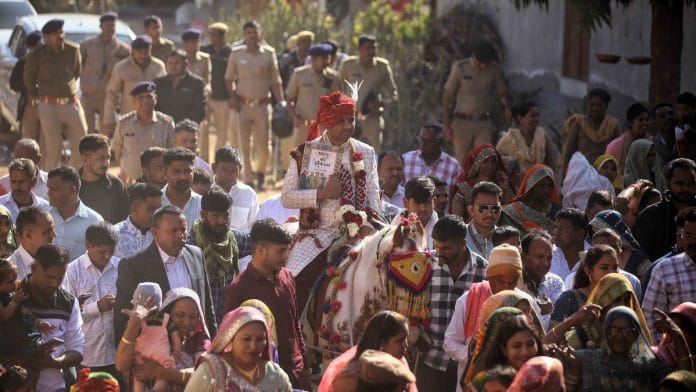


Caste minds have constructed worlds and cultivated cultures that are inherently anti-joy and actively anti-Dalit. This is our crooked room. And this is precisely why even the most mellowed expressions of joy from Dalits are threatening to those around us. Like in 2018, Mahesh Rathod, a 13-year-old Dalit boy from Vithalapur 8 in Ahmedabad, Gujarat, was beaten up for having a Darbar-like etiquette. Meaning, Mahesh was wearing jeans, a shirt, a thick gold chain around his neck, and Rajwadi Mojaris. In 2015, Sagar Shejwal, a twenty-three-year-old Dalit man from Shirdi in Maharashtra, was beaten to death by seven men belonging to the Maratha and OBC communities for having an Ambedkar song as a ringtone on his phone. In 2019, Jitendra in Kot, Uttarakhand was beaten up and killed for sitting on a chair and eating at a wedding in the presence of upper castes. The same year, four wedding processions of Dalits were attacked in a single week in Gujarat.
A moustache. A dance. Riding a horse. An unbuttoned shirt. Leather shoes. Simple things and small joys that lead to thrashing, beating, stabbing, humiliation and death. This is what caste is. It emboldens joy-killing monsters that sit at the top of the pyramid, obese from eating the joys of Dalits.
Urban savarnas are no different. They may not kill you, but they too cause damage. When I noticed that my hair was so thick, my friend piped, ‘That’s ’cause you’re nicely eating mutton and chicken.’ When I texted another about a new gadget I had bought, he replied, ‘All you rich, privileged people.’ When I announced that I had got a new job, a colleague said, ‘That’s because I didn’t apply for it.’ Prick that bubble. Dull that shine. Kill that moment. Savarnas believe in the impossibility of Dalit joy—and if and when it happens, they are convinced of their right to rob it.
To discover joy as Dalit thus means that we first deconstruct this ridiculous inadequacy we have been rationed. We have to take apart their lies not just with rage, but with jeer. Call it silly. Call it absurd. See how foolish it is to treat joy as an individualistic pursuit that is sheathed, hidden within the self, from the self. See how wearisome it is to restrict something so available. See how fabricated it all sounds. Mediocre, even.
I don’t want this warped notion of joy. I want no part in this laboriousness. I’d rather relish fruits like Vijeta Kumar’s father. I could go on morning walks with my mother, listening to little birds heralding the dawn. I could eat mutton curry andgaré at my mother-in-law’s. I could sit on a rocky beach and let the thick, salty air wash over me. Joy should be free to take.
Still, I suspect that learning new ways of pursuing, sustaining, and savouring joy takes practice. Every time something beautiful happens, however small or big, my mind has no idea what to do with it. Instead of revelling in it, it searches for something that could go wrong. My mind believes it’s protecting me from unnecessary hurt, but in so doing, it has (almost) rid me of the ability to be in the moment. To relish, to enjoy, to experience.
Also read: How Asha Bhosle became the chosen voice for cross-dressing Bollywood heroes
Dr Brené Brown calls it foreboding joy—an experience of joy immediately followed by worry or dread. It’s a form of self-protection against vulnerability, she says. I used to admire Brown’s work, but I now find her a tad too simplistic in the way white American worldviews generally are. Indeed, while‘foreboding joy’ as a term makes sense, its explanation does not. It is not without reason that Dalits fear joy. For Mahesh, Suman, and Delta, appearing joyful can literally get them killed. And it exposes the rest of us to ridicule, hurt and ‘lessons’. In this sense, joy is not an easy thing to embrace. Joy seems lethal. Joy seems unnecessary.
So, what does Brown even mean when she says, ‘In moments of joyfulness, we try to beat vulnerability to the punch’? That, ‘when we lose our tolerance to be vulnerable, joy becomes foreboding’? Disappointingly enough—but not surprisingly—a number of South Asian influencers and brown therapists also resonate with Brown’s dare-to-be-vulnerable rhetoric. Perhaps they would advise Dalits to embrace vulnerability in order to realise joy.
Here’s the thing though: Dalits’ foreboding isn’t because they are scared of vulnerability. They are already systemically vulnerable and have even been told that they have a victim mindset if and when they speak of it. So, how is a performance of vulnerability, in the way Brown is advocating for—which is to ‘daringly’ show the world how soft and gooey we all are—going to work? How will it lead to joy? If anything, the opposite happens. Caste minds respond with disgust, name-calling and more exploitation. A Dalit’s vulnerability is a reminder of their evil.
Vulnerability is not our magic potion. Recognition is. Reconstruction is. Our foreboding joy is our minds grappling with the real cost of what joy demands of us—the history and the reality of our joy being robbed and the usual trauma that follows it. It is a warning, a writing on the wall that has been passed down through generations. Perhaps we must ignore the likes of Brown and stop calling our minds and bodies chicken-hearted. Perhaps we must see them as intelligent beings that are understandably tempered in their enthusiasm. Perhaps we must empathize with the fear that bubbles from within. Perhaps only by validating it can we and our communities truly pursue joy.
This is why resilience and resistance feel more authentic than vulnerability. Indeed, a foreshadowing of what could happen and the fear that it will all fall apart is entirely reasonable, but it is also true that we are our ancestors’ wildest dreams. Our fore-parents fought hard for our joy. Not in one grand sweep but painstakingly, through everyday struggles and small victories, through acts of relentless determination, and through a perseverance that would put Brown’s ‘courage culture’ to shame.
We must position this inherited strength, this generational legacy, right next to the foreboding—like two handrails of a staircase—knowing that both are there to help us. And slowly, but eventually, we might learn to lean more on one than the other. We may realize that we too are resilient, and no matter what life throws at us, we will find a way out and a way up. We may reconstruct joy in the manner that works for us. We may soothe the inner child and let her daydream again.
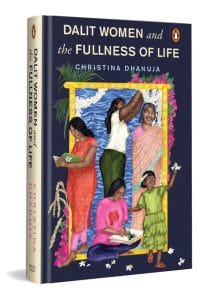 This excerpt from ‘Dalit Women and the Fullness of Life’ by Christina Dhanuja has been published with permission from Penguin Random House India.