






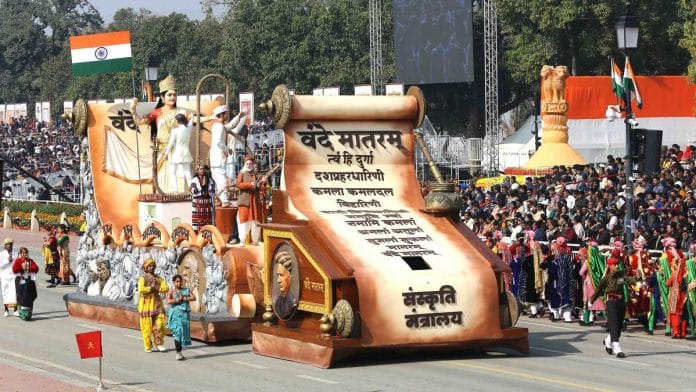


Union Home Minister Amit Shah is set to introduce the Prevention of Insults to National Honour (Amendment) Bill, 2026 in the Rajya Sabha during the present Monsoon Session. The Bill brings all six stanzas of Vande Mataram under the same statutory shield currently reserved for the National Flag, the National Anthem and the Constitution, making deliberate insult or obstruction of its singing punishable with up to three years’ imprisonment, a fine, or both.
It arrives, fittingly or awkwardly, in the 150th anniversary year of the song’s composition—a moment to revisit both its layered history and the philosophical question of what criminal law is for.
I approach these questions primarily through two texts. The first is TM Krishna’s 2026 book We, the People of India, which examines the somewhat uneasy process by which Vande Mataram acquired the status of a national song. The second is legal philosopher Patrick Devlin’s 1959 lecture Morals and the Criminal Law.
Also Read: Vande Mataram in Bankim Chandra’s Anandamath is a violent, anti-Muslim war cry: TM Krishna
The idea behind the anthem
TM Krishna’s We, the People of India: Decoding a Nation’s Symbols traces the song’s composition and political afterlife with a musician’s ear.
Bankimchandra Chattopadhyay wrote the first two stanzas sometime between 1872 and 1875; the more martial, explicitly theological third and fourth stanzas were added only when he folded the song into his 1881 novel Anandamath. Krishna, analysing the song purely as sound rather than sentiment, argues that the later additions never cohere musically with the opening. Every attempt to set all six stanzas as one composition, he concludes, ends up disjointed, each part working alone but the whole falling apart.
That aesthetic seam, he suggests, opens exactly where the politics turns sharpest: the lyrical mother of the opening gives way to a sword-bearing Durga rallying warriors against an enemy that, within the novel, is explicitly the Muslim community.
This context shaped how the song was later handled. When Sarala Devi sang it at the 1905 Banaras Congress session, she quietly swapped “saptakoti” (seven crore) for “tringshakoti” (thirty crore) so the song would sound less narrowly Bengali—an early sign that it needed editing to serve as a national symbol.
On 20 October 1937, Jawaharlal Nehru, having just read an English translation of Anandamath, wrote to Subhas Chandra Bose admitting that the novel’s background would likely irritate Muslims, a marked shift from his earlier view that the objections were mostly manufactured.
Rabindranath Tagore, writing to Nehru on 26 October 1937 and again to Bose later that month, defended the song’s opening stanza but acknowledged that Muslims could never accept Bankim’s Durga imagery as a symbol of their own homeland. The Congress Working Committee tried to bridge this on 28 October 1937 by restricting national singing to the first two stanzas.
Devotion to the full song, meanwhile, ran deep. Hemchandra Das Kanungo traced the birth of his own revolutionary politics to the novel. Harivansh Rai Bachchan, in his 1948 essay “Our National Anthem”, recalled that, as a twelve-year-old schoolboy in 1919, his uncle warned him that humming the tune aloud risked getting the family arrested. Gandhi, speaking to political workers in Sodepur on 23 December 1945, said a song carrying such associations of sacrifice could never be discarded.
It was this unresolved mix of reverence and unease that Rajendra Prasad tried to formally settle on 24 January 1950, announcing that Vande Mataram would be honoured equally with Jana Gana Mana. This was a settlement of sentiment, not of text, since the Assembly never specified which stanzas that equal honour covered. The 2026 Bill now proposes to enforce, by statute, a status that has stood on this unfinished compromise for seventy-six years.
Criminalising disrespect
Lord Patrick Devlin’s 1959 lecture “Morals and the Criminal Law” is unfashionable today but useful here because it reasons in plain, testable steps rather than abstractions.
Devlin pictures society as a house held together not by bricks but by a shared morality; loosen that invisible bond enough, and the structure comes apart. He tests the idea with an everyday example: a man getting drunk alone in his own home harms no one, but if a quarter or half the population did so every night, society would plainly look different. Somewhere between those two points, he argues, the state acquires the right to legislate, even though no one can mark the exact threshold in advance. He makes a parallel argument about treason: the law protects government from violent overthrow not because dissent is wrong, but because organised society cannot survive without it.
Read this way, Devlin’s framework gives the government’s proposal some force: a song accorded, since Rajendra Prasad’s 1950 announcement, equal honour with the Anthem is, in his terms, arguably one of the institutions a society may wish to fence off from casual insult.
But Devlin qualifies that with what he calls “elastic principles”, or limits on how far the law should intrude on conscience and dissent. Indian courts have already drawn a version of that line around the National Anthem, and this Bill will have to reckon with it as well. In Bijoe Emmanuel (1986), the Supreme Court held that children who stood respectfully but did not join the singing had shown no disrespect whatsoever, and that no provision of law obliges anyone to sing the Anthem at all. The Kerala High Court in Salman Case (2014), ruling separately on what conduct actually amounts to an offence under the Act, has drawn the corollary: it is active disruption, causing noise or interruption, that can constitute a punishable “disturbance,” not silence or mere non-participation.
Read together, the two judgments confine criminal liability to precisely the narrow band of settled consensus Devlin describes, leaving personal abstention, however discomforting to onlookers, outside the law’s reach.
This is precisely where the Bill sits uneasily: a song whose scope Nehru wanted narrowed, whose full text Jinnah rejected outright, and whose “equal honour” in 1950 was itself a negotiated compromise rather than an unopposed consensus does not obviously meet Devlin’s own bar of settled, undivided public sentiment. Any attempt to criminalise silence or non-participation would therefore reach further than either court has permitted for the Anthem itself.
Whether the state’s case can survive Devlin’s bar, rather than merely the objections of its critics, will be decided less in Parliament than by how the law is applied in the years that follow.
Shashank Maheshwari is an assistant professor at Jindal Global Law School. Views are personal.
(Edited by Asavari Singh)
True pluralism requires mutual accommodation, not perpetual surrender by the majority. The compromise on Vande Mataram was already made in 1937 when only the land-praising stanzas were retained.
A truly pluralistic society cannot be a one-way street where only one community’s sensitivities dictate national symbols, while the sacred cultural sentiments of the majority are expected to yield permanently.
Calling Vande Mataram’s history “contested” dilutes its foundational role in liberating the country. Extending legal protection against deliberate disrespect is not ‘coerced patriotism…it is the baseline civic standard required to protect national dignity and honour the civilizational values of Bharat