









Welcome to the annual Bollywood misogyny-lympics—that esteemed race to the bottom where the bar for what constitutes romantic devotion drops a few notches every year. Last year’s lover slapped you or made you lick his boots? This year’s lover will set your house on fire. Next year’s will be even worse. Year after year, we’ll be here to applaud the fall.
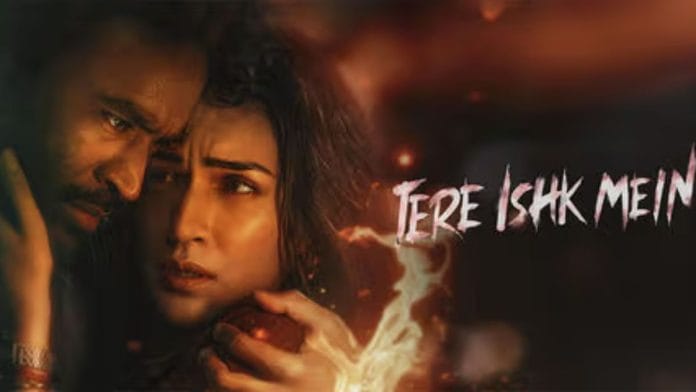
2025’s entry in the competition is Aanand L Rai’s Tere Ishk Mein, starring superstar Dhanush and Kriti Sanon. The movie’s weekend collection crossed Rs 50 crore. In 2017, Sanon had starred in the charming Bareilly Ki Barfi, playing a small-town girl who smokes, falls in love with an author she feels a kinship for, and refuses to marry for societal approval. The relentlessly wretched Tere Ishk Mein is about teaching that young, carefree girl a lesson.
Bareilly Ki Barfi was hardly an outlier. For a brief window, between 2011 and 2020, Bollywood allowed its heroines to be fully fleshed out, difficult, independent, and still desirable, without requiring them to be humiliated.
Rani from Queen (2013) goes on her honeymoon alone after being abandoned at the altar, and discovers the best thing in life is to decentre men. Rani was played with great efficacy by Kangana Ranaut, who also portrayed Tanu from Tanu Weds Manu (2011) as a fierce and unapologetic woman. The heroine of Dum Laga Ke Haisha (2015) is fat, but her husband has to learn to look beyond the superficial. In Hasee Toh Phasee (2014), the female lead is a brilliant scientist riddled with social anxiety, as the male object of her affections tries to play catch up. Pink (2016), with three women leads, was an incisive commentary on sexual assault.
These might have been imperfect films, but they were squarely in the mainstream. They made money; many went on to become cultural touchstones. For a moment, it felt like the industry had proof that stories about women could also pull their weight commercially.
But that experiment was killed as soon as an old formula showed that it was still profitable. In 2019, Sandeep Reddy Vanga’s Kabir Singh arrived and grossed over Rs 379 crore, despite being critiqued, protested, analysed to death. The film’s hero slaps the woman he supposedly loves, and gets a woman to strip at gunpoint. Back then, CBFC member and actor, Vani Tripathi Tikoo had warned during a TV debate, that Kabir Singh would spawn many spinoffs. Vanga’s own Animal (2023) fulfilled that prophecy, by doubling down on the toxicity. In the film’s homoerotic universe imagined for men, of men, and by men, the women are just NPCs flitting in and out of frame. The film netted Rs 917 crore worldwide.
Animal set a template that proved that you could take every feminist critique of the last decade, step on its neck, and still print money. Films like Tere Ishk Mein and Ek Deewane Ki Deewaniyat, are the inheritors of this pernicious lineage. The latter is a particularly instructive case study in the ritual punishment of its female lead.
Also read: Indian universities follow the same template on sexual assault—cover up, blame the victim
‘Everything for love’
In Tere Ishk Mein, Dhanush plays Shankar, the violent president of the Delhi University Students’ Union, renowned for beating up his opponents and attacking buses, that DU launda rite-of-passage. Mukti, a rich psychology PhD student researching violence, believes she can fix him with a combination of behavioural therapies, A Clockwork Orange-style. She might be one of the worst-written women characters of the last few years, but Sanon plays her with admirable conviction.
Despite his violent tendencies, Shankar is actually a Nice GuyTM. We know this because the script believes it—and also because he announces it at every opportunity. He complains about the wealthy and drinks with unhoused people sitting on the footpath (that he has beaten up an equally impoverished bus driver and conductor does not count). But the surest proof of his Nice Guy-ness is that he refuses to accept transactional sex from Mukti.
For her part, Mukti, as the civilising influence, giggles her way through Shankar’s violent outbursts, while supposedly treating him. She is Victor Frankenstein, and he’s the misunderstood monster. She makes excuses for him when he douses himself and her boyfriend in petrol, and asks her to set one of them on fire.
Aided by an army of idiots, Shankar prepares for UPSC. All in the hope that Mukti will someday accept him. After three years of no contact—during which Mukti has moved on with her life and gotten engaged—Shankar reappears. He lobs Molotov cocktails at the home where her engagement party is in progress. “I did everything for love,” he declares, to a woman who has never once said she loves him back—because he’s never bothered to ask. “Either accept me, kill me, or die by suicide with me,” he tells her, because apparently, “no” is not enough of an answer. In the only honest moment in the film, Mukti admits that she’s been hesitant to spell it out for him, because he’s incapable of handling rejection.
Then comes the film’s most egregious moment. Shankar arrives at Mukti’s wedding carrying a bottle of clear liquid. Someone in the background screams that he’s about to throw tezaab (acid) at her. It’s actually gangajal. It’s a perfectly calibrated barbarous joke in a country where “jilted lovers” exact revenge by throwing acid on women’s faces with such regularity that we have survivor networks and legislation dedicated to the phenomenon. The audience is meant to feel relief that Shankar doesn’t disfigure the object of his affections. What a gentleman!
Eventually, a heavily pregnant, alcoholic Mukti is brought down to her knees—and I mean that literally, when she supplicates to Shankar to take her back, lying in a pool of blood. She has to prostrate herself at the feet of a man who, despite being a criminal, is somehow an IAF pilot. The whole thing ends with a bizarre invocation to love.
This is the wormy insidiousness at the bitter, cynical heart of Tere Ishk Mein and films like it. The very real threat of violence experienced by India’s real women is repackaged as the currency of passion. Stalking is persistence, arson must be devotion, and outright threats of harm are just proof of how deeply he feels. The worse his behaviour, the more intense his love must be. It’s like handing a manual for coercion to the coddled men of a country where the line between the screen and real life has always been dangerously porous.
Raving fanboy reviews of the film are willfully blind to its pitfalls. And entire battalions will range against anyone who complains. In the post-Kabir Singh and Animal environment, if you dare to point out that the script does not treat its women as human, you will be told: Arre, it’s just a film! Cinema doesn’t cause violence; people who want to do bad things will do them anyway. What about misandry? Listen, did anyone get influenced by Deewar and Sholay? Why are you taking this so seriously? It’s just a slap, just a woman licking a man’s boots, just some light arson. You are all just hysterical, “illiterate” feminist killjoys too dim to appreciate the craft of cinema. And look at the box office collections – how can RS 50 crore be wrong?
But the market is not a moral arbiter. Good money is thrown at bad ideas all the time. Look no further than Theranos, which raised hundreds of millions, or how Delhi’s government tried to solve air pollution with artificial rain via cloud seeding. All that box office collections tell us is that we are willing to pay for regressiveness.
As for the smart young women of Bollywood? Farewell, Bitti, Rani, and Tanu, it was nice knowing you. You’ve been replaced with women who know their place—prostrating themselves in front of violent men.
Karanjeet Kaur is a journalist, and a partner at TWO Design. She tweets @Kaju_Katri. Views are personal.
(Edited by Theres Sudeep)
Women love and marry only violent, rogue, smoker, and alcoholic men.