


The Russia–Ukraine war, which has dominated Europe’s strategic space for nearly five years, had taken a backseat in several discussions I attended during the Athens Security Forum earlier this week. Instead, conversations were either focused on Turkey or kept returning to it amid the wars and rivalries reshaping the Middle East and Mediterranean.
Geography shapes not only threat perceptions but also the importance countries attach to different security questions. Despite a shared and unusually strong institutional identity, Europe does not have a common hierarchy of strategic anxieties. Russia remains central to the eastern and northern flanks, and to debates in London, Paris and Berlin. Along the southern flank, the emphasis shifts towards Turkey and the Middle East.
But Ankara’s influence now extends much further: the Caucasus, Syria, North Africa, the Sahel and the Horn of Africa. Closer home, India is encountering Turkey across South Asia and, increasingly, Southeast Asia. New Delhi has generally analysed Pakistan’s defence modernisation through a Chinese lens. Operation Sindoor brought the Turkish dimension more sharply into focus. Bangladesh’s purchases of Turkish equipment and Ankara’s expanding partnerships in Indonesia and Malaysia underline why this cannot remain a Pakistan-only discussion for India.
There is a paradox here. Turkey is a $1.6 trillion economy, not a poor country, but it faces persistent inflation, expensive credit and structural weaknesses. Yet it possesses NATO’s second-largest military by personnel, after the US, and has built a remarkably active defence industry. Why has this sector performed so differently from the mesh of economic challenges around it? And is Ankara escaping dependence, or getting better at managing it?
I outline four propositions to help explain the contradiction.
Economic vulnerability has helped shape the defence-industrial model
Turkey’s economy combines considerable productive strength with chronic instability. GDP per capita was approximately $18,650 in 2025. Its manufacturing base extends from automobiles and machinery to shipbuilding and construction services. Defence is therefore not an isolated miracle conjured out of an otherwise industrially barren economy.
Yet inflation reached 29.77 per cent in October 2026, even though it fell considerably from earlier peaks, while the central bank’s policy rate was 36 per cent. Imported energy exposes the Turkish lira and current account to external shocks. High financing costs complicate long-term investment, while pressure on currency raises the cost of imported components.
An ongoing stabilisation programme has improved some macroeconomic conditions, but the World Bank and IMF continue to flag disinflation, external vulnerability and structural reform as difficult unfinished business.
Then there is the question of governance. The European Commission’s 2026 assessment records persistent weaknesses in judicial independence and anti-corruption safeguards. Such conditions can undermine confidence and the consistency of investment decisions, even if they do not establish corruption in particular contracts.
So, why has defence been different – or has it?
The Turkish defence sector has enjoyed something the broader economy cannot claim to the same extent: sustained political priority, state procurement, institutional coordination and targeted technological investment.
And the story does not begin with the Baykar Group, owned by Erdoğan’s son-in-law. Western restrictions after the 1974 Cyprus intervention encouraged import substitution, and Turkey created a dedicated defence-industry institution in 1985. The later exclusion from the F-35 programme reinforced an older concern about reliance on treaty allies. The industry’s achievements, then, draw on both state support and capabilities accumulated through Western industrial partnerships.
Melike Bozkurt and H. Emrah Karaoguz’s research offers a useful framework: systemic economic vulnerability can coexist with concentrated areas of industrial success. The point is not that economic crisis automatically produces innovation. It is that particular institutions and incentives can channel scarce resources and political attention into a favoured sector.
In this sense, what appears to be Turkey’s economic contradiction is partly the product of the very conditions that shaped its defence-industrial model.
Industrial agility has its limits
The next advantage has been organisational rather than merely technological. With a “deploy first, improve later” approach, Turkish manufacturers have often moved relatively quickly from usable equipment to operational deployment, feedback and improved versions. The Bayraktar TB2’s early success in Ukraine, followed by its reduced utility as Russian defences adapted, captures both sides of this approach.
Battlefield experience can accelerate design improvements, allowing manufacturers to improve operational limitations in later versions.
The latest example is the combat aircraft Kızılelma. On 19 November, Baykar delivered its first three uncrewed combat aircraft to Turkish security forces. A year earlier, Kızılelma had used Aselsan’s Murad radar and the Gokdogan beyond-visual-range missile to successfully strike a jet-powered aerial target.
This is huge because air forces are searching for ways to protect expensive fighter aircraft and trained pilots as air combat becomes longer-range, more dispersed, and more lethal. Separating some sensing and weapons functions from crewed platforms is one possible response.
But a successful test does not automatically become a mature combat capability. Neither does removing the pilot from the cockpit settle the question of human control over lethal engagements.
But the ability to test a cutting-edge technology, induct it in the armed forces, field it wherever possible to gain operational experience and incorporate learnings for improvement, is a unique strength.
Aaron Stein, president of the Foreign Policy Research Institute, describes another tension: Turkey has built commercially successful products in drones, munitions and other comparatively accessible categories, while still facing bottlenecks in advanced engines, materials and systems integration.
Kaan’s reliance on foreign propulsion and some of the engineering challenges of Kızılelma show why a deploy-learn-improve approach cannot substitute for capital-intensive development and certification. Agility is indeed a competitive advantage, but achieving high-end technological capabilities requires considerably more.
Also read: India and EU have new reasons to engage. Real test comes after FTA is signed
Ankara converts industrial capability into cross-cutting defence value chains
Turkey’s most interesting achievement may be its ability to cooperate with different partners for different reasons. It remains within NATO’s technological ecosystem but is often an outlier in the alliance’s politics, particularly over Russia, Cyprus, Greece and regional interventions.
Yet it is using the Western industry while building alternative markets and production relationships.
Europe illustrates deeper industrial integration. Leonardo and Baykar’s joint venture brings Turkish unmanned platforms together with Italian mission systems and certification capabilities; Baykar’s acquisition of Piaggio Aerospace adds an established European manufacturing foothold.
Spain’s 30-aircraft Hürjet programme is likewise not simply a Turkish export. Airbus leads a Spanish training system incorporating local modifications, equipment and through-life support. Britain’s Eurofighter agreement and BAE Systems’ engineering relationship with Kaan reinforce the point. European companies are simultaneously becoming collaborators and competitors, even as Ankara remains institutionally at arm’s length from EU defence initiatives.
The Gulf reveals a different model. Saudi Arabia’s Vision 2030 seeks to localise military expenditure, making Turkish manufacturing and technology-transfer proposals attractive alongside Riyadh’s capital. The Mecca agreement with Pakistan adds a security dimension, although it should not be confused with a NATO-style integrated military structure.
The UAE case is even more interesting. Despite political tensions, Emirati defence conglomerate EDGE has integrated its Desert Sting 16 guided munition on the Turkish TB2 and agreed with Baykar to integrate Al Tariq weapons on Akıncı. Turkish aircraft thus successfully become platforms on which others, including regional rivals, test, adapt and market their own payloads.
South and Southeast Asia show procurement evolving into longer industrial relationships. China still dominates Pakistani major-arms imports, but Türkiye has become its second-largest supplier in recent SIPRI data. The four-vessel MILGEM corvette programme includes Pakistani shipbuilding; Turkish firms have upgraded Agosta submarines and previously modernised Pakistani F-16s.
Chinese missile technology also contributed to Turkish programmes in the 1990s, although present-day bilateral military-industrial cooperation remains cautious and selective. Pakistan’s November 2026 Fa’az missile test was described as indigenous, but reported cooperation with Turkey on the longer-range Fa’az-2 programme continues. Bangladesh has purchased several Turkish systems and discussed local defence production, while Indonesia’s Kaan deal remains an ambitious acquisition and Malaysia’s Turkish-built corvettes are approaching delivery.
Africa makes the geopolitical implications clearer. Turkish drones, training and security cooperation have extended from Libya and Somalia into the Sahel, in areas where French and, in some places, Russian influence has weakened.
There is also a less conventional side that is often overlooked. SADAT, a Turkish private defence consultancy, has been linked to allegations of Syrian fighter recruitment for Niger and Burkina Faso, although it officially denies operating there.
Separately, Le Monde reported this month that another Turkish firm, Equipped Tactical Academy, trained Malian special forces. Such arrangements make Türkiye somewhat unique among NATO states, as they complicate its identity as a conventional Western security partner and raise questions about accountability.
The examples above, however, do not represent components of a single Turkish-led bloc. Europe offers advanced technology and certification; the Gulf offers capital and localisation; Asian partners offer production and procurement opportunities; Africa combines markets, security access and influence.
Ankara’s achievement is the ability to compartmentalise these relationships while making them commercially reinforcing.
The success story also conceals the dependencies it creates
This brings us back to the economy. Turkey’s defence and aerospace exports exceeded $10 billion in 2025, and have already reached $8.05 billion in January–October 2026. Yet foreign sales need to be understood in a broader context. A September study by Nebahat Tanrıverdi Yaşar and Barış Alp Özden finds that exports generated 97 per cent of Otokar’s defence revenues in 2025 and 90 per cent of Baykar’s revenues in 2024.
This suggests that domestic demand alone cannot absorb the sector’s developed production capacity.
Export dependence creates another kind of vulnerability. Producers must continually find customers, satisfy demands for local manufacturing, navigate sanctions and sustain costly research programmes. Co-production may open markets, but it can also distribute production value and control over technology outside the country.
The same partnerships that make Turkish aerospace more competitive also show how dependent it remains on engines, components, finance and certification from abroad.
Nor can defence exports compensate for everything else. Even a globally visible $10 billion sector cannot, by itself, resolve inflation, energy dependence or institutional credibility problems. Opportunities created by European rearmament, conflicts around Russia’s periphery, Moscow’s declining influence and instability in the Middle East are consequential, but they will not necessarily produce permanent demand. Political and military commitments in fragile states may also create liabilities alongside access.
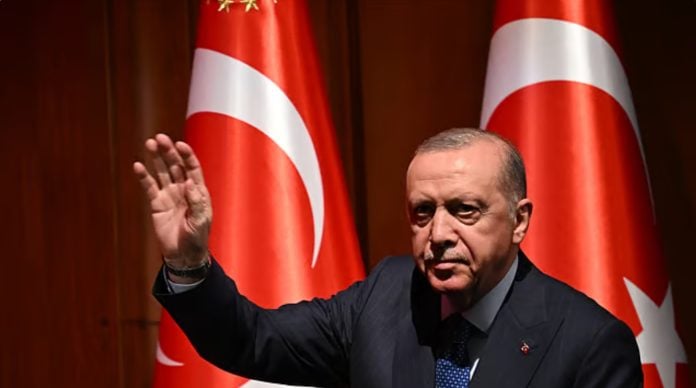
By suppressing dissent at home, Erdoğan has been able to turn selected economic constraints into industrial incentives, and industrial capability into foreign-policy options. But that is not the same as resolving the structural constraints. If macroeconomic stabilisation falters, the costs of advanced programmes and far-flung commitments will become harder to absorb.
For India, the consequence is rather clear. New Delhi was late to wake up to the Turkish factor in its neighbourhood. Now, it should not be treated merely as an adjunct to Pakistan’s China-backed military modernisation. Its influence rests on relationships across Europe, the Gulf, Africa and Asia, each serving a different industrial and strategic purpose.
That said, Ankara is becoming more sophisticated at managing interdependence, not escaping it. The question is how long its fragile economic foundations can sustain that distinction.
Swasti Rao is a Consulting Editor (International and Strategic Affairs) at ThePrint. She tweets @swasrao. Views are personal.
(Edited by Maryam Hassan)
The Turkish lira has depreciated 95.8% since he became President in August 2014.
There must be a balance between military power and economic power. In fact with soft-power too. Turkey’s military power is excessive compared to its economic power just like that of Pakistan. This forces these countries to take steps which they cannot manage and it makes the countries more unstable. No doubt both countries are becoming more and more unstable.
Very high inflation. A collapsing lira. President Erdogan HAS made an effort, entrusting the central banker’s and the finance minister’s jobs to competent professionals, but a lot more needs to be done. All over the world, leaders from the Right not to be very good on bread and butter issues that matter to ordinary citizens. Play up emotive issues.