






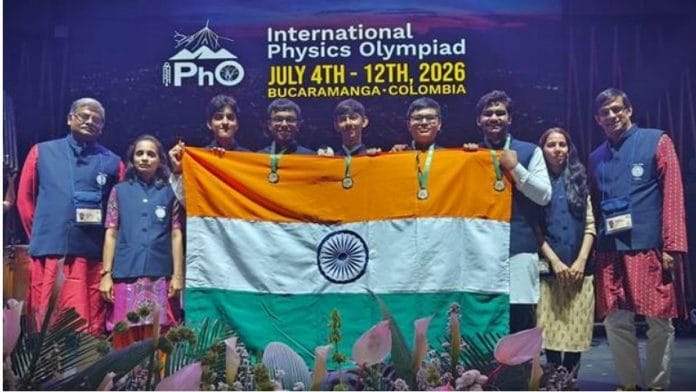


The past week was one of headlines. Hidden in obscurity was news of young Indians’ achievements in STEM.
A team of the best young physicists from India gave an outstanding performance at the 56th International Physics Olympiad (IPhO) 2026 in Colombia earlier this month. The achievement was all the more remarkable as all five participants won gold medals. A total of 381 students from 87 countries participated, and India secured the joint World No 1 rank.
Kanishk Jain from Pune, Riddhesh Anant Bendale from Indore, Rishit Garg from New Delhi, Shresth Suraiya from Mumbai, and Svarit Joshi from Ahmedabad have made not just their parents, but an entire nation of 1.47 billion people proud.
The Homi Bhabha Centre for Science Education spearheads India’s Olympiad programme, along with the Tata Institute of Fundamental Research, under the Department of Atomic Energy, which offers its unstinted support for nurturing and mentoring scientific talent and facilitating participation in international competitions.
At around the same time, a team of young Indian number crunchers participated in the 67th International Mathematical Olympiad 2026, held in Shanghai, China, winning two gold and four silver medals. India placed seventh among 117 countries, with 666 participants.
July also saw India achieve an iconic, historic milestone. Private aerospace company Skyroot Aerospace launched India’s first independently developed rocket, Vikram-1, making India just the third nation globally to launch a non-government-developed rocket.
And then, India’s first hydrogen-powered train made its maiden run between Jind and Sonipat in Haryana. This placed India in an exalted group of around five nations operating hydrogen trains to curb railway emissions.
Why are all these achievements in STEM so relevant in today’s AI-enabled age? This is the question that all policymakers, educators, people in influential positions, and parents should be asking.
Also Read: India’s hydrogen train not just about environment. It’s a step toward Atmanirbhar Bharat
STEM is the foundation of all AI
The age of AI has made learning easier in many ways. Yet, during a recent interaction with students and parents, I was struck by how dependent many students have become on AI. Across universities worldwide, students are using AI to frame answers, revise lessons, and even complete homework assignments.
At one American university, a professor exposed this dependence by embedding an invisible prompt instructing AI to write about ‘Madagascar’ in a midterm on the Industrial Revolution; 32 of 35 students failed part of the exam because they used AI.
In another case, an economics professor at a prestigious US university stopped assigning take-home exams and returned to in-person finals after noticing unusually high midterm scores.
AI is definitely here to stay. But it is mathematics that is the very foundation of its language. Calculus, probability, and linear algebra form the architecture of data processing, neural networks, and error optimisation. It is mathematical reasoning that allows you to audit, test, and spot logical flaws and hallucinations in AI-generated answers. Mathematical logic is also required for framing problems.
Knowledge of physics, meanwhile, teaches systems thinking: how physical constraints and dynamic forces operate beyond the digital world. Simply put, the physical plane exists differently from the digital realm. Scientific simulations help integrate machine learning with real-world models in fields such as fluid dynamics, climate forecasting, and robotics. Therefore, learning mathematics and physics in the age of AI remains vital because they provide the foundational logic, critical verification skills, and conceptual frameworks needed to build, correct, and innovate beyond automated systems.
Teaching young Indians to think, not just build
There is so much excitement around AI. Many young Indians have been drawn toward coding, app development, and AI-driven entrepreneurship.
I have had occasion to visit many universities and colleges where I’m often invited to address students and sometimes give away prizes. Almost every college and university has added AI courses to its offerings—BTech in AI and Machine Learning, or BTech in AI with a specialisation in prompt engineering. What exactly are students learning in courses such as these? These are valuable skills, no doubt, but are they really core STEM education?
The real strength of AI lies not in its applications alone, but in the mathematics, physics, and computer science that make an AI-enabled world possible. India has long been the home of mathematics; IITians dominate the who’s who of global CEOs—Sundar Pichai, Arvind Krishna, Sanjay Mehrotra, Nikesh Arora. These brains were trailblazers in the field of computing long before AI came along.
For India to remain relevant in the race for AI supremacy, we have to build our own AI stack, our own LLMs, rather than merely train models for Western giants. India must encourage its youth to master first principles, to ask why systems work the way they do, not just how to use them. A student who understands calculus, linear algebra, probability, electromagnetism, thermodynamics, or quantum mechanics is equipped not only to build with today’s AI tools, but also to contribute to tomorrow’s scientific breakthroughs.
During Covid, I met a dynamic IITian who selflessly utilised his 3D printer to produce protective shields for frontline staff such as doctors and nurses. He also used his acumen in robotics to design UV sanitisation machines, which we put to use for sanitising floors and walls in some NDMC hospitals. I understand that he is now building an edtech system to ignite the curiosity of young minds in robotics. Agentic AI, in contrast, uses coding and LLMs to create automated workflows that, like robots, do your work for you.
In a world where AI agents will automate work at the click of a mouse, the ability to reason, model, discover, and innovate will become the most enduring advantage. This is why it is an absolute necessity to bring STEM into our classrooms.
Also Read: India has a science soft power gap. Even after giving the world zero, Covaxin, Chandrayaan
Educating a generation of inventors
As India advances toward the vision of Viksit Bharat 2047, our greatest investment should be not just in technology, but in the minds that create it.
Does India need coders, or algorithm-devouring water bugs who are watching reels at full volume for mindless entertainment? Rather, the country will need busy bees who will shape the global scientific and technological landscape.
I was floored to learn that the average age of Skyroot Aerospace’s engineers and scientists is 28. A young India, a Viksit India, needs leaders and visionaries, not people who play follow-the-leader by becoming puppets in the hands of vested interests.
This reminds me of an incident when former US President Barack Obama, during an interaction with young students, stressed the importance of education and told them they risked being outcompeted by their peers in places like Bangalore— the term used widely then was ‘Bangalored’.
Inspired by the same thought, I am repeating my oft-spoken lines: if data is the new oil, then social media is the new opium. We have to make our next generation future-ready and align our policies with current needs and future challenges.
An education system that nurtures curiosity, rewards original thinking, and builds a strong foundation in mathematics, physics, and engineering from an early age is the need of the hour. Our goal should be to produce a generation that is able to comfortably prove a theorem without the help of AI, or design new, biodegradable materials that can fight climate change.
The National Education Policy (NEP) was introduced in 2020 as India’s first education policy of the 21st century. It is a forward-thinking, futuristic concept that proposes revamping the current education structure in its entirety. The policy places particular emphasis on transforming existing STEM education in India.
In 1947, the need of the hour was a defiant revolution against colonial subjugators. In the vision for Viksit Bharat 2047, there should be a STEM and technical revolution among our students and at the grassroots.
Learning by experiencing—like The Boy Who Harnessed the Wind (the true story of a young, largely self-taught African boy who built a windmill to help his famine-stricken village)—should inspire the young to find efficient and scientific solutions to the climate crisis, air pollution, and the need for clean water for all. Science and engineering, thermodynamics, faster trains—these are the areas in which the youth should be asking questions. And we, who have had our day, should be provoking these thoughts to build a growth mindset in our children.
Meenakshi Lekhi is a BJP leader and lawyer. Her X handle is @M_Lekhi. Views are personal.
(Edited by Asavari Singh)
And what part of STEM, if I might ask, has to do with homeopathy, cow dung/urine, temple building and story-telling (“plastic surgery in ancient India” and all that drivel)? All these brilliant students achieves all that they did inspite of the givernment policies, just like our olympic medallists did, not because of support from the government. Please don’t try to divert our attention away from your government’s incompetence, inadequacies, corruption and mismanagement. Please give us more credit than that!
“If data is the new oil, then social media is the new opium.” So states this senior member and parliamentarian of a party which has usurped power by weaponizing social media for the purpose of relentlessly, mercilessly attacking and silencing its critics and opponents.
And why is Ms Lekhi lecturing us about the virtues of STEM?! Should she not be educating her own party members, including their supremo, about the need for a scientific temper?
This article bares so many of the same ol’ flaws in her/their thinking, including the shallow, uneducated obsession solely with STEM subjects for the syllabus, that…really…it is pointless debating with them.
I am not as much incensed by these incompetent, corrupt fascists and misogynists for the cruelty and misery they have inflicted upon the nation all these years as by those who enabled them.
Surely, there will be a day of reckoning for the Arun Shouries and Tavleen Singhs. As also for the likes of Shekar Gupta and ThePrint. They helped to legitimize and normalize the untenable views of these violators by eagerly providing unconditional use of their platform to the latter.
Jobs. That is what they are asking for.
BJP leader Meenakshi Lekhi: The youth should asking questions-about science, fast trains, clean energy (Unsaid-Not paper leaks, corrupt ethanol mandates, marital rape and the general functioning of the Government. How dare they mount a “political” protest with a “political” demand like the resignation of a minister. Are they trying to control the “politics” which controls “their life”? Next what? Will they start talking about employment and delivery of basic public services instead of Hindu-Muslim?Will they start asking what their government can do for them, instead of what they can do for their government? Anti-national little cockroaches!)
Maybe by dictating the questions the students should ask , Lekhi Madam wants to rule in peace without being asked the unsettling questions on the sad state of governance in country. Let students decide which questions are worth asking. Political and governance questions are equally important as STEM questions.