





This happened in 1995. Nicole and Eric were strangers standing in line to board a flight to Anchorage, Alaska, when they struck up a conversation. Eric would later say that it was love at first sight. They talked throughout the flight and exchanged landline numbers before going their separate ways. For the next two years, they kept a long-distance relationship alive in the pre-internet era, when a phone was tethered to a wire, a PCO could become a lifeline, and a letter could take days to arrive. Then, in 1997, Nicole met someone at her law firm, and the couple broke up.
A CNN Travel feature about Nicole and Eric is now going viral because, over 30 years after they first met, having lived entire lives apart, the two have found their way back to each other. After her divorce, Nicole could not stop thinking about the one who got away. She wrote Eric a letter and waited for the phone to ring. It finally did, five years later. In 2023, they met in Mexico, and the sparks were still there. The title of a new Bollywood movie comes to mind: Pehla Pyaar Doosri Baar. First love, second time.
“This is it. We’re it. This is my life partner,” Nicole remembers thinking as she sat next to Eric.
I can’t help wondering how differently this love story might have unfolded if Nicole and Eric had been able to video-call each other in the 1990s. Perhaps they would have worked things out the first time around, with long-distance no longer such an insurmountable obstacle. Or perhaps they would have spoken so much, so often, that they would have discovered why they weren’t meant to be together. In that case, Nicole might never have found herself thinking about him after her divorce. The distance, the silences and all those years of not knowing may have had something to do with the way their story endured.
But there is a certain charm to the unknowing that defined old-school romances. When communication was scarce, longing had room to grow into a whole love story. Not every romance lasted, of course, but even the ones that fizzled out could survive as sweet memories. You didn’t have to watch an old flame post Instagram stories about a silly goose or his avocado toast, or discover that the person you once thought was the love of your life now runs a scam start-up, selling fake stone bracelets to spiritual fools, promising to fix their “nakshatras” or star groups.
The cruel fate of modern dating
In the late 2000s, when my frontal lobe was nowhere near fully developed, I would chaperone my aunt on her PCO runs. She would disappear into a booth, giggling nonstop as she twirled the telephone wire, and emerge looking thoroughly hot and bothered. The man on the other end had first met her on a train. He scribbled his phone number on a piece of paper, and the moment my aunt could get her hands on a telephone, she would call him.
She was a young woman in Class 11, with little money and even fewer chillar coins to spare for the PCO. When she ran out, she would turn up at the booth at an agreed-upon time and wait for him to call. The logistics alone were enough to make a modern-day situationship look like a walk in the park. All this effort just to hear someone’s voice! It seemed insane to me then. Honestly, it still does.
That relationship didn’t last and left a different kind of damage for my aunt to heal from, but she never knew enough about the guy to hate him for breaking her heart. For all I know, he was her one who got away. Conversations were all they had for a relationship, unlike these days.
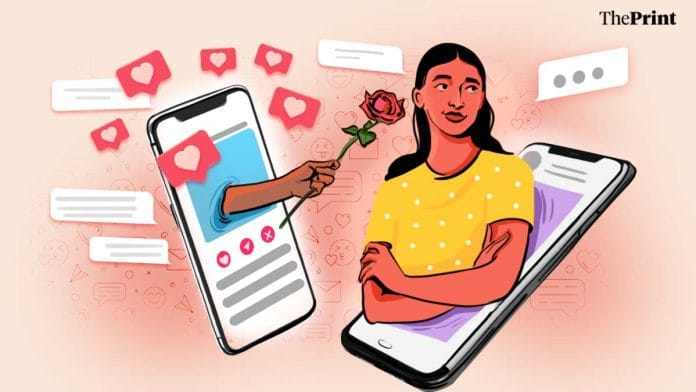
What my aunt had with a guy living on the other end of the city is called the “talking stage”, something that happens before the actual relationship. Nowadays, we spend almost every waking hour talking and don’t know if we are actually dating. People also don’t get away now. All the old flames are just a click away. Even when two people block each other, they find a way to stalk each other through burner accounts and mutual followers. We never have to wonder and fill our days with imagination.
How a generation loves is defined by what and how many means of communication they have. Kafka and Napoleon both relied on letters to sustain relationships across distance. Nicole and my aunt had letters and landlines, and we have Instagram, Facebook, WhatsApp, Telegram, Signal, Snapchat, a million more outlets.
I can’t say for sure that the lack of communication made for healthier relationships, but they did generate grander love stories. Perhaps people had more time on their hands, without a phone to constantly occupy them, to write elaborate letters and daydream about their lovers. They could spend hours imagining the person at the other end of the line, filling in the blanks with their wildest fantasies. There was, after all, no way to check whether the man who made your heart race was also following 700 Instagram models. By the time reality caught up, you might already have written him into an epic romance.
Also Read: Love in the time of crackdowns: How protests became Delhi’s newest dating scene
At the speed of love
We are not that technologically poor. Even when there is nothing to talk about, Hinge dates send other stickers, GIFs, memes, emojis. The lines of communication are never dormant, until they randomly are.
People become ghosts, and the ghosted ones find it impossible to move on with their lives. Today, we have constant access to people but struggle to establish what our relationships actually are.
“That’s why situationships are on the rise,” a journalist told me at a recent event in Delhi. Her theory is that because we talk too much, share too much, and constantly look people up online, we develop a false sense of intimacy with insignificant others. After weeks of pulling all-nighters, chatting and trauma-dumping, two people may eventually not be on the same page, but they still can’t let each other go. Even the exes, who have done the whole relationship thing and failed, stay active in chats. The 20-something Nicoles and Erics of today hardly get so far from each other to go looking for one another. To actually miss each other.
Moreover, there are too many Nicoles and Erics in our lives to know whom to hold onto and whom to let go. So desperate are the young to recapture the old world that a Brooklyn-based software engineer has built Carrier Pidge, an app that makes messages travel at the speed of a pigeon—using the actual GPS distance between users. You can even track your virtual bird on a map. Finally, a delivery app that makes you wait for a text.
It is a charming gimmick, but we can’t and will not go back in time. Curse or a blessing, the internet is what we have, and we will continue to love at the speed it provides. We will also forget at the speed of a swipe.
Views are personal.
(Edited by Insha Jalil Waziri)