






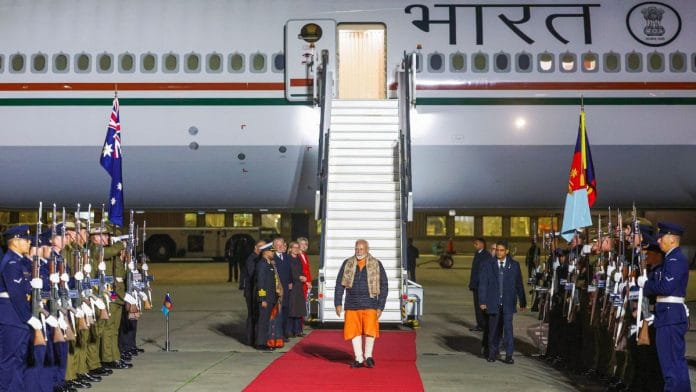


Prime Minister Narendra Modi’s visit to Indonesia didn’t get washed away in Indian news media’s coverage of the monsoon floods. Nor did it vanish in the abracadabra of ‘Messi Magic’.
It received page one headline coverage in major English daily newspapers Wednesday. And television news gave it ‘live’ telecasts at different times on Tuesday.
Unfortunately, the Indonesian press and news outlets didn’t pay it half as much attention.
Nor has there been a build-up in the Australian or New Zealand press for the PM’s visits to these countries.
Why? Don’t they think India matters? Don’t we grab readers’ eyeballs?
Agreements signed during the PM’s visits are important to India and to these three countries. They could also have implications for the region.
The visits are also significant for geopolitical reasons. Wars continue in West Asia and between Russia and Ukraine. And we have a President in the White House whose erratic decision-making has spread uncertainty everywhere and left many countries more dependent on China.
Countries are seeking out new economic and defence partnerships.
So one would expect more interest in Modi’s trips in the Asia Pacific region.
Also read: Modi beats Nehru’s record. TV channels & newspapers choose a victory tune over band baaja
What’s the story?
What’s so important about these visits?
In Indonesia, India agreed to sell BrahMos supersonic missiles, among a slew of defence agreements. There was cooperation on rare minerals, those crucial commodities in modern technology. As The Indian Express wrote, “Delhi, Jakarta sign off on key deals”.
In Australia the Australia Associated Press added, “The visit will have a backdrop of the long-range missile test by China in the South Pacific, which was launched this week after limited notice from Beijing…It could prompt India and Australia to strengthen their trading ties, given both countries have a strong reliance on China for trade.”
New Zealand and India have a Free Trade Agreement which needs to be ratified by the New Zealand Parliament, amid some political opposition.
And yet…
The news media coverage has been basic.
There have been articles in local newspapers such as The Jakarta Post and the widely read Kompas before, during and after the Indonesia leg of the visit ended. But these have mostly been short news reports.
The Jakarta Post led with the agreements signed by the two countries, but other reports on PM Modi were buried in the websites.
It published an editorial prior to PM Modi’s arrival in Indonesia in which it said: “The relationship between India and Indonesia has suffered from strategic caution, a tendency to drift into parallel diplomatic orbits rather than actively combining forces to shape global policy.”
Rather than serious stories, Jakarta Globe and Kompas were more interested in Modi’s visit to the Prambanan temple that India has promised to restore.
The Kompas story was placed low on their website, obscured by news on the World Cup soccer and US President Donald Trump.
It took a keen interest in the two leaders’ attire and cars. It wrote: “Prabowo was seen wearing a white shirt, black trousers and a navy blue cap, while Modi wore an orange kurta and scarf. Prabowo was seen riding in his white Maung car, while Modi was riding in a black limousine.’’
It also highlighted Modi receiving the Bintang Republik Indonesia Adipurna, the highest level of honorary award in Indonesia, and the bond between the two leaders as they exchanged hugs upon meeting.
Regional news media showed little interest in PM Modi’s visit. The South China Morning Post carried an agency-written article on India’s sale of the BrahMos.
It did longer pieces on robotic elephants at temples in Andhra Pradesh and one about India’s crop waste as fuel for airlines.
Straits Times (Singapore) had a comprehensive news report, which covered both Modi’s visit and the agreements.
Also read: TV news changes its tone on Ram Mandir—reverence & respect to no-holds-barred questioning
Curtain raisers
PM Modi is in Australia today and will travel to New Zealand on 10 July. The Guardian (UK) showed more enthusiasm than the Australian and New Zealand press, saying he would receive a “rock star welcome” but also some “human rights protests”.
Besides the articles already quoted at the beginning, local news media in Australia are still yet to get going on the PM’s visit.
So far the highlight in the coverage was the Indian community reception to be held in Melbourne. ABC network wrote: “It may be a grey July day, but inside a community hall in Melbourne’s south-east, it is a riot of colour.”
The Herald Sun published a curtain raiser, which highlighted the community reception but also explained the official agenda.
In a separate story, the newspaper dealt with an alleged death threat to the PM.
The Australian gave prominence to its report on Naveen Jindal’s corruption charges in India. Jindal Steel is competing to buy the Whyalla steelworks, the only manufacturer of rail in Australia.
One story on the Indian PM’s visit to New Zealand is making headlines—the proposed FTA between the two countries. This after Foreign Minister Winston Peters criticised the deal as not beneficial for New Zealand.
Television news service, 1News reported that Peters will be travelling abroad, while Modi is in New Zealand and raised an eyebrow at his absence.
The author tweets @shailajabajpai. Views are personal.
(Edited by Theres Sudeep)
To be fair, Indian media makes up for tepid foreign media coverage. A long standing template. Diaspora interaction a standard feature.