








The Cockroach Janta Party has shown the way, and now others are following its lead. That goes for the news media as well.
The continuing protest by students and job aspirants in the Ranchi agitation, and its news coverage, have imitated and replicated the CJP-led demonstrations at Jantar Mantar, New Delhi last month.
You’ll notice this in the coverage by television news as well as newspapers and their online portals.
You may be surprised by the similarities.
Since the Ranchi protests began on 29 July with a sit-in at Jaipal Singh Munda Stadium—four days after the students’ stir ended in Delhi—they have faithfully abided by the CJP’s playbook. And the news media has been right there in a similar supporting role: ‘NDTV with students,’ wrote the news channel on the Jharkhand stir.
India Today went one step further: “India v/s paper leaks,” it said.
Sound familiar?
The front pages of leading English newspapers reflected a matching sentiment on 11 August, the day after the Jharkhand protesters took out a march to the Assembly—in Delhi, the march had been to Parliament.
‘Cops stop march to Jharkhand assembly with lathis, tear gas,’ wrote The Times of India. It ran a similar headline on 21 July after the CJP-led march: ‘Cops block protesters march to Parl…’
On Tuesday, a headline in The Indian Express said: ‘Lathis, tear gas, a sea of protesters: Jharkhand anger reaches Assembly’. An article in the paper on 21 July was along the same lines.
‘Protesters storm heart of Delhi, police use lathi charge and tear gas to stop march,’ said the headline.
The news photographs from Ranchi showed police using water cannons on students; in Delhi, they had shown them using batons.
The headlines run parallel
The similarities between the CJP-led protest and the Ranchi agitation didn’t end there.
In both cases, students were on fast. In Ranchi, student leader Devendra Mahto led five others. TV news channels constantly sought him out—and others who are fasting—for sound bites and quotes.
AISA’s Neha Bora, whose fast at Jantar Mantar made her an instant media star, has joined the protest at Ranchi—and TV news made a beeline to interview her.
Television news channels and newspapers spoke to students about their grievances regarding the irregularities in government recruitment examinations, the lack of job opportunities, and the government’s apathy. Close your eyes, and you’d hear echoes from Jantar Mantar.
On Monday, the day of the march to the state Assembly, TV news and online news portals went ‘live’ and stayed ‘live’ for most of the day. For them, it was a re-run, with reporters and cameramen in position to walk alongside the protesters.
And then came the volley of headlines and non-stop commentary: ‘August Kranti,’ proclaimed Zee News, ‘Maha March,’ wrote News Nation.
News media found ‘thousands’ on the march. Here’s Hindustan Times front page lead report: “Thousands of students protesting against alleged irregularities in Jharkhand state recruitment exams clashed with the police as they attempted to march to the state assembly…’’
Replace Jharkhand with Delhi and ‘state assembly’ with Parliament, and you could be reading about the CJP-led march.
This was followed by water cannons and lathi charge by the police: ‘Police resort to lathi charge, protesters refuse to step back,’ read a headline in The Hindu newspaper.
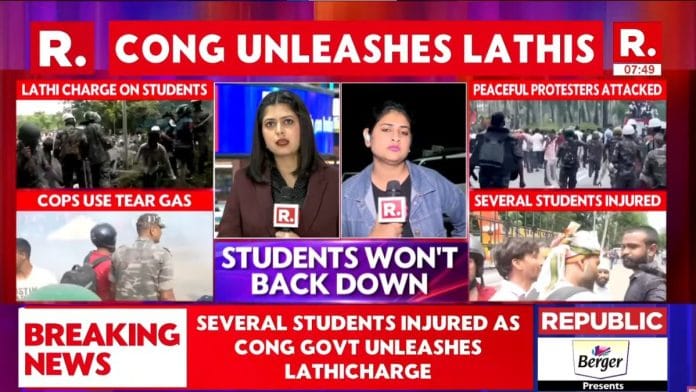
The TV cameras focused on students breaking through barricades, and, more importantly, the violent reaction by the police.
At Jantar Mantar, we had seen students dancing and singing in the rain. Dateline Ranchi: News 24 caught them doing so here, too.
By early afternoon, the language became tougher as reporters watched police action meet with student resistance: ‘Student rage against exam machine’ said the NDTV 24×7 reporter.
Soon, we were looking at injured students and hearing how they had been roughed up by the police. ‘Police brutality unleashed,’ declared India Today, dramatically.
Republic TV, which sees the Congress’ hand everywhere, blamed the party again even though it’s a junior partner in the Jharkhand Mukti Morcha government led by Hemant Soren. ‘Congress unleashes brutality,’ its headline said.
‘Police lathis and fury’ said CNN News 18.
Hindustan Times reported that “four agitators and three policemen (were) injured”. (11 August)
There were editorials in The Indian Express and The Times of India. Both joined the dots between the agitations.
“You can regard (the protests in Delhi and Jharkhand) as part of a continuum, reflecting growing youth angst,” The Times of India wrote in ‘Jharkhand & Beyond’ on 11 August.
“The discontent in Ranchi, like the upsurge at Jantar Mantar, reflects a deeper crisis of confidence amongst a generation whose hopes seem to be increasingly tied to government employment,” wrote The Indian Express on 12 August in ‘When tear gas clear, what remains in Ranchi’.
Also read: Why the FCRA Bill is an asset grab in disguise
‘Govt vs Opposition’
The one significant difference in the TV news coverage of the Ranchi protest was DD News.
During the Jantar Mantar stir, the government-funded channel almost ignored the protests. At Ranchi, it showed much more interest in the march and the police ‘brutality’. There were constant updates and video reports of both.
We know why: Jharkhand has an Opposition-led coalition government and the BJP completely supported the agitation. In Delhi, it is the BJP that is in power, and the student protest was against the NDA government at the Centre—it was opposed by the Narendra Modi government.
The other fallout of the Jharkhand protest could be seen in Parliament, where there was a sudden change in the government’s stance on discussing student protests. So far, it had remained silent on the Opposition’s demand for home minister Amit Shah to make a statement on police violence in Delhi on 20 July. Every day, TV news told us, ‘Lok Sabha adjourned’, ‘Rajya Sabha adjourned’ after Opposition protests.
Shah declared himself prepared to make a statement this week, and was all over TV news channels Wednesday, urging the Opposition to discuss the student protests.
TV news saw extraordinary scenes at Parliament’s Makar Dwar, on Tuesday, as the NDA ministers held a protest against Rahul Gandhi, Leader of the Opposition, for allegedly running away from a discussion—and the Opposition continuing its demand for a Shah statement on who ordered the police firing in Delhi.
News channels were tickled by the ‘Govt v/s Oppn’ protest (News 18) and ‘BJP v/s Rahul’ clash (India TV). They constantly broadcast the slogans from each side.
‘Amit Shah jawab do.’ Amit Shah, speak up.
‘Rahul Gandhi bhago mat.’ Don’t run, Rahul Gandhi.
The author tweets @shailajabajpai. Views are personal.
(Edited by Prasanna Bachchhav)