






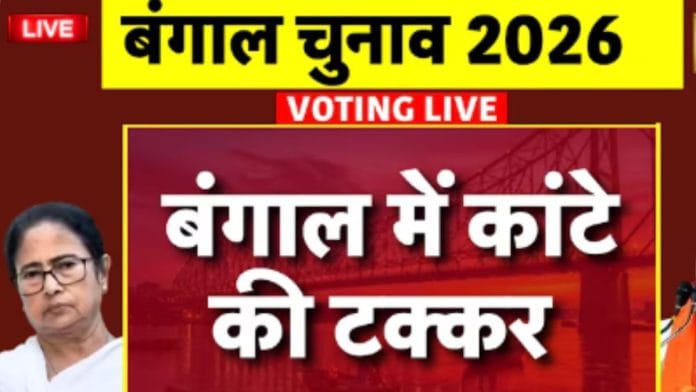


The television exit polls have told you who will win Battleground Bengal and four other state Assembly elections. The winners’ names may surprise you.
News media coverage of the elections in West Bengal has been very careful not to declare a victor. Over the last seven weeks, TV news and leading English newspapers have diplomatically predicted, “too close to call”.
In the more colourful Hindi description on many reporters’ lips, it is a “kaante ki takkar” between ruling chief minister Mamata Banerjee’s Trinamool Congress (TMC) and Prime Minister Narendra Modi’s Bharatiya Janata Party (BJP).
The contest between a 71–year–old slip of a woman who has ruled Bengal for 15 years and India’s most powerful and longest-serving head of government has captured the imagination of the press in India and internationally.
“‘Didi vs. Modi’: A Test for the Hindu Right in India’s Bengali Heartland,” read The New York Times headline.
What has added seriousness to the political glamour of this clash is the Special Intensive Revision (SIR). The exercise has removed over 90 lakh voters from the electoral rolls in Bengal and has been centre–stage through the election coverage. The Guardian made it the theme in its article, “Millions in India stripped of vote before critical state election, as government seeks to ‘purify’ electoral roll”.
Analysis in Indian newspapers gives you a 360-degree snapshot of opinions. “Can BJP’s rise breach Bengal electoral wall?” asked Rahul Verma in Hindustan Times. Neerja Chowdhury in The Indian Express replied, “Why BJP thinks it has the edge”.
Most in-depth reporting across newspapers suggests that this is Didi’s election to lose. She is not up against Modi’s BJP alone. As reports repeatedly stress, she has to battle anti-incumbency, crimes against women, corruption, and the lack of development. This story in The Indian Express by Vandita Mishra brings all the issues to the fore: “More than Didi vs BJP/EC/SIR, it’s Didi vs Didi: In silences, you also hear talk of ektu poriborton”.
News stories also emphasised that this time, the BJP is a formidable opponent. “The Saffron Surge: How BJP became TMC’s main challenger in West Bengal — a ground report,” read the headline for Gulam Jeelani’s story in Mint.
Where are CPI(M), Congress?
You may well ask, what is the coverage of CPI(M), which once ruled Bengal for 34 consecutive years? Where is Congress, which led the state from 1947 to 1977? Er… they barely troubled the headlines. While newspapers have written about the two parties, they have been almost completely ignored by television news.
The New Indian Express was virtually egging on the communists in its story, “Will the Left make a comeback after 2026 Bengal Assembly polls?”
The Deccan Herald saw the hurdles before the communists in its opinion article, “CPI(M) in West Bengal: Politics of renewal or repetition?”
As for the Congress, well, the one time it made national headlines was when Rahul Gandhi, Leader of the Opposition, lashed out at Mamata. Then too, newspapers barely gave him a single–column mention: “Not democracy but TMC reign of terror prevails in Bengal: Rahul,” wrote The Times of India on Gandhi’s remarks.
Important constituency profiles, data on seats, communities’ voting patterns, women’s voices on safety concerns, and the impact of SIR, especially on the Muslim vote, remained recurring themes in newspapers right up to the final day of voting on 29 April.
“ECI adds 1,468 names to WB rolls ahead of last poll phase,” read a page one headline in Hindustan Times.
The Indian Express headline Wednesday was similar. But more interesting was the subhead: “The Great Bengal Exclusion: Of 89 Lakh names deleted, 34 Lakh had gone to Tribunals”. It indicates the enormity of the exclusion and the paltriness of the last-minute inclusion in the voters’ list.
The Hindu had an interesting take on the very high turnout during Phase One of voting in Bengal and on voting in Tamil Nadu: In “A false high”, it wrote that the numbers must be seen in light of the SIR, with 13 per cent of voters deleted in Bengal.
“If this is factored in, the percentage turnout begins to look inflated by a reduced denominator (total electorate)… rather than by genuinely expanded participation (the numerator),“ the article read.
Also read: Arvind Kejriwal is paying the price for the politics he created
BJP dominates TV news coverage
Television news performed as expected Wednesday night during the exit polls –high strung anchors brought you the winners and losers with much fanfare.
Before they revealed the ‘result’, TV news pestered voters to reveal how they voted. On 29 April, India TV visited Chowringhee Lane and accosted Muslim voters. The reporter thrust his microphone forward (isn’t it time to stop this absurd practice?) and asked questions such as, “So, will there be change?”
“No change,” the women replied. “How are things going?” he persisted. “Things are going fine,” was their answer.
Ditto the men. “Theek hi chal raha hai.“
On Zee News, Muslim women didn’t want to speak up, so the reporter said almost angrily, “Say something. What are the issues you voted on? What do you think will happen (in the elections)?”
“What will happen will happen,” replied a few Muslim men. Que sera, sera…
“Kya hoga?” asked a News 24 reporter. “Whatever the public thinks should happen,” said one voter.
Besides this silliness, TV news coverage had a distinct preference for coverage of the BJP. It travelled through Bengal speaking to the public, it did a lot of data digging and explaining, and constituency visits.
However, live coverage of speeches, roadshows, and rallies by leaders was for BJP leaders: PM Modi, home minister Amit Shah, Uttar Pradesh chief minister Yogi Adityanath. There might be a brief look in at TMC rallies, but those were few and far between.
Interviews covered some TMC leaders, but once again, favoured the BJP. For example, Smriti Irani, one of BJP’s main campaigners, was interviewed across Hindi and English news channels.
So was Suvendu Adhikari.
The final day of the campaign, 27 April, tells you everything about the coverage: Modi’s speech, his cavalcade, Yogi’s rally speech, Shah’s roadshow—during which he gave his customary interviews to TV news channels—dominated the coverage.
Glimpses of Mamata Banerjee on her padyatra were seen occasionally.
The author tweets @shailajabajpai. Views are personal.
(Edited by Prasanna Bachchhav)
Ms. Bajpai misses no opportunity to diss the Election Commission of India (ECI). Yet, this time the ECI has done a stupendous job in Bengal so far. There have been 0 deaths so far in Bengal – compared to the 52 in 2021 elections.
The least Ms. Bajpai could have done was to acknowledge the ECI’s work and appreciate it.