






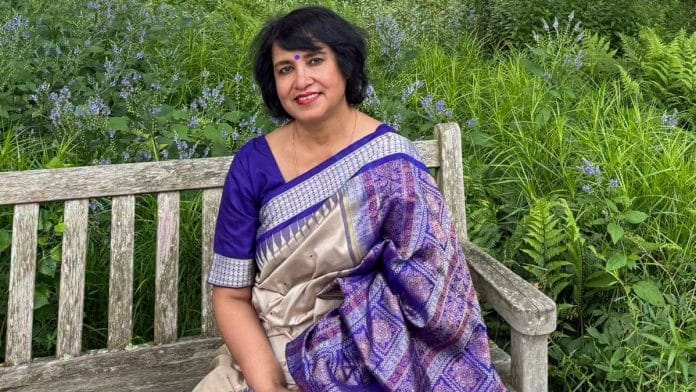


Bangladeshi author Taslima Nasrin is no stranger to controversies, threats to her life, and wading into newsrooms for the wrong reasons. This time, the stir is over her decision to attend a meeting against fundamentalism at Rabindra Sadan in Kolkata, the city she had to leave following violent protests over her views on some of the archaic, fundamentalist social customs in Islam.
Chief Minister Suvendu Adhikari is expected to attend the 1 August event, which is reportedly being jointly organised by three organisations — Secular Mission, Paschim Banger Pokkhe, and the Human Rights Bangla Book Fair Forum (HRBFF). Calcutta High Court lawyer Osman Mullick, a senior office-bearer of Secular Mission, has stated that Taslima Nasrin is finally coming to Kolkata, “defeating all reactionary forces”.
Though the event is being organised by non-government organisations, Adhikari’s likely attendance, possibly accompanied by some of his cabinet colleagues, sends several signals within the state and beyond, especially to neighbouring Bangladesh.
Through his presence, the Chief Minister will reiterate his party’s commitment to opposing fundamentalism in all its forms. Several Left Front and Trinamool Congress leaders were opposed to Taslima Nasrin. However, during the violent protests against her in 2007, Suvendu Adhikari was himself leading the agitation against the then Left Front government’s plan to acquire 10,000 acres of land in Nandigram for a Special Economic Zone.
It’s worth noting that Taslima Nasrin’s critiques have not been limited to her own community. Though her writings have focused particularly on socially obscurantist customs among Muslims, as a staunch secular humanist and feminist she has consistently written and spoken against fundamentalism, patriarchy, and obscurantism across all religions. She has also been a vocal critic of Hindu social ills and religious intolerance.
It will be interesting to see how predominantly Hindu voters view her return, given her criticism of what she has described as “patriarchal festivals” such as Bhai Dooj and Jamai Shasthi. Such criticism has drawn significant ire and has been viewed by many as an unwarranted overreach, especially given her religious background.
Nevertheless, the event will accord the BJP in West Bengal a chance to showcase its “secular” stance that Hindu unity is not directed against Indian Muslims, but that the party is opposed to infiltrators from Bangladesh.
Also Read: Who is an Indian citizen? The onus is on govt to deliver a reliable, transparent NRC
A series of exiles
The August event against fundamentalism in Kolkata will be watched keenly in Bangladesh. Taslima Nasrin was forced to leave Bangladesh in 1994 after facing escalating threats to her life as a result of her writings on women’s rights, religious fundamentalism, and secularism, as well as the publication of her novel Lajja in 1993. The international bestseller illustrated the devastating impact of attacks and violence against Hindus in Bangladesh by Islamic fundamentalists following the demolition of the disputed structure in Ayodhya in 1992.
Nasrin’s essays criticising patriarchy and religious extremism and her comments were also seen as blasphemous by the Islamic clergy and religious and political leaders.
In 1994, several Islamist organisations called for her arrest and execution. The threats became so serious that her personal safety could no longer be assured. Bowing to pressure from radical Islamic groups, the Khaleda Zia government charged her under laws relating to offending religious sentiments. After being granted bail, she left Bangladesh for Sweden, where she was granted refuge.
In 1998, Nasrin returned to Dhaka with her mother, who had been undergoing cancer treatment in New York and had been given only a few months to live. Once again, she was hounded out by radical Islamists who reportedly pressured then Prime Minister Sheikh Hasina, demanding her arrest and execution.
Ironically, Sheikh Hasina too had to flee to India after a mass uprising in which Islamist groups played a prominent role. She also faced demands for her arrest and execution. The present Prime Minister, Tarique Rahman, who returned to Bangladesh after 17 years in exile, should know the pain of being driven out of one’s country.
For Nasrin, Kolkata was no safe haven either. Her 2003 memoir Dwikhandito was banned by the Left Front government for hurting the religious sentiments of Muslims. The ban was struck down in 2005, but violent protests over the book led to a deterioration in the law and order situation in Kolkata in 2007, forcing the state government to deploy the Army. Nasrin had to leave.
Even after the Trinamool Congress came to power, several attempts to facilitate her return, hold lectures, and organise events have been unsuccessful, citing security concerns.
Also Read: Why foreign universities alone won’t fix India’s higher education crisis
Potential for a ghar wapsi?
This time around, the BJP government needs to tighten security and frustrate every attempt to create mayhem and violence.
Bangladesh could take a cue from this.
Taslima Nasrin’s “Kolkata wapsi” can become “ghar wapsi” if the dispensation in Dhaka is prepared to accept reality and rein in radical Islamic elements. If this were to happen, there could also be a political role, albeit a limited one, for the Awami League in re-establishing freedom of expression, democracy, and the rule of law in Bangladesh.
On her part, Taslima Nasrin too has to appreciate that freedom of thought and expression has limitations.
Criticism of archaic and obscurantist socio-religious traditions and customs, an emphasis on tolerance and secular values, and deradicalisation are noble ideas that need to percolate through a larger segment of society. But coming from an atheist, considered an outsider and heretic by the very people she is trying to reform, words of wisdom fall on deaf ears. Several social reformers over the past century and more have experienced the futility of trying to reform society from the outside.
Seshadri Chari is the former editor of ‘Organiser’. He tweets @seshadrichari. Views are personal.
(Edited by Asavari Singh)