






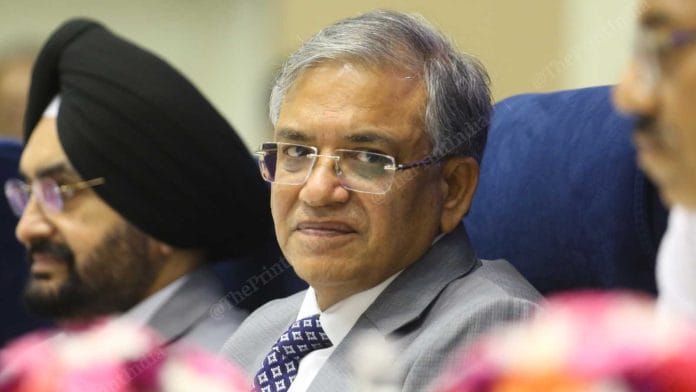



The increasing clamour over the Chief Election Commissioner made me wonder: Do shame and politics go together? And more generally: Have we become a country that has lost a sense of propriety? One where people in powerful constitutional posts no longer bother whether they are seen as neutral?
Let’s start with the Chief Election Commissioner. Till 2023, the Chief Election Commissioner was appointed by a three-person committee consisting of the Prime Minister, the Chief Justice of India and the Leader of the Opposition. The government then passed an Act which changed the process of appointment, removing the Chief Justice from the selection committee and replacing him with a cabinet minister.
The controversial move was challenged in the Supreme Court. Last week, the Chief Justice recused himself from hearing the case and said another bench would hear it. So the matter continues.
Till then, the Election Commission is headed by Gyanesh Kumar, a former civil servant who came to public attention when he worked to establish the Ram Janmabhoomi Trust in the Home Ministry.
When Kumar was appointed as CEC, Rahul Gandhi, the Leader of the Opposition, submitted a dissent note. But as the government had two of the three places on the committee, the appointment went ahead anyway.
Just because a civil servant worked under Amit Shah in the Home Ministry, we shouldn’t take the line that he leans a certain way. He should be allowed to demonstrate that he is fair and impartial.
But whatever you think of Gyanesh Kumar’s performance in office, it is clear that he feels under no obligation to demonstrate his fairness. He does not believe that the circumstances of his appointment—with the law changed so that the government’s nominee can be appointed—make it incumbent on him to show the nation that he acts in the interests of Indian democracy and is nobody’s stooge.
The Opposition has lost all confidence in his fairness. And rather than seeking to win back its confidence, Kumar has been needlessly combative. The Election Commission’s revision of the electoral rolls has been treated as a partisan act. His enthusiasm for removing key officials in Opposition-ruled states such as Bengal to replace them with people of his choice has also evoked protests.
His behaviour has been so controversial that even former members of the Election Commission have been critical of his actions and his failure to win the faith of the Opposition. Democracy cannot function if the man who runs the elections is seen as biased.
Also read: CEC Gyanesh Kumar isn’t interested in convincing the people of India
Democracy above reputation
There are situations where a man who has spent his life in government service will say something like: I know that I have acted fairly, but I also know that the controversy surrounding my actions casts a shadow over the whole democratic process. So, I am going to step aside. The sanctity of elections in the world’s largest democracy must come before my own career prospects.
If Kumar had said that as the controversies mounted, he would have been remembered as a high-minded figure. One who put Indian democracy above his reputation.
But obviously, he doesn’t care about his legacy or what history will say about him. He is fixated on continuing to do what he is doing.
What we have now is a farcical situation where the Election Commission risks becoming perceived as a partisan body or even a figure of fun. This was neatly summed up by an incident earlier this week when a statement issued by the Commission carried the BJP’s official stamp instead of the Commission’s own. The BJP’s online army was quick to call the document a forgery. But, of course, it was entirely authentic as the Commission itself admitted. The stamp, it said, had been a ‘clerical error.’
So, not a Freudian slip then?
Also read: CEC Gyanesh Kumar is a constitutional failure. Damage is not procedural, it is existential
An old trend
Though it was the Election Commission’s controversies that got me thinking, the truth is that hardly anyone in a position of authority in India acts out of shame or a desire to respect propriety.
It’s easy to focus on the BJP, but the rot began in Indira Gandhi’s time when talk of ‘a committed bureaucracy’ began.
We don’t talk about it any longer because it is now a fact. In nearly every state government, Chief Ministers will only promote civil servants and police officers whose loyalty to their political masters is greater than their loyalty to the country.
Indira Gandhi began to look for committed judges, too. There were whispers in Delhi about senior judges who were so loyal to her that they threw parties on her birthday. It’s believed that many of these judges were promoted, and many outstanding judges (like HR Khanna, for instance) were passed over.
There are many weaknesses with the Collegium system we have today, but it is far better than what was before. Nevertheless, the bargaining implicit in the Collegium appointments system (the government will accept three recommendations only if it gets one of its own people through) means that some judges are still seen as easy on the government. So when cases are assigned to them, you know which way they will rule even before the arguments begin. This is regarded as normal. None of these judges seems to care how they are perceived. Fortunately, they are the exceptions, and the judiciary is the one institution that Indians still have faith in.
Other institutions have not fared as well. Indira Gandhi began the tradition of using Governors as the centre’s agents in Opposition-ruled states. Today, the process has reached such heights that some governors are happy to be regarded as partial to Delhi.
And as for shame, the less said the better. There was a time when ministers felt obliged to resign on grounds of propriety. The days when Lal Bahadur Shastri resigned as Railway Minister after a train accident are long past. The tradition survived till the 1990s when P Chidambaram and Madhavrao Scindia resigned, claiming moral responsibility. Now, such examples are hard to find. Most ministers who resigned in the Manmohan Singh era were pushed to do so, and hardly anyone resigns from the Modi cabinet.
So why blame the Chief Election Commissioner alone? We are looking at an entire system where propriety and values have either been forgotten or have just gone to hell.
(Edited by Theres Sudeep)