






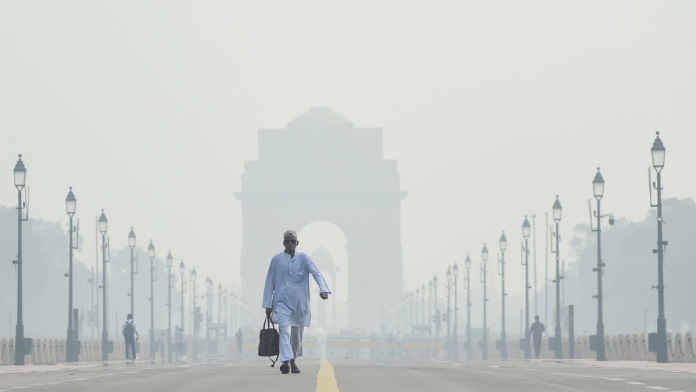



Do you ever feel that, as a middle-class Indian, you have lost control of your life? That now, more than ever, you are at the mercy of circumstances completely beyond your control? And that, though you are paying more taxes than ever before, you are getting less and less from the government? Even your health and safety are at risk.
It’s certainly beginning to feel that way for me. Rarely have I felt more like a cork helplessly bobbing along in a flood of dirty water with no direction home.
It starts with the air. I travel a fair amount, and there was a time when I would long to return to Delhi. Especially in the winter, I would long for Delhi’s blooming flowers, tree-lined roads, and that slight cold nip in the air.
No longer.
I know I am back in Delhi the moment my eyes start burning and my throat feels like it is being sandpapered. My wife, who has asthma, struggles to breathe and sleep at night.
Also read: BJP to middle class: Was nice to have your support at the beginning. Now we don’t need you
‘There is no solution’
We know what the problem is. I have lived in Delhi for over three decades now, and I have watched horrified as more and more poison has been released into the air. Delhi is now the world’s most polluted city, and the smog blanket is a health hazard.
The city’s ever-increasing levels of pollution are due to many things—geographical location and wind factors, for instance. But there is a myth we have been fed: there is no solution. Everything has been tried and nothing seems to work, goes the narrative.
It suits politicians to feed us this lie, but the truth is that nearly every other city in our situation has actually found solutions. The best example is China, where the air in the cities was as bad as ours—until the government began cleaning it up.
Nor are these solutions hard to find. A couple of weeks ago, Amitabh Dubey offered some ways out in his column for ThePrint. Others have also offered sensible suggestions. But none of these will ever be implemented, even though the BJP now runs the central and state governments as well as the municipalities.
There is no political will to fight pollution. Instead, there is a desire to undermine the measures that already exist. GRAP quickly turns into CRAP, air pollution figures are fudged, and citizens are told that, because there is no solution, we must just live with toxic levels of pollution.
Some of this comes down to stupidity: AQI levels in Delhi are three or four times the IQ levels of the Delhi cabinet members. But venality is also involved. Pollution control measures will hurt contractors, builders, transporters, and people who run polluting industrial units. It is far easier for politicians to tell us that nothing can be done while keeping the gravy train running.
Also read: Indigo crisis is a management failure. Don’t blame the pilots
IndiGo crisis
You could, of course, try to escape Delhi. But that brings its own problems. For several days now, IndiGo, India’s largest airline, has been paralysed. It’s hard to get a flight out of Delhi.
The government will have told you how evil IndiGo is and how irresponsibly it has behaved. But it’s a little more complicated than that. The basic problem is that when the flight duty norms for pilots changed, it became clear that all airlines would have to hire more pilots to fly the same number of planes.
Most airlines duly hired new pilots. But IndiGo did not. This could hardly have passed unnoticed. When the country’s largest airline (IndiGo is bigger than all the others put together) is not hiring enough pilots, people talk and wonder what’s going on.
The regulators at the Ministry of Civil Aviation (MoCA) must have noticed. But they did nothing. So when the duty norms changed, IndiGo found that it did not have enough pilots, and chaos ensued.
The ministry is now trying to recover its besmirched image by calling IndiGo names. But, of course, it won’t do the one thing that would help the affected passengers: ask IndiGo to pay compensation to all those whose flights were suddenly cancelled. Besides, not one of the regulators who allowed this to happen has been sacked.
The IndiGo crisis, where regulators looked the other way, is symbolic of the Indian way. For over a decade now, almost everyone I know who follows the situation in Goa has been warning that corruption has reached such levels that you can do anything illegal if you pay off the right people. No regulation is ever honestly enforced, and the tourist season is an accident waiting to happen.
Also read: Why Modi’s supporters fear ‘proud Hindu’ MK Gandhi and venerate his murderer Godse
Was it always like this?
Last week, a fire at a sleazy nightclub killed over 20 people. Fire regulations had not been followed, and there were not enough routes for those caught in the blaze to escape.
There is some talk of extraditing the owners of the nightclub from Thailand, where they fled. But no government official has been arrested. They will live to be bribed another day.
When each day brings more and more news of this nature, I sometimes wonder: was it always like this? Was our system so lax that politicians could sit back and watch citizens being poisoned, stranded, or burned alive? And did they always get away with it?
Perhaps I am romanticising the past, but my sense is that things have never been as bad as they are today. We have always been at the mercy of corrupt politicians, but they have never been as brazen as they are now. The issue is not one of party politics. In 2014, we voted out the UPA. But every single instance quoted above is the responsibility of the NDA.
Mostly, it is our fault. We are now a society that debates the national song for 10 hours in Parliament rather than the real issues facing India.
Why do the politicians do this? Because we let them. We will moan. We will groan. But when we go to the polling booths, none of this will matter.
And we will get the governments we deserve.
Vir Sanghvi is a print and television journalist and talk show host. He tweets @virsanghvi. Views are personal.
(Edited by Prasanna Bachchhav)
At least one or two senior journalists like Mr Sanghvi take the risk of speaking the truth. 10- 15 years ago this was very natural, but, today this article stands out…
Things were always bad.
Illegal colonies have always been regularised.
Public infrastructure development was always ridiculed and distributing freebies was glorified.
And you are talking only about Dlegi were BJP is ruling. You have no words for Bengaluru which is being destroyed under Congress.
Well said Vir.
Where does this government come from?
It comes from the Indian people, who are a product of an education system that provides degrees but doesn’t educate.
From a society that is more interested in flexing some caste lineage than looking past caste. From men who cannot stomach the idea of a woman having any agency. From a media that would rather mislead than inform. From the Indian uncle generation who should know better but don’t.
From citizens who hate someone they don’t know and take “pride” in something they had no part in.
It is high time we admit the naked truth to ourselves: This is the best we can do. Garbage in. Garbage out.
Where was Vir when Rajiv Gandhi supported the killing of Sikhs with his bada ped (sick) analogy? Where was he when Sikhs were burnt alive in 1984 riots? Where was he when so many were killed in riots or bomb blasts?
I used to think highly of Vir, now equate him with Raghuram Rajan – a Pappu sidekick
Why do you always complain about India? We got it, it’s a shithole. If Rahul Gandhi takes over, it would become a paradise. Happy?!
Imagine there is a guy who says “things were so good before 2014, everything was so great, people had all the basic facilities”
Now I agree that you should blame the indigo debacle and the Goa debacle on the government. The pollution is something which is more nuanced than you actually think. I am pretty sure you have read the IIT paper on Delhi’s pollution ? Only 30% of source is within Delhi and everything else lies outside of Delhi which you failed to mention and I wonder why ? Did you write these articles when AAP was in power ? Maybe you did. The failure to understand the core problem and calling geography as a “myth” shows how ideologically brainwashed you are.
Anyone who says that before 2014 there was less corruption is just gaslighting his audience. You only need to speak to a businessman to understand the ground realities. Obviously why would you ?
Before 2014, did you forget about the major corruption scandals in the UPA era ? Ohh I guess you had amnesia so you forgot about it. Did you forget about the Maoist’s insurgency which covered 35% of the country ? Maybe we should blame the serious amnesia ? Did you forget that every other month there was some terror related incident and how the UPA failed to take any action against it ? Before 2014, we couldn’t defend our country from such major problems that you think that we would focus on small scale corruption ?
Also did you forget to mention how every dirty bureaucrat was taking cuts in the welfare scheme and it was the modi government which solved it by digitalization of the system. It’s amnesia right ?
I have read all your articles and it’s fair to say that you, Mr Vir sanghvi are a Congress shill. Nothing wrong with it but people should know.
If you want Congress to be a serious contender, maybe you should write 5 op-Ed’s about how bad Rahul gandhi is for congress and how he undermines the democracy which is he supposed to protect. Maybe you should write how his obsession with caste will eat away the country. Maybe you should talk about his economic policies? Never mind they don’t exist. Rahul gandhi says “factories will take away your job”. He also said “we should bring private sector reservation”.
Are you smart enough to understand the consequences of what he proposes? You are complaining about corruption, have you thought maybe there won’t be a country to even complain about corruption ? If Rahul gandhi comes to power, we will only be talking about how our economy has fallen, companies have left and more terrorism mixed with more appeasement. Yes we will have no discussion on corruption under Congress because that would be considered small.
I urge people to read all his articles so you can corroborate what I am saying.
So Vir Sanghvi thinks that there was less corruption before this. What do you think these reforms do which were only passed during the Modi government’s era ?
Also do you know where the pollution in Delhi comes from ? Have you actually read the IIT study done in 2019 or 2018 ? 70% of the source lies outside of Delhi and then there is the geography.
Indigo crisis should be blamed at the government. My only problem with you is somehow you think that Congress is going to get rid of bureaucratic corruption ? Really ?
It seems like you forget what Rahul gandhi is ? Or you think there is some other national party ?
Good for all you sanghis – you elected a murderer, now its your turn to be killed by him.