





The English spy’s home was guarded by an army of Abyssinian baboons; the king had gifted him a teenage sex-slave; he once rode a donkey hundreds of kilometres along Saudi Arabia’s southern frontier to Al-Lith, where the king’s Rolls-Royce was waiting. To friends at London’s Athenaeum Club, he was ‘Jack’; hangers-on at the Saudi court knew him as Sheikh Abdullah. Like every genuine narcissist, he professed many loves—imperialism, socialism, fascism, Islam, a long string of women—but nothing survived his tepid self-absorption for long. As he lay dying in a hospital bed in Beirut, Harry St John Bridger Philby received his final revelation: “God, I’m bored.”
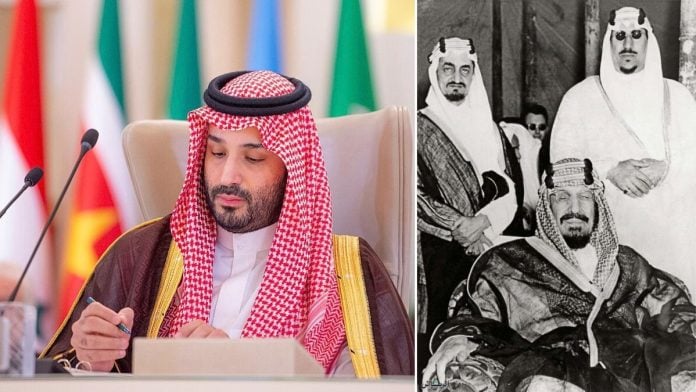
Life has handed Saudi crown prince Mohammed bin Salman—widely known by his initials, MbS—a cruel education this past week. As Yemen’s Ansarullah insurgents seized the mountains overlooking the mouth of the Red Sea, the crown prince’s desperate pleas for help were ignored by US President Donald Trump. Facing intense pressure to end the war with Iran from his own party, Trump picked safe passage for American shipping over MbS’s pleas.
Flattered by influence-peddlers, investment bankers, and management consultants, MbS believed glory was in reach. Following a 10-year war in Yemen, he pushed for regime change in Iran, and demanded obedience from small states in the region. The crown prince had believed conference-room babble on a multipolar world, imagining the kingdom’s wealth would compel the great powers to court it.
“He didn’t think he’d be kissing my ass,” Trump joked.
Ensconced in the king’s innermost council nearly a century earlier, Philby had stoked King Abdulaziz Ibn Saud’s fantasies of using oil to build an empire, the same dream that seized MbS. In May 1939, when he visited the oilfields in Dammam, the king teased a British diplomat: “Ya ibni [O, my son], that should all have been yours.” Six years later, when Abdulaziz met with President Franklin Delano Roosevelt, he accepted an unwritten agreement that traded Saudi oil for American security. Even though their defence budgets would come to dwarf those of all other regional states, Saudi rulers were willing to exchange the shackles of British imperialism for American chains—because all the other choices were worse.
All the Khatun’s kings
Fear was closing in through the darkness, the camel-drivers whispered, as if it was a living thing. The body of the bandit shot dead the previous night lay on the sand under the moonlight. The empty tents flapped in the wind, their residents having fled before vengeance arrived. Tears threatened to overwhelm Gertrude Bell, rising from “weariness and delusion as much as horror”. Forty-five years old, Bell had set out through the desert in December 1913, travelling by camel from Damascus to the citadel of Ha’il. “The place smells of blood,” she wrote, “murder is like the spilling of milk.”
Educated at Lady Margaret Hall at Oxford, Bell graduated in 1888 with first-class honours in modern history—although the university declined to recognise women’s degrees for three more decades. Lieutenant-Colonel Percy Cox encouraged the expedition, believing Bell’s skills would let her map the shifting allegiances of the Ha’il emirate.
Fratricidal violence had hollowed out the dynasty of Al-Rasheed, Bell reported, handing power to the Emir’s paranoid grandmother, Fatima, her scheming eunuch-in-chief and a gaggle of teenage royals. Even though Ha’il was loyal to the Ottoman Empire, its implosion was a matter of time.
Following the mission, Bell was recruited to the Arab Bureau, the tiny military intelligence unit which supported Lieutenant-Colonel TE Lawrence’s covert war against the Ottoman Empire in 1916-1918. The warm glow over victory did not last long. Tribes infuriated with being forced to pay for the occupation of their country revolted against the British military in Iraq. The rebellion was put down brutally, with Royal Air Force pilots massacring civilians, burning crops, and shooting up livestock. London realised it needed a native mask for imperial rule.
Like her colleagues, Bell believed the desert emirs constituted the authentic core of Arab identity—not educated urban nationalists. Faisal ibn Husein, the charismatic prince who fought with Lawrence, was installed as Iraq’s monarch. The Khatun educated Faisal (who was a stranger to Iraq) on local politics, ran his secret services, and exiled his critics to the far corners of the empire. Giving Iraq’s Shi’a majority a share of power, she believed, would open the door to theocracy. Bell refused to wear a veil to meet with the clerics of Najaf, ensuring no negotiations took place on the issue.
There was one unexpected problem: Even as the Khatun of Baghdad busied stamping out Iraqi nationalism, the English spy was encouraging it.
Also read: India has aligned with ‘middle powers’ in P4M—the label doesn’t quite fit
An embittered imperialist
Five hundred Egyptian cigarettes, 300 cheroots, 1,000 rifles, gold and silver watches: The English spy had travelled into Arabia armed to seduce. Together with a small group of colleagues who knew Arabic, the Indian Civil Service officer had been despatched from Punjab to the Middle East in 1915. The mission was simple: The Emir of the Nejd had to be bribed to cooperate with Britain’s aim of blocking Ottoman shipping and rail routes to Arabia. Abdulaziz would receive £542,000 in imperial payouts between 1917 and 1923. Rival rulers in Kuwait, Bahrain, Iraq, and Transjordan received smaller sums; the Hejaz received more, since it was raising irregular troops for Lawrence.
Even though the First World War ended before Philby’s plans for Abdulaziz could be put into effect, he had a second shot at greatness. In 1920, he was recruited to serve in Iraq. This time, he ended up at war with his superiors, assailing the rigged referendum Bell was organising to install Faisal as king. Evicted from Baghdad for his insubordination, Philby was stationed in Amman. Two years later, though, he was forced out of the civil service amid claims that he had leaked intelligence to Abdulaziz.
The Khatun wrote to her father in the summer of 1921: “I’ll never engage in creating kings again; it’s too great a strain.” But Philby was far from done.
Leaving home one morning in 1930, dressed for a hunting trip, Philby secretly changed into a pilgrim’s white robes in a tent outside Mecca and embraced Islam. Then, he joined the king’s private Majlis, recorded GC Hope-Gill, the British chargé d’affaires. The conversation in this élite council, Hope-Gill noted, “generally seems to end up with women.” Later, Philby published a more detailed account: “The king then confessed to having married no fewer than 135 virgins, to say nothing of about a hundred others.”
Even though polygamy was common, many were befuddled by the sheer excess.
Abdulaziz was, by this time, a king—though he would only rename his realm the Kingdom of Saudi Arabia in 1932. Türkiye had abolished the caliphate in 1924, and King Husein had eagerly stepped up to take his place. The Emir of Nejd mobilised for war. The cash-strapped British, who had ended their subsidies to both rulers in 1923, were uninterested in the outcome. Three months after the fighting began, the Ikhwan overran Mecca.
Also read: Bangladesh’s love affair with Jinnah is ending. It can help revive Sheikh Mujib’s legacy
Friends and enemies
Lines began to be redrawn in blood, though, when the Ikhwan sought to seize more territory. Five thousand Ikhwan who attacked Transjordan in 1924 were targeted by the RAF, which killed hundreds and left a trail of bloated bodies all the way back to the Hejaz. The Ikhwan’s raids into Iraq, targeting border fortifications, provoked RAF strikes deep into Saudi territory. From 1927 to 1929, King Abdulaziz was forced to fight the Ikhwan—and blamed the British for imposing a dangerous war on him. The English spy had been pushing Abdulaziz to break with England since 1922, and the king was now willing to listen.
In 1933, Saudi Arabia granted an oil exploration contract to the American company SoCal, rejecting offers from a British-owned rival. The next year, Abdulaziz went to war in Yemen before becoming bogged down in the north. In 1936, Philby would stage a provocative incursion into British-ruled Aden, with an armed Saudi escort. In 1939, Abdulaziz enlarged the American concession; the gargantuan find at Abqaiq followed a year later.
Philby likely also drove the Saudi decision to begin engaging with the Axis powers. Khalid al-Gargani, the king’s envoy, met Adolf Hitler in 1939. Earlier, the king had agreed to supply sheep and camels to Fascist Italy’s army in Ethiopia.
Six weeks before Nazi troops invaded Poland, Philby—unsuccessfully—fought a by-election as a candidate of the pro-fascist British People’s Party. He began proclaiming Nazi victory was imminent, and planned a lecture tour of India and America.
King Abdulaziz realised his friend had gone too far, and quietly suggested Philby be “treated as a mental patient”. The English spy was arrested in Karachi in August 1940, and then deported. King Abdulaziz would hammer out an agreement with Roosevelt in 1945. This time, Philby was not present.
For the most part, Philby’s embrace of Islam and fascism was forgiven. The English spy would pass away before his first-born son Kim, head of the Secret Intelligence Service’s anti-Soviet division, was revealed to be a double agent who had sent dozens of Cold War operatives to their deaths.
Abdulaziz’s successors were pragmatists. King Saud bin Abdulaziz Al-Saud led his kingdom into the Non-Aligned Movement in 1961, but also gave the US rights to operate the sprawling military base at Dahran. Faisal Al-Saud, his younger brother and successor, committed a brigade to fight Israel in 1973, but ensured it arrived only after the fighting was over. Fearing coups and foreign plots, Saudi rulers kept their military divided and weak—and let America guard the kingdom’s gates. MbS discarded that caution.
Like all great storytellers, the English spy made glory seem just a short walk away, Abdulaziz might have told his grandson—but there was a vast chasm to be crossed first, stretching down to the bowels of perdition.
Praveen Swami is a Contributing Editor at ThePrint. His X handle is @praveenswami. Views are personal.
(Edited by Prasanna Bachchhav)