





The raging fire had reached the gate of the ammunition store, brushing aside the soldiers trying to fight it and sweeping past Zamzama, the great siege gun that its admirers believed had the power to destroy the greatest fortifications of the celestial world. The residents of Mukerian braced for an inevitable, devastating explosion. Then the flames suddenly whimpered and died.
The miracle of 1793, as it was hailed, revealed a secret. The secluded room above the Barudkhana was protected by the sacred relics it contained: The Prophet Muhammad’s turban and cloak, his leather shoes and wooden rod; a prayer-mat owned by his daughter, Fatima al-Zahra; a blood-stained handkerchief that had been with her husband, the Imam ‘Ali, at his martyrdom.
For weeks, Kashmir has been roiled by an angry debate over proposals for clerics to deliver uniformly themed sermons at Friday congregational prayers. Darakshan Andrabi, chair of the union territory’s Waqf Board, which controls around 100 mosques, says such sermons, or khutbas, would help combat evils such as drug addiction and promote Islah, or moral improvement. Critics of the BJP politician argue that she is enabling state control over the practice of Islam.
The debate has deep roots in Kashmir’s popular religious imagination—and threatens to rekindle the faith wars that erupted in 2008, pitting a new generation of Islamists against establishment political parties and the Indian state. For Kashmir’s religious right, the annexation of the province by Maharaja Ranjit Singh’s Khalsa Sarkar in 1819 marked the beginning of an existential war between Kashmiri Islam and infidel rulers.
The story of the fire at the fort of Mai Sada Kaur shows how paranoia and deep hurt came to shape Kashmir’s relationship with the wider Indian milieu—and why that outcome was not inevitable. After the fire at the Barudkhana, thousands of pilgrims travelled to Mukerian to hail Singh as guardian of the holy relics, builder of mosques and protector of Punjab’s Muslims (can I get a link to this?).
“God intended me to look at all religion with one eye; that is why he took away the light from the other,” Singh would tell visitors.
Faiths at war
Lieutenant Colonel Eliot Colvin, the Prime Minister of Kashmir, watched from his window as the radical politician Sheikh Muhammad Abdullah led prayers under the shade of a tree in the garden, demanding the reconstruction of a shrine he claimed had once stood there. Even though there was no remnant of that shrine visible, Abdullah declaimed he would light a lamp each night, and lead prayers on Friday.
There was, indeed, a mention in one 1893 manuscript that there had been a shrine somewhere in the laws, but the politician was not seeking with archaeological research: Faith was the language of Kashmir’s movement for freedom.
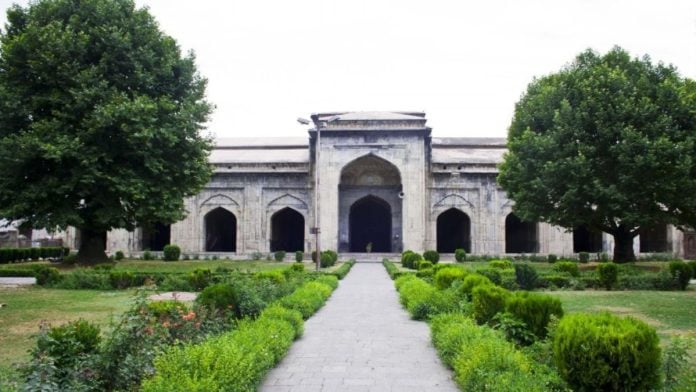
Ever since the turn of the last century, a new generation of educated Kashmiri Muslims—fed up with the institutionalised discrimination of the Dogra state, as well as brutal taxation—began using religion as a means of mass mobilisation. The Pather Masjid in Srinagar, the only one in Kashmir built with stone in the Mughal style, became the central motif of the struggle. For reasons that are not clear, the Pather Masjid ceased to be used as a mosque soon after it was commissioned in 1623. Later, the Pather Masjid was used as a stable and granary, with no evident protest.
Faced with similar religious disputes in Punjab, the Khalsa Sarkar had reacted decisively. In 1753, the Muslim feudal ruler Nawab Bhikari Khan had built a mosque near a well linked to the memory of Guru Arjun Singh. Akali Sikhs had later taken over the mosque and land around it. Following the capture of Lahore, Singh returned the mosque to the Muslims and arranged for its restoration. He offered prayers at Lahore’s Badshahi mosque and the Wazir Mosque, Mohamed Sheikh records, and built two more for his wives, Moran Sarkar and Gul Begum—who remained practising Muslims, enraging conservatives.
Even though Kashmir did become the Khalsa Sarkar’s second-most-productive province, the early damage could never be undone: Tired out by endless wars, his treasury drained by military competition with the East India Company, Ranjeet Singh had neither the resources nor energy to set things right.
Kashmir under the Khalsa Sarkar, historian Indu Banga has shown, drew on the system of Punjab’s Dharmarths, or state-run trusts, which gave grants, lands and tax exemptions to religious institutions of all faiths. Singh was careful to generously support Islam. The Dogra state, though, showered funding on Hindu causes and temples. A new class of educated Kashmiris, inevitably, responded by demanding equal rights to education, jobs and religious practice.
Then, in 1931, large-scale communal rioting broke out in Kashmir. An inquiry by colonial civil servant Bertrand Glancy recommended the setting up of a legislature, based on communal representation, as well as the return of mosques to Muslim control. Elections held in 1934—though with a severely restricted franchise—saw Sheikh Abdullah emerge as an influential leader. The Paather mosque itself was handed over to the magnate Khwaja Saad-ud-din Shawl, a conservative who counted both the Srinagar cleric Mirwaiz Yusuf Shah and the Maharajah as his friends.
Less than two years on, though, Shawl was forced to hand over the mosque to Sheikh Abdullah—a sign that mass politics would shape the future, not the divine rights of kings.
Also read: How Partition brought the Indian Air Force to Race Course in the heart of Delhi
Leashing the pious
Abdullah understood the political power of religion and maintained control over the mosques and their mullahs. Like other post-colonial politicians, he sought to create a religious space insulated from his political opponents inside Kashmir and in the wider region. Turkey’s Diyanet, established by Mustafa Kemal Atatürk in 1924, employs clerics and oversees the country’s Sunni mosques, with a budget exceeding $3.5 billion.
Egypt’s Ministry of Religious Endowments, the Wizarat al-Awqaf, has similar powers. The authorities in Saudi Arabia, Yemen and several states claiming to embody Islam’s principles have similar institutions; Liberal democracies, though, have generally walled off the state from religion.
Even if Abdullah’s impulse was understandable, his actions weren’t. Abdullah established the Idara Auqaf-i-Islamia to control the Paather Masjid. It remained under a private trust chaired by Kashmir’s first prime minister until his deposition in 1953; his successor, Bakshi Ghulam Mohammad, then took charge of the institution.
In 2003, legislation introduced by the Congress–People’s Democratic Party coalition government, as the National Conference’s long dominance waned, enabled the creation of the state-regulated Jammu and Kashmir Waqf Board. This brought practices in Kashmir largely into line with national models. After 2019, administration of the Waqf was brought under Union government law.
The BJP used its new powers to press its ideological message. Andrabi, infamously, installed a plaque bearing the Lions of Ashoka outside the shrine, a religious and cultural centre of the National Conference.
For both sides of Kashmir’s politics, this has been a largely cost-free enterprise. The National Conference and the People’s Democratic Party denounce the predatory designs of Hindu nationalism. The BJP, meanwhile, presents its actions to its own constituency as a commitment to discipline and the disempowerment of Islam.
India plainly needs a serious debate about how religious institutions should be regulated and what their relationship with the state ought to be. Kashmir’s political actors, however, are following a toxic script they know by heart—and one that has repeatedly ended in tragedy.
Praveen Swami is a Contributing Editor at ThePrint. His X handle is @praveenswami. Views are personal.
(Edited by Saptak Datta)