





The emerald-green damask canopy, its finial mounted with the kingdom’s silver orb-and-pyramid and swaddled in vermillion silk, shielded the midday sun from the Imam’s splendour. To kettle-drums and oboes, two hundred cavaliers marched through the citadel guarding Mokha, their mounts covered with jewels and black ostrich feathers. Then came Al-Mahdi Muhammad bin Ahmed, chosen by God to prepare the pious for the sounding of Israphil’s trumpet on the Day of Judgment. Each Friday, the elderly Imam dismounted from his white horse to deliver the sermon, light pouring off the jewelled jigha on his turban and waistcoat, bound with a “belt of a monstrous size, set thick with large silver plates.”
For hundreds of years, winds carrying coffee, spices and gold also carried foreign gods past the walls Islam had put up against the world. Travellers to Aden encountered the story of a great well dug from Ujjain to the Seraj mountain by a spirit in the form of a monkey, to rescue a princess from Hind kidnapped by the ten-headed djinn al-Ghazāl Darsīr.
The Banias of Kathiawar, bankers to the Indian Ocean trade, built temples alongside the city’s synagogues and celebrated Diwali. “They are the cleverest arithmeticians in the world,” the French adventurer Jean de la Roque—son of the first coffee-maker of Marseille—wrote after his voyages to Yemen in 1708–1713. “They cheat with a wonderful deal of skill.”
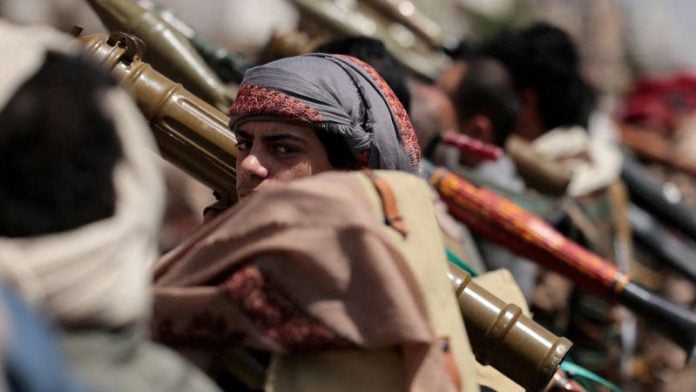
Last week, as the Ansar Allah insurgents seized Mokha and Perim, the world was reminded that wars along Yemen’s coast never quite ended. Drawn largely from the Zaydi clan federations that sustained the Imamate for almost a millennium, Ansar Allah has given Iran a new means to choke global trade. The Red Sea and Suez shipping routes carry 15% of world trade and just under a tenth of seaborne oil and gas traffic.
The war isn’t just about the power-struggle between Iran and the American-led axis of Israel, the United Arab Emirates and Saudi Arabia. Since the Imamate began to implode, Yemen’s leaders have struggled to craft a vision of statehood that its diverse peoples could share. Empires, regional powers and entrepreneurs have sought hegemony instead of accommodation—ensuring perpetual war.
Flying the banners of England, Portugal and Holland, warships appeared off Yemen’s ports in the eighteenth century. European competition helped destroy Mokha’s coffee monopoly, while the Imamate’s authority weakened. Local clans like the Yaf’i looted Mokha. Muhammad al-Shawkani blamed the crisis on the betrayal of shari’a by Imams who put wealth before Islam. His words helped prepare the ground for a rebellion by followers of Ibrahim al-Mahatwari, who believed him a sorcerer and the Mahdi of Shi’a prophecy.
Large numbers of Bāniyāns (Hindus/Jains) and Jews were massacred at Hajjah, ‘Affar and al-Ṣalabah before the Imam’s armies hunted down and executed the sorcerer [Ṣanʻāʼ: An Arabian Islamic city, edited by RB Serjeant and Ronald Lewcock (1983), page 434]. The war was never quite extinguished.
Two nations, many wars
The Big Turban, the American doctor Girard Foster called Ahmad bin Yahya Hamidaddin. Excess, bullet injuries and an endocrine disorder had ravaged the Imam’s body, and his mind had been hollowed by heroin. Faced with Arab nationalism, he joined Yemen to the United Arab States with Egypt and Syria. Yemen withdrew from the arrangement in 1961, earning Egypt’s ire, and he married the teenage daughter of a Zaydi chief threatening to pillage Ta’iz. Yahya was in no position to consummate the marriage. Even his harem of three dozen wives, concubines and slaves could not draw their corpulent master from the mattress that served as bed and throne.
A week after Big Turban died of a stroke in 1962, a coup forced the last Imam, his whisky-loving son Muhammad al-Badr, into exile. Few of his subjects, journalist Victoria Clark has written, mourned his end. There were no Yemeni doctors, universities or factories. The Imamate had just one asphalt road, built as a gift from the People’s Republic of China.
Faced with an Arab-nationalist regime linked to Gamal Abdel Nasser’s Egypt, Saudi Arabia financed royalist militias. The governments of Harold Macmillan and Alec Douglas-Home despatched mercenaries for sabotage and gun-running. France, Israel and America followed. The civil war was savage: the Egyptian Air Force attacked civilians in retaliation for assaults on its forces, sometimes using poison gas.
Egypt’s defeat in the Arab-Israeli war of 1967 led Nasser to withdraw from Yemen—and to Saudi Arabia becoming the principal patron of North Yemen’s political class. Elevated to lead North Yemen in 1978, after President Ahmad al-Ghashmi’s assassination, Ali Abdullah Saleh was typical of the political entrepreneurs. Little-educated and from a poor Zaydi peasant family, he purchased influence through control of Army liquor-smuggling rackets.
Ferocious fighting broke out in the British-ruled south as well. The East India Company seized Aden in 1839, claiming it was avenging the looting and rape of Hajj pilgrims from Kochi. After the Suez Canal opened in 1869, Aden became a critical base on the route to India. Britain sought a federation between Aden and surrounding emirates. Left-wing insurgents compelled Harold Wilson’s government to wind down its base and promise to withdraw by 1968.
The only socialist state in the Arab world fought an ever more brutal war with itself, each faction seeking absolute power.
Also read: Explainer-Who are the Houthis, Iran’s allies in Yemen?
Killing time
To run Yemen, President Saleh knew he needed Saudi Arabia’s support. Saudi funding of clan chieftains was critical to the political order, enabling Saleh to become patron of the powerful Hashid federation into which he had been born. Its chief, Abdullah al-Ahmar, later explained it thus: “Saleh is my President, but I’m his sheikh.” Three crises then exploded across the Arab world: the revolution in Iran, an Islamist effort to seize Mecca and the emerging jihad in Afghanistan.
From the early 1980s, the Saudis secured their southern flank by despatching neo-fundamentalist proselytisers into the Zaydi highlands. Salafist leader Sheikh Muqbil bin Hadi al-Wadi’i—himself of Zaydi origin—was an unembarrassed anti-Shi’a chauvinist, yet found support. For poorer Zaydis, such as Saleh, the real threat came from élite Sayyid families who had upheld the Imamate. Yemen’s Zaydi Shi’a and Shafe’i Sunnis pray in each other’s mosques and have few ritual markers of difference.
“Local converts from low-status families attracted by the anti-Sayyid thrust of the movement and Sunni Muslims from across the world,” the journalist Ginny Hill has recorded. “Volunteers formed a school militia to patrol the borders and protect the madrassa from their Zaydi neighbours.”
A second strain came from jihadists who had travelled to Afghanistan and fought with al-Qaeda. From 1988, large numbers of Yemeni jihadists returned home, some settling in camps north of Zinjibar. Brigadier Ali Muhsin al-Ahmar, Saleh’s relative and ally, was given charge of organising them into a fighting force. Bin Laden himself is reported to have delivered sermons, asking his men to prepare to liberate Saudi Arabia.
The collapse of the Soviet Union compelled the southern Marxists to ally with the north in 1990, but the alliance soon unravelled. With his new jihadist allies, Saleh gleefully went to war against the so-called infidel leadership in 1994. Leaders like the jihadist commander Tariq al-Fadhli led militia which bulldozed the shrines of saints. The militia of the Muslim Brotherhood-linked Islah party was reported to have attacked churches and vandalised a liquor warehouse holding $7 million in stock.
A reborn Imamate?
Less than a decade after becoming ruler of all Yemen, President Saleh’s power began to crumble. Leaders from Aden—often better educated than their counterparts elsewhere—began calling for independence. The events of 9/11 pushed Yemen’s government into a long conflict with al-Qaeda. The Houthis began their march to becoming the principal challenger to Yemen’s rotten state. Fear that Ansar Allah would entrench itself as an Iranian proxy led the Saudi monarchy to war in 2009. That war ended in stalemate; the Arab Spring of 2011 swept Saleh from power. Three years later, Ansar Allah took Sana’a; it would later execute Saleh and fight Saudi Arabia to a stalemate.
There are two paths forward. Like the Arab nationalists of the north, the Communists of the south and the Imamate before them, Ansar Allah could seize all Yemen—and then implode. Alternatively, it could reconcile itself to sharing sovereignty with other actors. Likely, Ansar Allah hopes its actions will yield recognition of its sovereignty through access to central revenues. That, however, would require America and regional powers like Saudi Arabia to accept that the pursuit of hegemony is a dangerous delusion.
Praveen Swami is Contributing Editor at ThePrint. His X handle is @praveenswami. Views are personal.
(Edited by Prashant Dixit)