






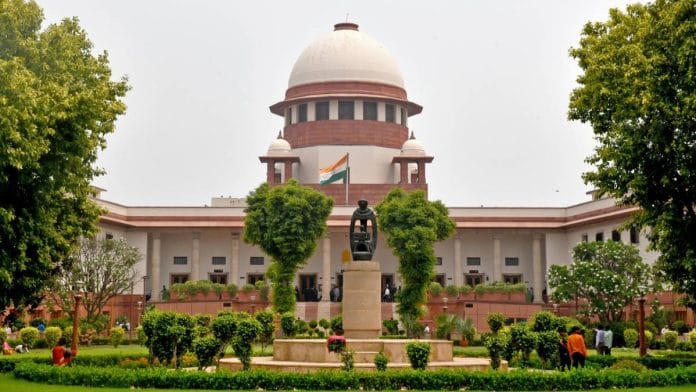



In a significant judgment, the Supreme Court recently clarified that if a Scheduled Caste person converts to a religion other than Hinduism, Sikhism or Buddhism, he or she immediately loses Scheduled Caste status.
The Apex court relied on the provisions laid down in the Constitution (Scheduled Castes) Order, 1950, which clarifies that any person who does not profess one of the religions specified under Clause 3 of the 1950 order ceases to be a member of a Scheduled Caste, regardless of birth.
Predictably, this stance has triggered outrage, especially among the “conversion mafia”, which sees the judgment as regressive. But read more carefully, the court’s approach marks a quiet but significant step in decolonising India’s caste policy architecture.
At the heart of the issue lies a simple but uncomfortable truth: India’s contemporary caste framework is not purely indigenous. It is deeply shaped by the classificatory logic of the recent colonial past, which transformed fluid, context-bound social identities into rigid, state-administered categories.
British Colonial censuses did not merely record caste, they froze it, standardised it, and permanently tied it to governance. Independent India inherited this mechanism and utilised it by a section of the Church with an ulterior motive.
Historical evaluation of society
Caste-based discrimination is probably practiced in a much greater degree by a large section of the Church, which vociferously propagates the idea of “Dalit Christians” as against a negligible minority of the clergy who feel marginalised for their saner views. Both Christianity and Islam lured a large section of the Dalit population with a promise that these two religions are egalitarian and do not recognise caste discrimination.
But ironically, the National Council of Churches in India (NCCI) reported that nearly 70 per cent of the Christian population in India are from the Scheduled Caste background. If a ‘Dalit Christian’ or a ‘Dalit Muslim’ continues to feel discriminated, what purpose did the conversion serve?
The classification of Hindus into castes and classes has its origin somewhere in the historical evolution of the society in the recent past. There is no scriptural sanctity to castes, nor classifies people as Dalits and untouchables mandated by the scriptures. Even the British officers who were instructed to highlight caste divisions agreed that there is no scriptural evidence to do so.
WR Cornish, who supervised census operations in the Madras Presidency in 1871, wrote that “… regarding the origin of caste we can place no reliance upon the statements made in the Hindu sacred writings. Whether there was ever a period in which the Hindus were composed of four classes is exceedingly doubtful”. Similarly, CF Magrath, leader and author of a monograph on the 1871 Bihar census, wrote, “That the now meaningless division into the four castes alleged to have been made by Manu should be put aside”.
Also read: Religion was not a consistent barrier for temple or mosque entry in India. It’s caste doing
‘Untouchables and Dalits emerged after Islamic atrocities’
According to a section of historians, Islamic invaders resorted to forcible conversion, and those who resisted were either mercilessly killed or banished to remain outside the area of their normal dwelling, forcing them to do scavenging and live away from the “converted elites” of the society. Gradually, these groups got organised and began life afresh in ghettos.
Like RSS chief Mohan Bhagwat had said, “It was only after the Islamic atrocities during the medieval times that the untouchables and Dalits emerged”. Historians, like H V Srinivas, S V Kamath and K M Panikkar, too, have written extensively on this issue. On their part, they highlighted the same issue during the British Raj.
Whatever be the origins of the caste system, it is undeniable that it was the collective fault of the Hindu society that it allowed a large section of its adherents to remain confined to a life more degraded than that of the animals. Questioning this abhorrent practice, BR Ambedkar had asked, “How is it that even the animals in our households can partake the water from the ponds which are denied to us, owners of those animals?”
But many of these obscurantist practices were consigned to the dustbin of history once the Constitution came into existence. Ambedkar, who piloted the Bills on reservation for the oppressed classes of society, had clearly indicated the need for such a Constitutional provision, but for a limited period. His firm belief was that equality of economic and political opportunities would bring the historically marginalised communities to the forefront of progress.
In fact, one of the pioneers of the movement to provide social dignity and justice to the so-called Dalits, Ambedkar, had himself mentioned this in many of his writings and speeches. “The outcaste is a by-product of the caste system. There will be outcastes as long as there are castes. Nothing can emancipate the outcaste except the destruction of the caste system. Nothing can help to save Hindus and ensure their survival in the coming struggle except the purging of the Hindu faith of this odious and vicious dogma,” he had said.
Also read: How the RSS dialogue on caste changed over 100 years. Sangh and its ‘samajik samrasta’
Caste and contemporary India
The despicable practice of untouchability and treating someone as belonging to a lower class appears to have crept into the Hindu society as a complex system of relegating people to an unalterable social status. According to some researchers, Hinduism—its Vedic and classic variants—did not support the caste system; it rigorously opposed it in practice and principle. Contemporary India is witnessing a phase where caste is increasingly becoming irrelevant.
There could be more indicators to substantiate the view that caste is becoming irrelevant, at least in urban India, if not in rural India, but four important developments suggest that this is evidently discernible.
The loathsome practice of caste-based separation of food and water outlets in rural areas is far and few and has totally vanished in urban and semi-urban clusters. The same goes for inter-caste (and even inter-religious) marriages, which were once considered taboo and highly prohibitive in a rigidly stratified polity.
Massive mobility due to economic compulsions and employment has rendered this “roti-beti” ban ineffective. The second aspect is the disappearance of discernible caste identity through dress code and caste surnames. The urban lifestyle has mandated a more practical dress code, obliterating traditional overt caste identities. The third aspect is that the compulsions of the job market have erased the caste-occupation linkages, which were an essential element in rural India.
Lastly, the evolution of a robust Panchayat Raj system has replaced the caste-based jury system, which could dispense punitive verdicts for violations of rigid caste codes.
The Supreme Court’s refusal to allow automatic transposition of caste benefits across religions must be seen against this backdrop. It has put a stamp of approval on Hindu society’s outright rejection of the colonial mechanism to treat caste as a portable label, continued by proselytising religions. By asserting that constitutional and affirmative entitlements anchored in the Constitutional provisions cannot automatically follow religious conversion, the Apex court has facilitated yet another much-needed step towards course correction and decolonisation.
Seshadri Chari is the former editor of ‘Organiser’. He tweets @seshadrichari. Views are personal.
(Edited by Saptak Datta)