







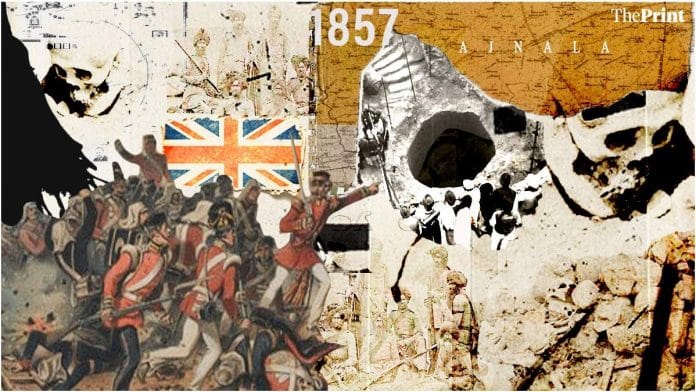


The uprising of 1857 remains one of the most contested and defining moments in Indian history. It has been described as a Sepoy Mutiny, a revolt, as well as the First War of Independence. In popular memory, Delhi appears through familiar images: sepoys marching towards Shahjahanabad, Bahadur Shah Zafar ensconced in the Red Fort, the siege on the Ridge and the British assault through Kashmiri Gate.
That memory, however, remains incomplete.
The rebellion did not unfold only inside forts, cantonments and imperial records. It moved through the villages around Delhi. It travelled through fields, grazing routes, village paths, kinship networks and local solidarities. The villages surrounding Shahjahanabad were not passive landscapes. They fed, sheltered, informed and, in some cases, directly joined the resistance.
To view the events of 1857 only through Old Delhi is to miss the rural geography that sustained it.
Delhi’s villages sustained the Mughal capital. Places such as Mehrauli, Najafgarh, Narela, Bawana, Ballabhgarh, Gurgaon, Sonipat, Ghaziabad, Chandrawal, Alipur, Palam, Raisina and Wazirabad fed Shahjahanabad labour, grains, caste networks, pastoral routes, land relations and everyday movement. Long before the modern National Capital Region existed, these settlements were already part of Delhi’s political and economic life.

Historian Nayanjot Lahiri’s study of Delhi and the uprising of 1857 is significant because it shows that it not only produced military battles, but also physically transformed the city and its surroundings through destruction, confiscation, demolition and later British attempts to create a landscape of their victory.
What was remembered
The British built a visible memory of conquest, while the memory of resistance remained largely unmarked, scattered and often carried orally.
That imbalance continues to matter. British graves, memorial tablets, siege batteries and monuments marked where their soldiers died and where their victory was secured. The people of Delhi and its villages, whose homes were destroyed, whose lands were confiscated and whose lives were overturned, rarely survived public memory. Their history survived differently: in oral accounts, family stories, village lore, shrines, place names and silences.
The villages surrounding Shahjahanabad were not mere witnesses to the uprising. Many became rural bases from where resistance moved in and out of the city. They acted as supply lines for grain, fodder, manpower and intelligence. They offered refuge to rebels, fleeing sepoys, messengers and sympathisers. Some paid a severe price for this association.
One of the clearest examples is Chandrawal village, whose older settlement was near the present-day Majnu ka Tila near Kashmiri Gate. Thomas Crowley’s 2020 book Fractured Forest, Quartzite City: A History of Delhi and Its Ridge on Delhi’s ecology and settlement history shows how British policies disrupted pastoral and agrarian communities around the city. Colonial officials often viewed pastoral groups, including Gujjars, as difficult to regulate and economically unproductive. These prejudices hardened after the rebellion, especially when communities were seen as politically unreliable.

Chandrawal is remembered for one of the most striking acts of rebellion in Delhi—the burning of Metcalfe House, associated with the British official Sir Thomas Metcalfe. The punishment that followed was severe. Lahiri in the essay “Commemorating and remembering 1857: The revolt in Delhi and its afterlife” notes that retribution after 1857 was not limited to Shahjahanabad. Agricultural land from as many as 33 villages in the Delhi district was confiscated, including Alipur, Chandrawal, Kotla Mubarakpur, Mehrauli, Indraprastha, Palam, Raisina and Wazirabad.
In Chandrawal, two-thirds of the village land was taken away. In Wazirpur and Alipur, more than half the village lands were confiscated. Much of this land was later rewarded to loyalists or bought by outsiders.

“चौपाल ग्राम चन्दावली”—इतिहास से
मातृ देश को आजाद कराने के लिए सन् 1857 के स्वतंत्रता आन्दोलन में
अंग्रेजी सरकार के दमन, कुर्बानियाँ एवं भारत माता को आजाद कराने
के लिये जानी–माली बलिदान करके अपना और अपने ग्राम चन्दावली का नाम
स्वर्णिम इतिहास में अमर अक्षरों में लिखवाने वाले चन्दावली के वीर
शहीदों व उनके वंशज स्वतंत्रता सेनानियों की यह ऐतिहासिक चौपाल है।
(This is the historic chaupal of the brave martyrs of Chandawali and their descendants, the freedom fighters, who took part in the freedom movement of 1857 to liberate their motherland.
They faced the repression of the British government, made sacrifices of life and property for the freedom of Bharat Mata, and wrote the name of themselves and their village Chandawali in golden letters in history.)
Chaupal, Village Chandawal—From history
This changes how 1857 is understood in Delhi. It was not only a battle over the Red Fort or the Ridge. It was also a struggle over land, loyalty, punishment and memory.
Also Read: 1857 rebels marched to Delhi with a plan—not a spontaneous ‘chalo maro’, says Sohail Hashmi
What happened next
The violent aftermath reshaped Delhi’s rural society. Villages that had aided rebels, sheltered them, or even been suspected of supporting them were marked as dangerous. Confiscation became both punishment and warning. Land was no longer only a source of revenue; it became a tool through which the colonial state disciplined communities.
Similar memories survive in south Delhi villages such as Fatehpur Beri, Asola, Dera, Tughlaqabad and Jasola, where Gujjar oral histories recall how resistance to colonial power was later used to brand communities as “disorderly” or “criminal.” Such memory is not always found in official documents, but it lived in the way elders narrated repression, defiance, the humiliation of colonial officers and small acts of local retaliation.
Libaspur, near Narela on the Delhi-Karnal route, offers another example of rural resistance. Oral accounts remember Udmi Ram, a young Jat from the village, who organised local men to intercept British movement through the area. Villagers used their knowledge of routes and terrain to turn ordinary rural paths into spaces of resistance.
When the British regained Delhi, Libaspur faced harsh retaliation. Udmi Ram and his companions resisted with rural weapons such as spears, axes and choppers before being overpowered. He is remembered locally as a martyr, even if formal memorial culture has not given him a comparable place.

Figures such as Seth Ramjidas Gurwala, who financed rebel activities, and Abdul Samad Khan, who fought at Badli-ki-Serai, also show how the rebellion drew strength from networks beyond the walled city. The revolt was not sustained by soldiers alone; it also depended on money, food, shelter, routes, courage and local trust.
Lahiri’s work also helps explain why rebel memory became so difficult to preserve materially. After the British recaptured Delhi, the city was treated almost as enemy territory. Raids were common across the city. Property was seized. Religious and civic spaces were altered. The Red Fort itself was transformed into a military headquarters, with many structures demolished or repurposed.
Even around the fort, buildings within a large security radius were cleared. Mosques were confiscated, closed, sold or converted to other uses. This was not punishment. It was a deliberate restructuring of space after conquest.
The same logic extended into the countryside. Villages were watched, classified, punished and reorganised. The British began to see rural Delhi not only as a revenue landscape but as a political landscape that could support rebellion. Suspicion became part of governance.
After 1857, the colonial state strengthened intermediary structures such as lambardars, zaildars, chaudharies and village headmen. These figures were tied more directly to colonial administration and made responsible for revenue collection, reporting dissent and maintaining order.
The system allowed the colonial state to insert itself into village society through selected local figures and lineages. It weakened collective village solidarity and brought rural authority more directly into the machinery of colonial rule.
Following the uprising, the British started to closely monitor movement between villages. Gatherings, routes, messages and rural mobility became matters of state concern. Boundaries were formalised. Records were tightened. Commons such as forests, ridges, grazing lands and shared resources increasingly came under regulation or restriction. The village was no longer seen simply as a settlement. It became a space to be monitored.
Also Read: On this day in 1857, how ‘punishment parade’ in Meerut lit spark of 1st war for Indian freedom
What remained of 1857
At the same time, two parallel histories of 1857 emerged.
The official British record described the uprising through the language of law and order, rebellion, punishment and imperial recovery. It carefully remembered British sacrifice and victory. Lahiri has shown how British memorials in Delhi created a visible landscape of heroism and conquest, while the physical traces of Indian resistance remained largely absent.
That absence was not accidental. A brutally defeated population could not easily build memorials to its own resistance. Its homes, mosques, civic institutions and village lands had already been subjected to punishment, confiscation or erasure.
Village memory, however, preserved another history.
It remembered who gave shelter, who fought, who betrayed, who was punished, where British camps stood, where rebels hid and where violence took place. This memory did not always become stone or an inscription. Sometimes it remained in stories. Sometimes it remained in fear. Sometimes it survived in silence.
Lahiri offers a powerful example of such silence: a missionary, soon after the revolt, asked students to write an essay on the Mutiny. They returned blank sheets. That refusal itself became a form of memory. It showed that the revolt remained present, but was not always speakable. Social remembrance, especially among the defeated, often leaves few physical traces.
This is why Delhi’s villages matter to the history of 1857. They hold the afterlife of the uprising in ways that official archives often miss. Post-Independence remembrance has not fully corrected this imbalance. Lahiri notes that the British Mutiny Memorial on the northern Ridge was reinterpreted in 1972 through new inscriptions honouring those who rose against colonial rule. But this remained a limited correction. There was still no full memorial to the rebels, no detailed naming of local participants and no sustained attempt to connect the revolt to the wider history of Delhi’s people and villages.
The local was absorbed into the national. Delhi’s revolt became part of India’s freedom story, but its own villages remained largely unnamed.
This remains relevant today.
Many villages of Delhi continue to be treated as peripheral spaces, useful for land, labour and expansion, but rarely recognised as historical actors. Their relationship with the state has been shaped by old patterns of suspicion, extraction and weak participation. The distance between governance and lived reality did not appear suddenly. It has roots in colonial systems of surveillance, classification, punishment and selective recognition.
To remember 1857 only through Delhi’s monuments is, therefore, to see only part of the story. The rebellion also lived in its villages, in the fields that supplied resistance, in the homes that sheltered rebels, in the roads that carried messages and in the communities that endured punishment after the guns fell silent.
The road to 1857 did not simply lead to Delhi. It ran through Delhi’s villages.
Dr Shreya Malik is an Assistant Professor of History at the Amity Institute of Social Sciences.
Puneet Singh Singhal is the Founder/Curator of Dilli Dehat Project, a community-led archive and storytelling initiative that documents the rural histories, cultures, and lived realities of Delhi’s villages.
Akshay Kumar runs the project Bhashakosh, documenting the regional languages, cultures and geographies of India. He is currently working at a regional OTT company as a Consumer Insights Associate.
Views are personal.
(Edited by Insha Jalil Waziri)