



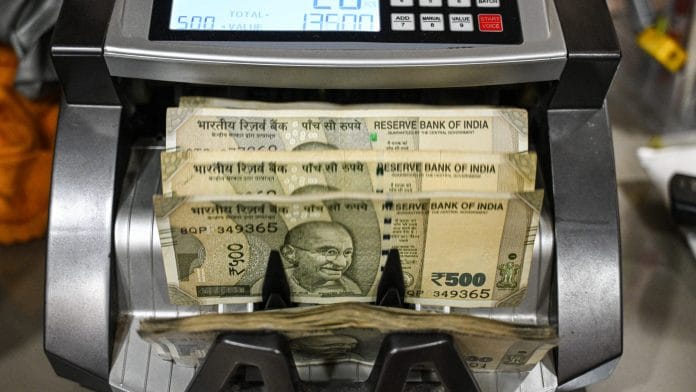
On 8 June, the Reserve Bank of India opened a swap window for fresh FCNR(B) deposits, foreign-currency deposits held by non-resident Indians with Indian banks. Banks could sell dollars to the RBI at the day’s reference rate, around Rs 96 per dollar, then buy them back at the same rate when the deposits matured in three to five years. The circular stated that the swap “will be undertaken at par”. The aim was to stabilise the rupee. By the time the window closed on 31 August, banks had raised $133 billion.
To return those dollars, the RBI will need to buy them back or hold on to what it already has. With the rupee back near Rs 94 and the pressure easing, two questions are worth asking. Was the window worth its cost, especially given that the RBI has since used a substantial part of the funds to defend the rupee? And should a decision involving such large sums have been taken without greater public scrutiny?
What it cost
A bank with a five-year dollar deposit has a five-year dollar liability. To cover it in the market, it buys dollars forward, which typically cost more than spot dollars. The premium for this tenor is around 3 per cent a year, according to market estimates.
The RBI, however, charged nothing. At 3 per cent, the estimated subsidy is worth about Rs 1.26 lakh crore in today’s money. Even at the 1.5 per cent rate that the RBI itself charged on a parallel window for public-sector and bank borrowing, opened the same day, the cost works out to Rs 0.62 lakh crore.
That amounts to between a fifth and almost half of the Rs 2.87 lakh crore the RBI transferred to the government in May.
Swapping the dollars also injected about Rs 12.7 lakh crore into the banking system, nearly a quarter of the monetary base. The RBI absorbed more than 95 per cent of it, based on our reading of its weekly balance sheet.
The remaining liquidity could have pushed up prices by as much as 1 per cent, as a one-time effect. We are now witnessing that inflation.
Taken together, we estimate the cost at Rs 0.6 lakh crore to Rs 1.3 lakh crore, excluding the additional cost of inflation.
Also Read: At memoir launch, Sonia recounts her journey towards finding a sense of ‘belonging’ in India
What did it buy?
The window brought in a substantial volume of dollars at a time when the rupee was under pressure.
Preventing a sharp depreciation offers two benefits. First, it keeps down the cost of imports, which amounted to $775 billion in goods last year. Second, it reduces the rupee burden of foreign-currency debt that firms have not hedged, including about $65 billion in external commercial borrowings as of September 2024, according to the RBI.
These are the gains from preventing a depreciation. But a weaker rupee also benefits exporters by increasing their rupee earnings. Any economy-wide assessment of the policy must therefore weigh exporters’ losses against importers’ gains.
The benefits might still justify the cost if the RBI retained the dollars. But it has not.
Bankers estimated in mid-October that the RBI had deployed $75-80 billion through spot sales and swaps, more than half of what the June measures raised. Foreign-exchange reserves fell from $786 billion in early September to $720 billion in early November.
Once a dollar is sold, it is no longer available to meet the obligation to return it when the swap matures. If the rupee is weaker at maturity than when the dollars were sold, at around Rs 95.5, the RBI would incur a loss equal to the difference.
At today’s exchange rate of around Rs 94 to the dollar, it would gain. But a 3 per cent annual forward premium implies a rate of roughly Rs 108 at maturity.
This raises an uncomfortable question for the central bank. The more reserves it uses to defend the rupee, the greater the benefits the swap window must deliver to justify its cost.
What about the process?
The public justification for a commitment of this scale has largely been confined to a circular, a policy statement and a few interviews.
Based on the estimates above, the arrangement involves an implicit transfer of Rs 0.6 lakh crore to Rs 1.4 lakh crore, potentially approaching Rs 2 lakh crore once losses on dollars sold are included.
The RBI should have published the problem it sought to address, the alternatives it considered, the estimated cost under each scenario and the point at which the benefits would outweigh the costs.
It has probably conducted this analysis. But it needs to make it public.
Without such disclosure, Parliament, the courts and the public have no record against which to assess whether a commitment of this magnitude was a considered policy decision or an arbitrary one.
This is as much a question of the rule of law as it is of economics.
The subsidy reduces the surplus the RBI transfers to the government, making it, in substance, a form of fiscal spending.
A rules-based process would require the RBI to document its decision, formally inform the government and commit to disclosing the swap book’s volume-weighted rate, its maturity profile, the share of liquidity sterilised and the dollars subsequently sold.
Yet the rate remains unpublished and the maturity profile only partly disclosed, even as the RBI’s net forward obligations rose from $103 billion in June to $239 billion at the end of September.
The swap window may ultimately prove to have been worth its cost. But a decision involving such large sums should not require the public to take its value on trust.
Renuka V Sane is managing director at TrustBridge, which works on improving the rule of law for better economic outcomes for India. She tweets @resanering.
Views are personal.
(Edited By Raunaq Lekhi)
Thank you, dear Print, for the e mail option. Have just e mailed this insightful column to my son in Singapore.
Have always worried that the RBI, acting in a completely opaque, it would be harsh to use the word unaccountable, manner, has picked up a huge tab. It will be reflected in a reduced transfer of surplus to the government. Compounding the original decision, it has flared more than one half of the foreign exchange mobilised through this costly scheme in a matter of weeks.