




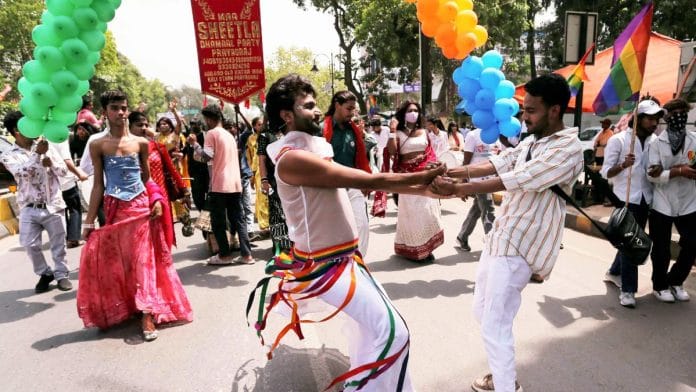

The gays are at it again. They want to be rid of the tail end of the letters in ‘LGBTQIA+’. The term ‘queer’, especially, has become quite a problem.
In an opinion piece in The New York Times on 30 June, author Matthew Vines tried to distance himself from queerness. ‘I’m Gay, Not Queer. It Matters,’ read the headline.
“‘Queer’ carries an adversarial charge that ‘gay’ does not, and that charge has a specific intellectual lineage,” Vines wrote. “And in that difference lies a danger for our hard-fought equality.”
He means marriage equality, of course. It’s the apex of the homosexual political ambition, of late increasingly harassed by gender trouble. Why do trans women need to compete in women’s sports so bad? Why do genderqueers have to shove their pronouns in the face of the good, kind god-honouring straight folks? Why do they want gender-affirming care at the cost of my two dogs, three kids, white picket fence life?
Western culture wars have two active battlefronts. When the colonisers aren’t panicking about an ‘Islamic colonisation’ of British Whitelands, they’re celebrating each new state-sanctioned attack on trans women. And as Republicans in the US gear up to tear down the Supreme Court’s marriage equality ruling, White gay ‘activists’ are offering up trans queer ‘radicals’ as a peace offering. As if the Right-wing ever cared to differentiate between categories of queerness. Who will tell Vines that no matter how hard he clings to god, he will remain a slur for the conservatives?
And as with anything that starts in the US, the ripples eventually reach India, too.
“As a gay man, i want equal rights that uphold our human dignity, not a revolution that risks undermining it,” Ankit Bhuptani, founder of the Queer Hindu Alliance, posted on X Thursday.
Last year, when I wrote about whether Indian queerness is Right or Left-leaning, I was surprised to find how vociferously Right-wing gay men distanced themselves from minority, caste, or trans issues. Their fight is not for the upliftment of all queer folk, but for assimilation into the folds of power. It’s a single-plank bridge to the rainbow lands of blessed gay monogamy.
Also read: Queer protesters refuse to be a meme. Armed with painted nails & defiance
Queer respectability politics
The recent effort is hardly new. American gay men began to distance themselves from the street queens, drag queens, and hormone queens (gay men who took estrogen) sometime in the 1960s, writes Kadji Amin, Professor of Women’s, Gender, and Sexuality Studies at Emory University. Until that point, all these groups were subsumed under the label ‘homosexual’. But these ‘screaming queens’ were seen as a detriment to the gay liberation movement and hence discarded.
When trans activist Sylvia Rivera was stopped by the middle-class gay and lesbian organisers of a protest rally in 1973, she jumped onto the stage and voiced the anguish of a community whose struggles had been sidelined for wedding rings.
“I have been beaten. I have had my nose broken. I have been thrown in jail. I have lost my job. I have lost my apartment for gay liberation, and you all treat me this way?” she said.
When the conversation surfaced at Rainbow Lit Fest last year, writer and sexuality educator Jaya Sharma said she was worried about the repercussions.
“Respectability is on the rise, and it worries me. It means bad things for those of us who are not good queers… Families will accept you if you do queer desire plus monogamy plus marriage plus top-of-the-hierarchy behaviour. And for those of us who don’t, it’s punishment, whether it’s in families, with colleagues, or in our professions,” Sharma added.
Some on X have questioned whether the denouncement of respectability politics by the queer movement in the US is the reason trans rights are under attack.
“We live in a socially conservative country. We are outnumbered. Public opinion is backsliding left and right. We HAVE to appeal to large swaths of people outside our communities if we want protections to not slip away. Acting dense & inert has backfired greatly,” read a tweet.
Some referred to Martin Luther King Jr’s approach of presenting respectability in the fight for civil rights. Indeed, in India, BR Ambedkar’s impeccably tailored suits served a political purpose.
But let’s not confuse dignity with gay and lesbian respectability narratives. They aren’t merely adopting the norms of those in power to better articulate their oppression; they’re deliberately breaking ties with the most oppressed groups of their community.
Trans lives are at stake. Across continents, governments are doing their best to add precarity to trans marginalisation. The UK has started moving trans women out of women’s prisons. The US Supreme Court has allowed states to ban trans women from competing in women’s categories. And reports of these events are openly referring to them as ‘biological men’.
And is ‘queer’, in fact, a radical term? Quite the opposite; it is a welcoming one. Even Vines admits as much.
“The capaciousness that makes “queer” appealing to some also makes the term remarkably easy for anybody — regardless of orientation — to adopt as a kind of radical chic identity label. Because the word “queer” can describe any departure from social norms, it becomes an open door through which almost anyone can walk. Polyamorous? Queer. Vaguely uncomfortable with gender expectations? Possibly queer, too,” Vines wrote.
While categories such as gay, transgender, even non-binary, imply an opposite—straight, cisgender, or, ironically enough, binary—queer is all-encompassing. Queerness exists in everyone, and hence everyone is welcome to it.
At a time when the community finds itself besieged, the term ‘queer’ isn’t the problem. It’s our way out.
Views are personal.
(Edited by Theres Sudeep)