






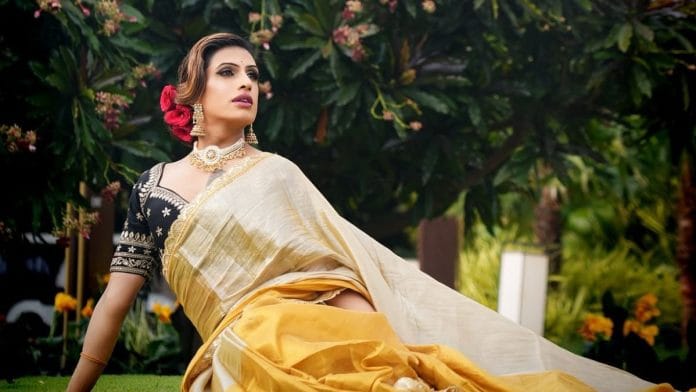


I fell in love with drag—where performers create an exaggerated persona of gender—at 19. It started in university, when a straight girlie introduced me to Drag Race. The show revived a desire buried under years of coaxing and control.
I was six years old when I first saw Aishwarya Rai’s decade-defining angdai in Kajra Re. After that, whenever I went to play at my neighbours’, I would lift my chubby hand and do the slow walk she does at the end of the song, twisting my wrist just so. Uncle, aunty, and didi would clap every time, and I would nod with pride. If Bhansali were in the vicinity, my spot in Bajirao Mastani was certain.
But the fourth time Aish possessed my limp wrist, my mother put an end to it. I don’t remember if it was a whispered warning or a quick slap, but there was no more Kajra Re after that. That is, until I was 12 and learning a semi-classical routine to Taal Se Taal at summer camp, bless the instructor didi’s instinctive allyship. But my mother saw me teaching my younger cousins the moves—three of them boys—and asked the instructor to teach me some ‘boy’ songs. I was forced to perform to Mast Kalandar from Hey Baby. The indignity!
Eventually, I cut away every feminine frill of my being and became a man. So, RuPaul’s ultra-American show was somehow a homecoming. I decided I would win the first season of Drag Race India.
Also read: Is there an Indian way to be gay? Most of us learn about queerness from American TV
Drag in India
Flash forward seven years, and the India chapter of Drag Race is nowhere to be found. And you may have noticed, I am no drag queen. All that is on the back burner now, I tell myself. I live in survival mode in Delhi, and the prices of a halfway decent pair of heels scare my fragile wallet. And while there may be much more than money to blame for my inability to partake in drag, I am not alone in feeling that the craft feels too inaccessible.
Artists and audiences alike find it hard to reach—it belongs to The LaLiT, to Kitty Su, to expensive parties in Bengaluru and Delhi. The charge is real, yet it is also based on a Westernised idea of what drag looks like. Drag Race carries much of the blame for both.
Drag in India isn’t limited to RuPaul’s ‘man in a wig’ storyline that occupies the imagination of many Indian queers. Sure, there is more drama and spectacle in it, but there are smaller, more rooted performances that also happen in Tier 1 and Tier 2 cities. Swaja Saransh, who performs as Avatari Devi, takes much from Bihar’s queer traditions of Launda Nach and Bidesiya theatre.
“When I went to drag, it wasn’t just reclaiming my queer, trans identity, but also reclaiming my Bihariness and the language I spoke as a child,” she told ThePrint.
For Saransh, drag is about resistance, and so the Westernised version we often see in clubs is suspect.
“In a postcolonial world, if I’m mimicking a performance form from another country—which has its own origin in Ballroom and resistance—what am I resisting over here? How accessible is drag here? What is its core politics? Can there be a performance about becoming a cockroach now?” she asked.
Other performers put their own spin on drag. Aarya Pathak, who co-founded the Pune Queer Collective, explored the academic angle to drag through a fellowship with Maraa Collective.
“Drag for me became a moment of respite where you allow yourself to become someone you desire, embody, or parody,” they said.
After the Trans Act was passed, Goa-based drag king Mixie, who loved performing “macho, seductive hypermasculinity”, turned their persona into a more sensual romantic one. They couldn’t find sexiness or flamboyance in their drag persona anymore. Now, they conduct shibari events—workshops on body art, rope safety, and consent.
Also read: Indian gay men are marrying straight women, breaking hearts. Coming out is too risky
Borrowing from the West
I had long held a bitter complaint against the drag artists who do perform the Americanised version of drag in clubs: They argue they aren’t being paid enough, yet their shows are unaffordable to the majority of queers in a given city. According to Aishwarya Ayushmaan, who performs as Lush Monsoon, it’s a double-edged sword.
“Society doesn’t give you money to level up or upgrade your craft. At the same time, it doesn’t take you seriously. You need to show them that your show is polished, contemporary, global. But to do that, you require money,” they said.
Drag artists don’t own performance spaces. Organisers want them to pack three polished looks for a night and only pay them Rs 5,000 for it. A passable wig costs more. The highest one can earn is Rs 10,000, Ayushmaan said. And unlike the US, India doesn’t have tipping culture.
But when they started doing drag about a decade ago, Ayushmaan didn’t plan to do it professionally.
“My friend had a ratty old wig somebody had gifted them, I had a chadar, and my boyfriend had his mother’s dupatta—that and maybe an eyeliner and a lipstick, that’s how I started drag. After that first time, I felt so beautiful, and I wanted to do it again,” they said.
Drag queen Seventeen K Sins said she spent only Rs 100 on her first look: A white T-shirt turned into high fashion using a lot of safety pins. Today, she is the mother of House of Sins, a mentor to four young queens, her drag daughters.
“These kids, some of them are privileged, some are not. Some are supported by their families, some are not… I give my children the resources, but I also make sure that their market price goes up, so they can also afford the things I offer them,” Sins said.
In the US, it is drag houses that offered family to young queer people who were thrown out of their natal homes and came to the cities. Their entry into queerness often coincided with drag. In India, houses are beginning to take shape. Mumbai is home to Hauz of KoHEnur, India’s first drag house, established by Sushant Divgikar, who performs as Rani KoHEnoor. The city also has House of Luna.
Could drag families help make the art more accessible to young artists? Or is it that Indian drag must step out of RuPaul’s shadow if it is to truly house its queer people? The structures that shape the craft—Westernised or otherwise—are still emerging. It’s a messy place, and yet one full of possibility.
Views are personal.
(Edited by Theres Sudeep)