






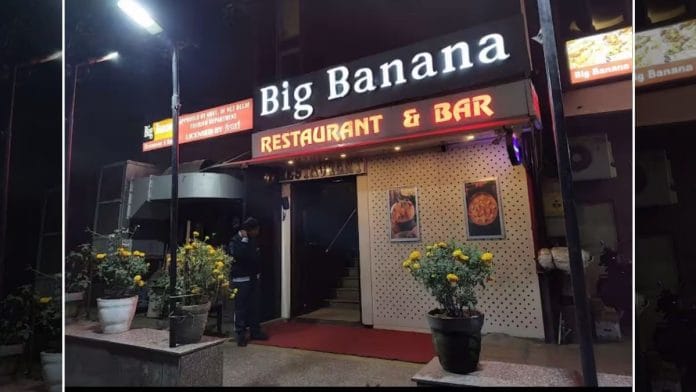


I will forever remain grateful to the kajal-wearing they/them who first took me to Big Banana Restaurant and Bar. It is where I have chosen to make my last stand on the battleground of romance. And why not, when every dating app known to humankind has failed to procure an emotionally unavailable, sexually interested, intellectually interesting hottie?
On the other hand, every two out of three times I’ve been to Big Banana, I’ve met at least one cute man worth talking to. I still owe that friend an invitation to my humble abode, but perhaps another trip to the famous Delhi dive bar is due.
There are many reasons why I love the place. Well, two: it has cheap alcohol and is overflowing with queer people. But at the same time, it is a favourite among Delhi uncles, who feel at home surrounded by masala peanuts, watching cricket on not just one but two TV screens.
At Big Banana, you’ll find style on one table and polo T-shirts on the next. Drag Race here will have completely different meanings depending on who you ask. It’s an oxymoron of a place, capable of housing both the patriarchy and its undoing. But this doesn’t come without friction. One eventful night, I witnessed just how fragile the balance is.
Queer joy meets Big Brother
It started with a table of six. I was meeting Anirudh Gupta, who was returning from a residency for social workers. Shocking absolutely no one, I was disastrously late. But the moment I sat down, a cute twink in the group beckoned me to sit next to him, pulling my chair toward his for added effect. Yes, I was instantly in a good mood. And, no, it didn’t last long.
When we entered the tiny smoking room, a sullen-looking man occupied a corner, dressed in a blue T-shirt and white three-quarter pants. Let’s call him Samir, because he looked like one. Anirudh continued their point from earlier. In their reading, the Trans Amendment Act functioned in parallel with the CAA/NRC—as the government’s attempt to corner minorities. The Trans Act, specifically, they said, was a way to limit transness to only the identities that Hinduism has (marginal) space for.
By the time they got to caste, Samir turned to two other uncles in the room who had entered after us. These trans people—he said loudly, using ‘hijra’ as a slur—they’re good for nothing. They know nothing, and they want to attack Hinduism. When the other men tried to calm him, he asserted that he often saw such queers in the bar talking against Hinduism. Was he upset that the people most famously oppressed by religion weren’t the biggest fans of it? I’m sure not. He was upset that we had the gall to talk about it in his presence. Or he was drunk and bored.
In unison, we turned to the man for a second and returned to our conversation. There was an implicit understanding that Samir was best ignored—though everyone was now tense. Big Brother was watching us, sipping his boring whiskey. Anirudh continued their argument, adding to it, for dear Samir’s sake, the example of the Ayodhya Ram temple scam.
“Yeh sarkar kisi ke bhi paksh mein nahi hai. Hinduon ke bhi nahi (This government is anti-people, it’s not even for the Hindus),” they said. A commendable attempt at outreach, well-rewarded when a fourth man nodded from a corner.
But as Anirudh spoke, the man only got louder, with more slurs.
What did I feel at the time? Annoyance, yes. Fear, certainly. Samir was itching for a physical fight. What else is a friendless man to do when he gets drunk? With a heavily tipsy twink draped over me, I resolved to fix Samir with a death glare. I’m gay, my friend is trans, what’re you going to do about it, I was conveying through my eyes. His answering gaze was blissfully blank.
A queer woman in the group—who stood two paces from him—turned around and told him to mind his own business. He was doing just that, he claimed. If we had a right to talk about Hinduism and criticise the government, he had the right to call us slurs. In a pre-CJP world, it must’ve seemed common sense to him.
How could a sad, sad man stomach queer joy, let alone queer dissent?
Also read: The thrill of ‘down low’ wears off fast. Why do gay men even fall for it?
The uneasy truce
Anirudh says they weren’t phased by the slurs. “It was garden-variety banal transphobia. Not worth the brain cells to even acknowledge,” they wrote in a WhatsApp text.
What they remember more from the night is everything that happened afterward. Back at our table, we could see Samir catching glimpses, ready with his cigarettes for round two if we were. But the table next to us, full of lesbians in printed cotton shirts, started singing along to the old Bollywood songs that Big Banana had wisely chosen to play. We joined in, and by the time the staff came asking for the last order, half the bar was dancing to ‘Kajra Re’. I didn’t catch when Samir slunk out, and had forgotten about him. It was of utmost importance that I hit the angdai precisely how Aishwarya intended.
In the final few moments of the night, the smoking room was full of our two tables singing ‘Hum Dekhenge’ and Ambedkar sangeet. I had mixed feelings about singing ‘Kahab To Lag Jai Dhab Se’—standing in a bar that would’ve been impossible to sit in if not for the AC, I wasn’t sure if that particular protest song was mine to sing. I remember being 24 in Pune and watching a university queer collective chant ‘Azadi’ slogans in a club.
“Azadi from what, overpriced drinks?” I would say every time I repeated the story afterward.
Anirudh sees it differently.
“The incident made me realise that any deliberate politicisation of an apolitical space will result in chaos, no matter how ‘inclusive’ we might think it to be. Inclusivity and safety come from the presence of active political dialogue, not the absence of it,” they said.
Sure, the queer community has claimed Big Banana as its own space. But has Big Banana done the same? Anirudh has a way to make the space more inclusive, one capable of holding political articulation.
“We need more queer Leftists flooding the space.”
Views are personal.
(Edited by Saptak Datta)