






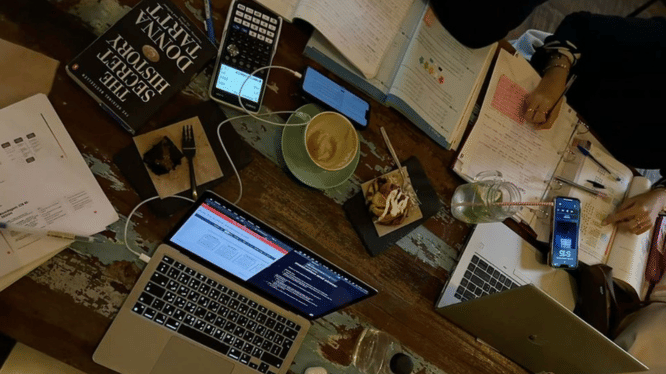


If I’m ever looking for a place to work or read, my first instinct is a nearby cafe, not a library. Not because libraries have disappeared or become inaccessible, but because somewhere along the way, they have slipped out of our collective imagination. For many urban Gen Z, the idea of going to a library feels outdated; functional, yes, but not desirable.
Instead, we’ve recreated the library in fragments, scattered across cafes. Book clubs meet over iced lattes, panel discussions unfold between espresso refills, and reading hours are tucked into aesthetically pleasing corners with curated playlists filling in the silence. In trying to modernise the idea of a “third space,” we may have forgotten the original ones altogether. Libraries, parks, and museums were about coexistence without expectation, which went far beyond productivity or leisure. But now even leisure has become an experience far beyond the idea of doing nothing or relaxing. So once, where someone might’ve just gone to a neighbourhood library to read or browse books, has turned into an experience of being in a space that is curated.
What’s changed is why we go to these places. Public spaces once carried the promise of serendipity, the chance encounter, the unplanned conversation with others sharing the same space. Today, that openness feels replaced by a kind of algorithmic socialising. When social media drives the narrative that everyone is at a particular cafe, the choice begins to feel like compliance and less like exploration.
Why risk going somewhere unfamiliar when you already know where the crowd and the validation will be?
Spontaneity versus Curation
There’s also a subtle but significant shift in what we consider worth missing out on. Skipping a day at the library doesn’t trigger any anxiety; it barely registers. But missing a “coffee rave” after a run club, or not showing up at the cafe everyone is posting about, carries weight. The fear of missing out has attached itself to spaces of visible participation rather than spaces of enrichment.
This has fed into a growing appetite for curated experiences. Simply existing in a space is no longer enough; there needs to be a reason, or an event. A walk in a park becomes a ticketed gathering. A visit to a garden turns into a scheduled activity. Even leisure is structured, packaged, and, more often than not, monetised. The spontaneity that once defined third spaces is gradually being replaced by intentional consumption.
There’s an economic dimension to this as well. Compared to Gen X and Millennials, urban Gen Z are more willing or more conditioned to pay for these experiences. A Rs 200 coffee is no longer just a beverage, it’s the price of admission into a certain kind of environment— aesthetic and sanitised.
Also Read: Gen Z and the art of the side quest—why purposelessness is the ultimate flex
What are third spaces for? Curation or consumption?
It makes one wonder one uncomfortable truth: Who are these spaces really accessible to? What looks like openness often operates as a filter, where participation comes with an unspoken cost. It begins to feel more like performance, an obligation to be seen in the right places, at the right time.
In contrast, public spaces are messier, less controlled, and free. But somewhere along the way, free began to feel less valuable.
It’s only now, in hindsight, that the trade-offs are becoming clearer. The quietness of a library, the openness of a park, and the accessibility of a museum, offered a kind of freedom that curated spaces struggle to replicate. There was no pressure to perform, to document, or to justify your presence. You could simply be.
I didn’t realise what I was missing at the time. In college, the draw of cafe aesthetics felt stronger than the idea of spreading out a picnic in a garden or spending an afternoon in a reading room. But looking back, it’s hard not to feel that something important was lost — spaces and the ways of inhabiting them.
Mrinalini Manda is a TPSJ alumna currently interning with ThePrint.
Views are personal.
(Edited by Insha Jalil Waziri)
Where are the public libraries? Big cities are becoming concrete and marble jungles . Where are the parks ?