




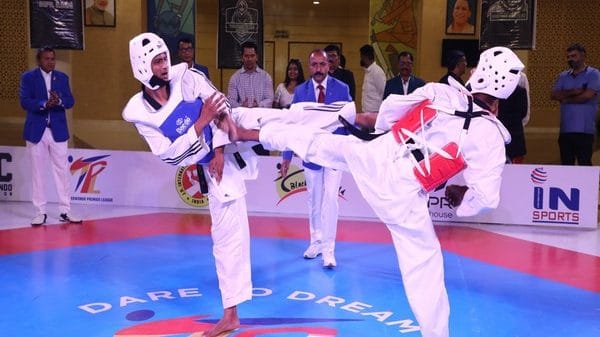

Taekwondo player Shayra went viral after she told Uttarakhand Chief Minister Pushkar Singh Dhami that she had won gold at a national-level championship in Jammu, but could not afford to participate in an international event because it would have cost around Rs 1.5 lakh. The Chief Minister responded, “Chalo chalo beta, abhi baith jao (Okay, dear, now sit down)”.
But Shayra’s story is not the only one. It reflects a wider phenomenon where a majority of taekwondo players and other martial artists in India are forced to sit down and simply watch opportunities go by because they cannot afford to compete.
My father is a taekwondo coach in Lucknow and has been teaching the art for nearly 25 years. I learned taekwondo from him and practiced it for nearly 18 years, earning my black belt in 2021. He has given his whole life to the sport, having started practicing it back in 1987, and later making it to the Taekwondo Hall of Fame.
I have been raised in its ecosystem, and can say that all the coaches are hopeless romantics. Trying to earn through championships and by selling uniforms and gear, they have the heart of martial artists. Some teach for almost no money, or for less than the cost of a monthly mobile internet pack.
Taekwondo has been reduced to a performance at school annual functions. It helps dance teachers find children who can do a cartwheel, or is used by management to attract new admissions through a 15-day workshop. The coach is paid like a daily-wage worker, and the amount is debited in one go.
A lost sport
Before Covid-19, my father ran an academy with nearly 20-30 students, most under 20, for a monthly fee of Rs 200. Many were state- and national-level players with black belts.
One of them was a 12-year-old boy who lived in a slum near the academy. Coaches around Lucknow thought he would be a star one day. But within a year, his family forced him into child labour. Coaches tried to help, but how much can a coach do?
Championships and gear cost money, and when 20-30 students are going through similar conditions, there is only so much a coach can do. Until the government intervenes, this will continue. But for it, these sports do not even seem to exist.
Anyone barely knows Rupa Bayor. She, last year, became India’s first taekwondo player to enter the top 10 of the World Taekwondo Poomsae rankings. Another talented athlete the country has produced is Latika Bhandari, who led the junior India team to Uzbekistan for the 2026 World Junior Championship in April.
Taekwondo originated in Korea and came to India through Vietnam in 1975 with Grandmaster Jimmy R Jagtiani, known as the father of taekwondo in India. The Taekwondo Federation of India was formed soon after with the support of the Indian government and the World Taekwondo Federation.
But with all this history, no one knows him or his students.
Half of Jimmy’s life has been spent fighting legal cases with other taekwondo bodies claiming to be the apex body. With all the chaos, coaches are now divided into two groups, one supporting the man who brought the art to India and the other supporting the decades-old organisation.
In 2012, TFI was suspended by the International Taekwondo Federation for not following the Olympic Charter, following the Indian Olympic Association’s failure to comply with it.
And even after the formation of a new body, India Taekwondo, which replaced the TFI in 2019, nothing changed. Instead, this destroyed the credibility of the sport, and players need authorised certificates to participate in competitions. But coaches themselves are confused — who is authorised?
I have seen how, in the absence of a proper committee to oversee tournaments, almost anyone can organise a competition, call it an “Open National Championship”, and name it after a deceased relative or the school they work at.
In 2015-16, I participated in an Open National Taekwondo Championship in Kanpur. We were initially told it would be held at the Green Cricket Stadium, but it was later cancelled and shifted to a local school. And only players from 2-3 districts nearby Kanpur showed up.
The ring had been prepared with brown tape on a concrete floor, with no mats. The protective gear looked like antiques. Players were given puri-aloo sabzi before their fights and then forced to compete on concrete.
It is a combat sport, imagine the injuries a player could suffer by falling on that surface.
And even if a player manages to somehow make their name at the international level, what is waiting for them afterward? Literally nothing. At the end, they will become coaches of a lost sport, with nothing but chaos around them.
This results in both students and their parents not taking the sport seriously. They see the coach struggling every day. Why would anyone want to choose a future like that — practicing an art form that demands physical labour, where there is no sponsorship like in cricket or wrestling, and where no one wants to be unemployed after giving decades to the game?
Also read: PUMA Suede gets a desi makeover in collaboration with Jaipur Rugs
Nothing but unemployment
A child playing cricket can dream of becoming a professional cricketer. A wrestler can dream of the Olympics, government jobs, and leagues. But what does a 14-year-old taekwondo player dream of? If he becomes a national champion, what comes next? If he wins internationally, what comes next? And if he retires at 25, he will just be rewarded with unemployment.
India has never won an Olympic medal in taekwondo. The last time the country went to the qualifiers in 2021, the whole team missed the tournament due to a lack of awareness about a 14-day quarantine rule. They were not properly apprised by the ad hoc body headed by Namdev Shirgaonkar, who was running the sport at the time.
The current Manipur Chief Minister Yumnam Khemchand Singh is a taekwondo player. But does anyone know that he is a martial artist?
And this is not limited to taekwondo. Most martial arts such as Karate, Judo, Silambam, Gatka, Thang-Ta, and Tai Chi and more are struggling in India. While traditional martial arts are fading, reels have pushed youngsters toward MMA and other forms of combat sports, often without knowing the discipline or philosophy behind them, turning martial arts into a way to show off fighting skills.
While martial arts teach discipline through meditation and all sorts of techniques, the whole ecosystem itself seems to be meditating in silence. The players are now in an identity crisis and, perhaps, do not even know what to do with the art form.
The people I grew up watching, the players and coaches who kept the art alive, are left fighting not just for medals, but for roti, kapda, and makaan.
Views are personal.
(Edited by Aamaan Alam Khan)