








Spin-offs are mostly a curse to the original series, and the best example is The Big Bang Theory. Chuck Lorre is once again banking on almost every character from the series in the latest show, Stuart Fails to Save the Universe.
Stuart, played by Kevin Sussman, was once a man struggling to pay his rent, starving, and barely keeping his comic book store alive. Now, he’s on a Star Trek-style journey to save the universe. But the real question is why Stuart? He has never had main-character energy and hardly feels like someone who could lead an adventure beyond the stars. The choice to make the saddest, least awe-inspiring character as your lead is questionable at best, boring at worst.
First airing in 2007, The Big Bang Theory ruled television sitcoms till 2019 with a total of 279 episodes. Every character in the series got their own arcs, subplots and eccentricities, but they all somehow came back to Sheldon (Jim Parsons), making him the unique centre of their world. There is an episode where Sheldon doesn’t get a ticket to Comic-Con, so he starts his own comic convention. Another episode explains why the apartment building’s elevator never works throughout its 12 seasons, something fans wondered about since the pilot. Honestly, there is nothing left in The Big Bang Theory universe that people want to know about.
Even Young Sheldon (2017-2024), starring Iain Armitage, which focused on Sheldon’s childhood and his family, somehow justified its existence. But then came Georgie & Mandy’s First Marriage. The show picks up where Young Sheldon left off and follows his elder brother’s married life. But was anyone really curious to see how Georgie & Mandy’s first marriage turned out? We all know it ends; it’s in the title. The makers seem so eager to stretch the universe that, given the chance, they could probably make a spin-off about Sheldon’s sad and single school librarian or any other random character.
Banking on the same hit story just to tell tales of characters no one truly cares about is a waste of time, money and writing.
Also Read: Christopher Nolan’s IMAX obsession has cheated most of us out of his real Odyssey
The power of nostalgia
Spinoffs are television slop, seducing audiences with nostalgia in the name of lazy storytelling. But Stuart Fails to Save the Universe is not where the American spin-off journey starts; it is just the latest episode in a tedious series. Take Friends (1994-2004). A show beloved by all simply because it shows the everyday challenges of adulthood. The vibe, the togetherness, and the comfort they shared made Friends one of the greatest series of all time.
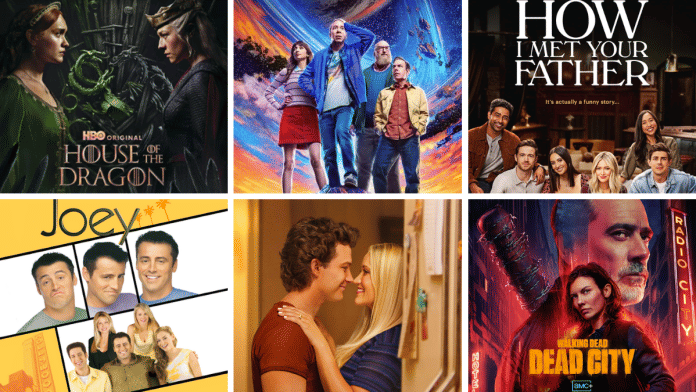
Joey’s humour worked because he had Chandler, Ross, Monica, Rachel and Phoebe. Put Joey alone in an apartment or sitting by himself at a cafe, and that magic disappears. Yet, that is exactly what the makers did with the spin-off Joey (2004-2006). The story picks up where Friends ends, with Joey (played by Matt Le Blanc) moving to Los Angeles to pursue his acting career and dealing with a pushy agent.
The makers obviously tried to cash in on the humour and love people had for the character, hoping to create something that felt like Friends. But Joey is a loveable character because of Friends, not the other way around.
Let’s look at Game of Thrones (2011-2019), a fine example of storytelling in recent years. The show never revealed too much about its characters, creating a sense of curiosity. The exclusivity of its world and the intrigue surrounding it is what made the show special.
Fans’ theories rivalled those of thesis submissions. Was Tyrion Lannister secretly a Targaryen or not? His mother died while giving birth to him, same as Daenerys; his closeness to dragons and his hate for the Lannisters sustained people’s curiosity. But that curiosity is what keeps the show and its spirit alive.
This is where spin-offs fail. House of the Dragon details the civil war known as the Dance of the Dragons. But there will never be another Mother of Dragons, except Daenerys. With the spin-off, we have entered the world of dragons and their riders, but lost the myth and legend that made Game of Thrones so special.
Spin-offs are failing to breathe new life into familiar intellectual properties from the original series. They cannot recreate the charm of the first one because the story and characters were new, with no unnecessary stretching. According to IMDb data, there are over 50 direct spin-offs, excluding reboots and prequels. If I want to watch all 50 television series, each running for several seasons, then after some time the makers will produce another spin-off, making it impossible for anyone to keep up with every character’s story. It’s a hamster wheel, chasing one sequel then another and another.
The Office (2005-2013), although technically a remake of a UK show, became a cult classic because of characters such as Steve Carell’s Michael Scott. Yes, The Paper tells a different story in the same mockumentary style, following a failing local newspaper, with new and unfamiliar characters But the chaos that made Dunder Mifflin’s Scranton office memorable is missing. And, of course, The Office universe is incomplete without Jim (John Krasinski), Pam (Jenna Fischer) and their pranks on Dwight (Rainn Wilson). The only real connection between the two is Oscar, played by Oscar Nuñez, who reprises his role.
But there are a few shows that did not simply bank on the popularity of the original series. Instead, they became even more critically acclaimed because of the uniqueness of their central character and the chaos surrounding them. The best example is the Breaking Bad (2008-2013) spin-off, Better Call Saul (2015-2022). Many even consider it greater than the original.
The series follows Saul Goodman, played by James Morgan McGill, a psychologically complex character who hooks fans from the get-go. Audiences can never fully decide whether he is good or bad. While he mostly defends criminals, he also brings out their human side, exposing how the system exploits people and sometimes even pushes them towards crime. Saul is selfish, yet kind, making him endlessly fascinating.
More importantly, Breaking Bad established a rich universe, and Better Call Saul expands it to its fullest. It adds new layers rather than subtracting from the original story, something most spin-offs often do.
Also Read: There’s a simple reason why Friends still works—absurdity of adulthood is timeless
Billable story-lines
Meanwhile, India has been on its own journey of creating television slops.
There are shows like Taarak Mehta Ka Ooltah Chashmah, which has been running for nearly 18 years. Over time, many original cast members have been replaced, and even some of those actors have again been supplanted. Yet Taarak Mehta persists. Take one problem, stretch it for a week, solve it, or leave it on a cliffhanger for the next week; two or three ideas are enough to survive an entire month. It is an unsaid spin-off happening within the show itself.
There is even a cartoon spin-off of the show from 2021 available on Amazon Prime.
Then there are iconic shows like Sarabhai vs Sarabhai. It began in 2004, but its revival arrived in 2017 on OTT, more than a decade after the story had already reached a satisfying conclusion. After a point, it felt like the only way left to continue the story would be to introduce aliens and have the Sarabhais fight them.
Even CID got a Netflix spin-off; fans can now watch Daya break down doors in HD. Most recently, Mirzapur is getting a full-fledged film titled Mirzapur: The Movie, while the web series continues. The only real difference is a few new cast additions, like Ravi Kishan and Jitendra Kumar, and fans can experience the thrill of the mafia on the silver screen.
From How I Met Your Mother (2005-2014) to How I Met Your Father (2022-2023), never mind the endless Grey’s Anatomy spin-offs and episodes to The Walking Dead universe, the pattern remains the same. These shows worked because their characters complemented each other and their stories had a natural end.
Spin-offs rarely add anything meaningful. More often than not, they are just creative blocks disguised as world-building, driven less by creativity and more by production houses trying to squeeze every last drop out of a successful franchise.
Views are personal.
(Edited by Insha Jalil Waziri)