






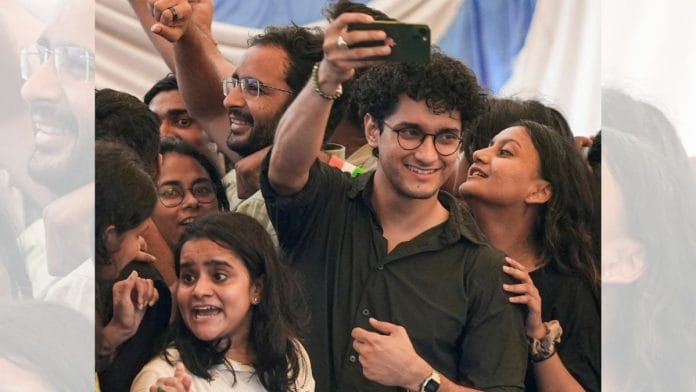


Apparently, every Indian protest needs three things: a slogan, a hashtag, and a good-looking man who will finally be declared the latest “pookie” of the country.
And this time, it’s Saurav Das.
The spokesperson of the Cockroach Janta Party (CJP) has become a social-media sensation following the recent protests in Delhi over the NEET paper leak. The agitation has spurred discussions on its demands and implications. Still, parts of the internet appear to have taken away something else entirely: Das is apparently very easy on the eyes.
Photos, reels, and edits have surfaced, with some social media users joking that the protest was just an excuse to see him. Some have even gone as far as to request he be made India’s new “national crush”. On the other hand, Das has reportedly asked people to focus on his work and not his looks.
A noble request.
But once the internet has decided that a spokesperson is its new pookie, good luck getting anyone to read the manifesto.
We came for the policy. And stayed for the cheekbones.
And that is not exactly new.
Not the first ‘pookie’
Remember Raghav Chadha? The fresh-faced poster boy of Aam Aadmi Party’s early years.
Chadha became one of the young public faces of AAP amid the Anna Hazare-led India Against Corruption movement. A 2015 profile in The Times of India referred to him as the “cute quotient” of AAP, and noted the attention he had started to get from young women on social media.
At 26, Chadha was a chartered accountant who found himself on prime-time television debate panels with politicians decades his senior. He stood out just by being young. “Of course, his appearance was part of the conversation.
The irony was that Chadha himself appeared ill at ease. Speaking to The Times of India, he said he was not comfortable with the attention and emphasised that the purpose of his political work was entirely different.
In 2015, apparently, the word was ‘cute’.
In 2026, it’s ‘pookie’.
The vocabulary has been altered. The phenomenon hasn’t.
Given Indian politics, a young man who can talk and looks good on camera soon gets a social media fan club.
It’s not like Raghav Chadha was the last politician to have been conferred the unofficial title of India’s Most Handsome Politician. Chirag Paswan, Sachin Pilot, and Aditya Thackeray have all been talked about on social media at various times for their looks, style, public image as well as their politics. Rahul Gandhi, and Tejasvi Surya too have drawn attention for their charisma and looks.
There are whole lists on the internet of India’s “handsome politicians”. Apparently, democracy now has a beauty pageant section.
But perhaps this is less about handsome politicians and more about how we consume politics.The modern politician is no longer merely a politician. He is a face on Instagram, a 30-second clip on YouTube, a meme on X, and, if the algorithm is feeling particularly generous, someone’s latest crush.
The protest gets its slogans. The leader gets his edits. And the revolution gets a jawline.
Nor is this an exclusively Indian ‘omenon. Consider New York City Mayor Zohran Mamdani. His youthful appearance, easy-going style of communication, and strong social media presence have helped him connect with younger audiences. His rise is part of a wider shift in the way politics is communicated. Politicians are now less often encountered through long manifestos or speeches in parliament and more often through short videos, memes, clips, and content driven by personality.
Politics, in other words, is being consumed a little like pop culture. You may enter through a policy speech. Or you may enter because someone made a handsome-man edit.
Either way, welcome to democracy in the age of algorithm.
Also read: CJP under fire over ‘resignation party’, Saurav Das says that’s the ‘language of Gen Z’
A silver lining
Personally, I find it all a little too much ado about a pretty face.
People are protesting over real issues, politicians are debating serious questions, activists are demanding change—and the internet is busy asking the most ‘urgent’ question of all: But is he good looking?
It is almost impressive.
A movement can build up for months, and then one spokesperson appears on camera for 30 seconds, and the comment section collectively gives up political analysis for cheekbones.
We had come for the revolution.
We stuck around for the jawline.
But maybe there’s a silver lining. The crush is not entirely useless if a charismatic young politician can get someone to pay attention to politics who otherwise would not have cared. A teenager might click on a video because the spokesperson is good-looking, and stay because the issue is interesting.
Maybe aesthetics are the spoonful of sugar that gets people to swallow the political medicine. The problem is when the spoon becomes the entire meal. When the personality becomes bigger than the cause, politics risks becoming celebrity culture in a kurta.
That is the real danger of the “national crush” phenomenon. Not that people find politicians attractive. They obviously will. The danger is that the face becomes more memorable than the fight, the meme more popular than the message, and the “pookie” more famous than the protest.
So, by all means, admire good hair. Appreciate the cheekbones. Make the reel. But perhaps also read what the man is saying. Because every protest may need a pookie to capture the internet’s attention.
Just make sure the pookie does not become bigger than the protest. Otherwise, somewhere between the slogan and the thirst trap, the revolution would officially lose the plot.
Views are personal.
(Edited by Aamaan Alam Khan)