






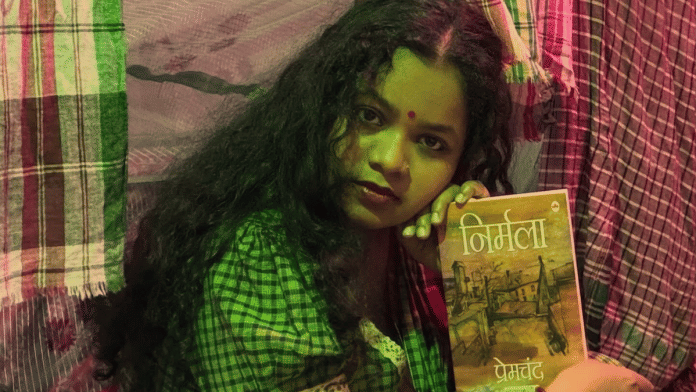



It began with an accusation. Instagram influencer Niharika Jain posted videos on fellow creator Pujarini Pradhan dissecting her rapid rise. Another creator, Aishwarya Subramanyam, took it further and called Pujarini an “industry plant,” suggesting that the now-viral rural Bengali who speaks about books, cinema and caste in English may not be as organic as she appears. That she has a team helping her shoot, edit and upload. That her simplicity might be, at least in part, staged.
The allegation struck a nerve, which then snowballed into a frenzy. The internet rallied behind Pujarini, who responded with a video disclosing her earnings, explaining her process, and admitting she did not even understand the terminology being used for her.
Then the story drew international attention. Snigdha Sur, founder of the New York-based South Asian platform, The Juggernaut, stepped in sensing a story. And so, Journalist Tulika Bose reached out to both Pujarini and Aishwarya on X. What was routine outreach became its own controversy: Pujarini was asked to “DM me”, while Aishwarya was told, “Please DM me”.
A small difference, but on social media, it became evidence. Lost in this churn is a simpler truth — Pujarini was always going to provoke this reaction.
Pujarini’s rise sits on a contradiction that the world has not learned to process. She is a lower-middle-class woman from East Midnapore, married young, who taught herself to read voraciously and now speaks fluent English — with an unmistakable, unapologetic accent — about literature, filmmakers and social issues. She does so without the aesthetic markers that typically legitimise such speech — no elite degree, no urban polish, and no performance of cosmopolitan ease.
That dissonance is what made her compelling, and then unsettling.
The phrasing from the journalists was read as a marker of tone, hierarchy and class bias. A Harvard doctoral student, Mahdi Chowdhury, called The Juggernaut “just the worst”.
What followed was a spiral of elitism accusations, counter-accusations, leaked old emails, and threats to escalate the matter to the Bose’s university.
An update a day after: instead of apologizing, Juggernaut doubles-down on their decision to a leak a the private correspondence, tries to rhetorically defame me, and issues threats to contact my university and supervisors. pic.twitter.com/vXJXGjVwHw
— mahdi (@_mahdichowdhury) April 1, 2026
Apologies from Bose followed when she clarified that she didn’t know Chowdhury was an international student and even called his work “fascinating”.
By then, the original question “Is Pujarini authentic?” had been buried under a louder spectacle about who gets to speak, who gets to question, and in what tone.
Another strand of critique emerged alongside it. Some argued, including Subramanyam, that audiences were drawn to Pujarini out of a “poverty porn” impulse — an upper-class, “savarna guilt” that finds comfort in celebrating exceptional stories from the margins.
But Pujarini pushed back in her own way.
“People think I’m poor because I live in a 40-year-old house with cracked walls… We are all poor to someone who is more privileged than us,” the 26-year-old tweeted.
Also Read:Who gets to sound intelligent in English? A rural Bengali woman is forcing India to answer
Creator or industry plant?
Pujarini is not just a creator with over seven lakh followers on Instagram. She is a story of self-education, intellectual hunger, and a rural woman stepping outside prescribed boundaries. She reassures audiences that access can be claimed, that English can be inhabited without permission.
But the moment that story begins to look even slightly constructed, the admiration turns into doubt.
“Industry plant”— the term used for her — suggests that success from the margins must remain pure and untouched by strategy, support or mediation. That a rural woman can be brilliant, but not managed; visible, but not curated.
Urban influencers, meanwhile, operate with teams, branding and strategy without scrutiny. Their polish is professionalism. For someone like Pujarini, it is framed as deception.
This is where the class edge sharpens. And this is also where the media interest becomes telling.
Pujarini is narratively irresistible to platforms like The Juggernaut. A rural, self-taught woman speaking in English about her life is a story that travels. It sits neatly within a global, diaspora-friendly frame — aspiration against odds, intellect emerging from the margins, “new India” in a single character.
Pujarini made it clear she does not give interviews. Yet The Juggernaut published the story regardless, built from her digital footprint, her virality, and her reels. The subject stepped back, but the narrative moved forward.
This is not unusual in the digital age. But it reveals something about the gaze shaping such stories.
The NRI media lens has long been drawn to narratives that make inequality legible but digestible, stories that can travel across borders while retaining emotional clarity. Pujarini fits that frame almost too well.
The irony is difficult to miss. Even as social media debated whether audiences were consuming her as a symbol, the media was doing something similar, turning her into a story that could circulate globally, with or without her participation.
And yet, through all of this, one thing became undeniable — her visibility (and followers) only grew.
She moved from being a niche Instagram creator to a subject of international media attention. The attempt to interrogate her authenticity became the engine of her amplification.
What this episode exposes is not whether Pujarini is “real” or “constructed”— a binary too simplistic for the digital age — but how stories from the margins are consumed, contested, and claimed.
Pujarini’s ascent breaks rules of language, class and access.
The backlash — and the rush to narrativise it — shows that another rule is still intact: that even when the margins speak for themselves, others are quick to step in and tell their story anyway.
Views are personal.
(Edited by Insha Jalil Waziri)