






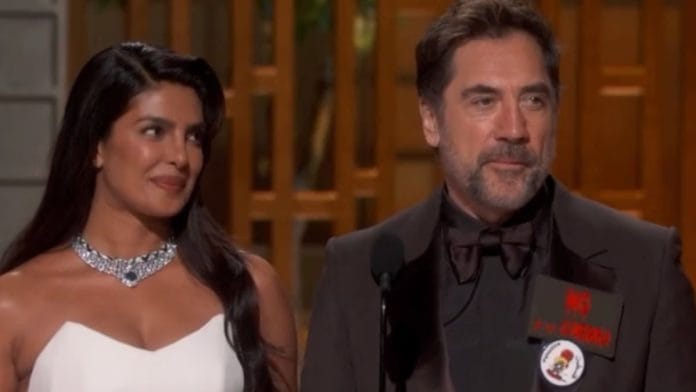



Actor Priyanka Chopra Jonas is again in the middle of a familiar internet storm. The trigger this time was not something she said, but something she did not. After actor Javier Bardem called for a “Free Palestine” on the Oscars stage on Monday, Chopra’s silence and a reluctant nod became the subject of intense online scrutiny.
Within hours, social media timelines filled with questions. Why had she not spoken up? Was her silence political? Was it hypocritical for someone associated with UN humanitarian work? Someone called her ‘Daal Gadot’ and the internet ran with it.
But, so what if she didn’t endorse Bardem’s stance? Chopra does not need to have the same opinion as her co-presenter and even if she does, she reserves the right to speak her mind where and when she wants. But critics tore into her silence.
It is an increasingly familiar ritual: the moral audit of a celebrity.
In the age of social media, celebrity silence has become a kind of statement that audiences increasingly feel entitled to interpret, interrogate, and condemn.
But the outrage also reveals something more complicated about the expectations we now place on public figures, particularly those who move between industries, countries and political contexts the way Chopra does.
Chopra has long been one of India’s most visible global celebrities, an actor whose career spans Bollywood, Hollywood, luxury brand endorsements and humanitarian work. With that visibility has come a peculiar kind of scrutiny, where every tweet, appearance or absence becomes open to interpretation.
Impossible expectations
This is not the first time politics has collided with her public image.
After the 2019 Balakot airstrikes, which followed the military escalation between India and Pakistan, Chopra tweeted praise for the Indian Armed Forces. The reaction was immediately polarised. Critics argued that her role as a UNICEF Goodwill Ambassador made such a statement inappropriate; some even accused her of endorsing war.
As an Indian, expressions of support for the country’s armed forces are hardly unusual. Yet as a global celebrity with an UN affiliation, the same statement was judged through a completely different lens.
What it exposed was the precarious terrain celebrities increasingly inhabit: where any comment can be read as either insufficiently patriotic or excessively political, depending on who is listening.
In this sense, Chopra’s silence is simply a recognition of the impossible expectations placed on celebrities in a hyper-polarised world.
Indian film stars, in particular, have learnt these lessons the hard way. Take the best case study: Shah Rukh Khan.
More than a decade ago, Khan faced fierce backlash after he spoke publicly about rising intolerance in India. The remark quickly spiralled into a national controversy, with politicians and news channels questioning his patriotism. The episode left a lasting imprint on how many celebrities engage – or refuse to engage – with political questions.
In a later appearance, he joked that India was in fact a very tolerant country. The moment was widely read as a careful retreat, a reminder of how easily public commentary can be weaponised.
Aamir Khan faced similar backlash after he said India was unsafe and that he wanted to move his children abroad. The response from critics was scathing: he was asked to leave the country if he was not happy.
Since then, many Indian stars have adopted a cautious distance from overt political statements because they understand how quickly a remark can be stripped of context and amplified into outrage.
Also read: Real question isn’t why songs like Sarke Chunar are made. It’s why we keep playing them
When silence becomes a statement
Social media, however, increasingly treats silence itself as a political act.
The logic goes something like this: if a celebrity commands a platform with millions of followers, choosing not to speak during moments of crisis becomes suspect. Silence, people believe, signals indifference – or worse, complicity.
But this expectation collapses several different roles into one.
Celebrities are influential, yes. They shape culture and command attention in ways few others can. But they are also actors, performers, musicians — people whose professional training is not diplomacy or international relations.
Expecting them to serve as moral commentators on every geopolitical crisis risks turning serious political questions into hollow and performative declarations from people who lack expertise on the matter.
Also, a part of the confusion stems from the habit of measuring Bollywood against Hollywood. Hollywood stars have historically spoken out on issues ranging from civil rights to the Iraq war, and more recently on movements like Black Lives Matter or immigration enforcement by ICE.
But Bollywood has never had the same culture of outspoken activism. During the Emergency, songs and movies were banned and censored, reminding the industry how vulnerable it could be to State displeasure. That too may have shaped an instinct for restraint among celebrities.
This demand to speak up also creates a paradoxical system of punishment. Speak, and the statement is dissected, politicised, and often attacked. Stay silent, and the silence itself becomes grounds for outrage. Hindu right similarly targets those who speak up for the Muslim community with arguments like ‘what about Bangladeshi Hindus or Kashmiri Pandits’.
The result is a permanent tightrope.
For someone like Chopra, the balancing act is even more delicate. She is an Indian citizen with family, relationships and a life embedded in a country where political speech carries very different risks and consequences compared to the US. Her audience spans India, US and the wider diaspora; the political meanings attached to any statement shift depending on who is interpreting it. What reads as solidarity in one country may be seen as provocation in another.
This is why the expectation that every Indian celebrity must behave like Meryl Streep or Leonardo DiCaprio is misplaced. This is not Hollywood.
This is not to suggest that celebrities should avoid politics altogether. Some have used their visibility to advocate for climate action, humanitarian relief or social justice.
But the decision to speak must remain voluntary.
Compelling every public figure to deliver a position on every crisis risks flattening complex conflicts into internet slogans. It also distracts attention from those whose voices carry greater authority: journalists, historians, diplomats and, most of all, the people directly affected by these conflicts.
The modern celebrity economy thrives on visibility. Yet it has also created a strange expectation that visibility must always come with commentary. That assumption needs some reconsideration.
Actors are not elected representatives or experts on war. They are not required to offer a position every time the world fractures. Sometimes, the most revealing aspect of these controversies is not what celebrities say or fail to say but how relentlessly we demand that they speak.
And how rarely we allow them the freedom not to.
Views are personal.
(Edited by Ratan Priya)