





Ask any woman in Delhi what she would like to do without fear, and most would say, “Go on a walk at night.”
No mountain, no world tour. Just a walk, without hurried steps or looking back every minute, under the looming fear of someone following, someone attacking, someone deciding who the night belongs to.
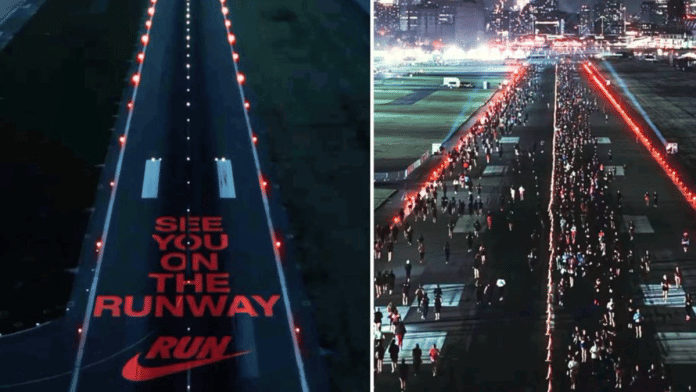
On 17 October in London, Nike reserved an airport runway so thousands of women could take back the night.
Around 5000 women took part in Nike’s After Dark Tour, running a 10K that included a stretch of the London City Airport runway. It was part of Nike’s global series of nighttime races designed to bring women together and encourage them to reclaim the night.
The evening also included live DJs, athlete hosts, an expo and a post-race celebration with a live performance by British singer-songwriter Pink Pantheress.
The campaign’s brilliance lies in the scale of the gesture. Nike could have released another advertisement featuring women running through city streets, with an inspirational soundtrack and a slogan about breaking barriers.
Instead, it made the experience itself the message.
Rather than being a mere dramatic backdrop, the runway became a reminder of the ordinary public spaces that women are so often denied.
It was a spectacular image. But beyond that spectacle lies an uncomfortable question. When a brand has to take thousands of women to an airport runway so they can run at night, what does it tell us about women’s safety on city streets?
Who does the night belong to?
In India, the phrase“Reclaim the Night” became a rallying cry in August 2024, when thousands protested in Kolkata and other cities following the rape and murder of a trainee doctor at RG Kar Medical College and Hospital. But such measures to “reclaim the night” are no stranger to the country.
On the eve of Independence Day, women gathered at crossings and streets to demand justice and the right to occupy public spaces without fear. The protests spread beyond Kolkata to Delhi, Mumbai, and Bengaluru.
More recently, on 9 October, women in Delhi took part in a Reclaim the Night walk from Lodhi Garden to India Gate, amid renewed outrage over a string of sexual violence cases in the capital.
They ask who the night belongs to, but they also reject the inevitable victim-blaming that follows any sexual violence – what was a woman doing outside so late at night?
The demands of these movements are hardly complicated. Women want to be able to leave their homes, work late, travel and walk the streets without their presence after dark requiring a chaperone, a safety kit, or an explanation.
Nike’s campaign rolls out the red carpet, or in this case, the runway. Rather than asking women to confine themselves, avoid streets at night, it creates a space in which they can run together, visibly and without the usual negotiations.
For one night, the spectacle is not a woman out alone after dark. It is thousands of women occupying space on their own terms. It is them enjoying the night and taking a much-needed walk.
After the lights go out
The campaign’s premise is celebratory, but the need for it signals a much less celebratory reality.
Because what happens beyond the runway after the lights go out and the event is over?
The real test is whether women can have that freedom without a special event, a closed route, and thousands of fellow sisters around them.
That is also why the wish to walk alone at night resonates so strongly. It is not an extraordinary ambition. It is an ordinary activity that has been made to feel like a risk.
Until the streets catch up, campaigns like these offer an absurdly simple thought. If we can make room for thousands of women to run safely after dark on an airport runway, we should be able to make ordinary streets safer for them, too.
Views are personal.
(Edited by Insha Jalil Waziri)