






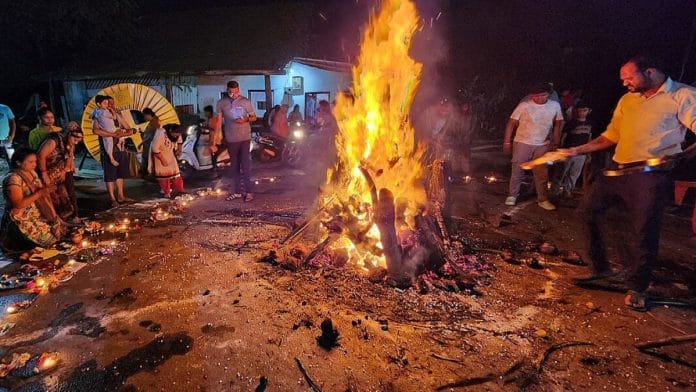



The day North India celebrates Holi, Maharashtrians are busy smearing each other with ash, dirt, and mud. On Dhulivandan, Marathi people use cinders from the Holika Dahan to play a colourless, grey Holi.
And what begins with ash eventually turns to dirt, as people start grabbing handfuls of earth to fling at family, friends, and frenemies. It’s not unusual to see gangs of rowdy men throwing each other in mud, either.
Is Dhulwad as aesthetic as Hindi Holi, with its white clothes, DJs, and multicoloured decor? Probably not. It unfolds in temple premises or places where poor Holika was burned at the stake. There’s no bhang to be found, either. But it’s still ten times as fun. Not just because it offers the ‘gremlin’ joy of flinging ash and mud at friends. The festival takes you back to the simple glee of a child playing in dirt.
Dhulwad reminds you of your ties to the earth. And if you’re just about dying to play Holi with colour, all you have to do is wait. For five days. That’s when Rangapanchami rolls around, and we Marathis pull out our gulaal, pichkaris, and water balloons.
Sadly, the festival is losing ground as Hindi Holi is becoming more popular with Marathi youth.
Also read: The world won’t end if older women desire intimacy. Violet Bridgerton is proof
A fading custom
A Google search will tell you that the festival is celebrated in the memory of Kamadeva. When the god of love tried to ignite desire in Shiva’s heart while he was in deep meditation, Shiva opened his third eye and burned Kamadeva to ashes for the disturbance. But Rati, Kamadeva’s wife, pleaded to Shiva, and he promised that the deity would be reborn.
So Dhulivandan, which translates to ‘worshipping the ashes’, is supposed to commemorate Kamadeva’s rebirth. The sight of pot-bellied men in baniyans rolling around in mud is surely the perfect tribute to the god of love. Who knew we Marathis were people of such culture?
I remember playing Dhulwad as a child. But as I grew up, the custom began to fade. In big cities, Marathi youth took to playing Holi on the day of Dhulivandan. It was more convenient than waiting for five days, and no one wanted to seem uncool in front of their Hindi friends. For all of Maharashtra’s infamy with intolerance for Hindi speakers, we’ve always loved ditching Marathi culture for northern styles.
Festival names are an obvious example of Hindi hegemony. For a generation that grew up watching Bollywood films and Hindi TV serials, Dhanteras was easier to identify with than Dhanatrayodashi, and Marathi Bhaubeej became Hindi Bhaidooj.
It’s no surprise that Rangapanchami is becoming a thing of the past and gulaal is beginning to replace ash in Dhulivandan. Perhaps Marathis need to be told that some north Indian states also celebrate mud Holi. If it takes some good old-fashioned apeing of Hindi customs to revive my colourless Holi, so be it. I propose we dedicate the additional holiday to Kamadeva.
(Edited by Saptak Datta)
Festivals are a cultural milieu. Dont segregate it by regions. Because same arguments can be used for Marathi festivals like Ganesh Chaturthi which was almost absent in north india 2 decades back has become a important festival. Even in states like UP where no one bothered to even look for Ganesh Chaturthi. And where even budhh Purnima was a bigger festival has not accepted Ganesh Chaturthi a part of it, thanks to the same bollywood. So if hindi version of Holi is gaining acceptance in maharashtra why feel bad.