






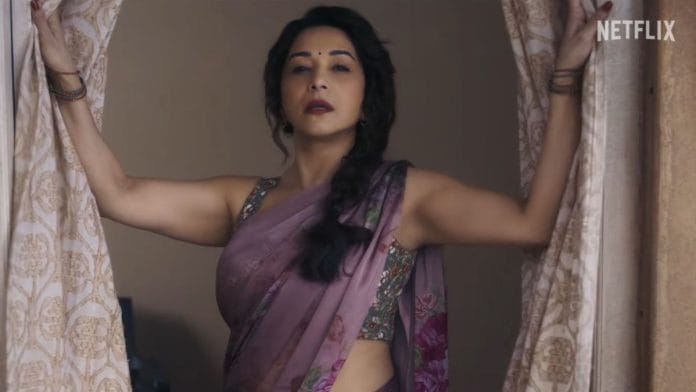

Suresh Triveni’s Netflix film Maa Behen should be renamed as ‘Maa Behen aur Sleeveless Blouse’. The sleeveless blouse donned by Madhuri Dixit’s Rekha draws so much attention, it’s almost a supporting actor.
The moment she steps outside her house in Mathura’s Adarsh Colony (perfect name, though), the residents look at one exposed shoulder, and they waste no time in giving her character certificates. According to colony aunties and uncles in the film, the blouse doesn’t just reveal skin, it reveals Rekha’s character too. Even her own daughters, Jaya (Tripti Dimri) and Sushma (Dharna Durga), resent her for wearing it.
The problem is not that the film depicts conservatism toward women. Indian society remains deeply invested in policing women’s bodies, particularly those of older women, whose desires, autonomy, and sexuality are often treated as inconveniences. The problem is that Maa Behen chooses an unconvincing symbol through which to stage this conflict.
The film wants us to believe that a sleeveless blouse attracts judgement in an urban neighbourhood today. Have we all time-travelled to the 1970s?
I get that Triveni wanted to make a point about patriarchal scrutiny, but in choosing a symbol that no longer carries the social charge it once did, he weakens his own argument.
In urban and semi-urban India, the sleeveless blouse has long been stripped of its transgressive power. It is perhaps the least controversial item in the average Indian wardrobe. Sleeveless blouses are everywhere. Your mother wears them. Your aunt wears them. The woman buying bhindi at the local market wears them.
If Rekha had walked in wearing something like a strapless blouse, a plunging neckline, or a body-fitting dress that still triggers moral panic, I would have followed along with the film’s logic. But a sleeveless blouse? It makes the entire conflict feel manufactured.
Also read: Kangana Ranaut does not like ‘British’ uniforms of Indian nurses
Bollywood’s sleeveless century
The sleeveless blouse, as it appears in Maa Behen, reveals cultural amnesia: Hindi cinema itself spent a century normalising the very garment the film now seeks to criminalise.
Back in 1933, Devika Rani wore one in Karma. The “modern Indian girl” of the pre-Independence era embraced the sleeveless blouse with experimental cuts and designs. Even the artist Amrita Sher-Gil sported them for a long time back in the 1930s. Then came the 1960s and 1970s. Sharmila Tagore turned sleeveless blouses into a style statement in An Evening in Paris (1967). Even Mumtaz paired them with her saris. They became synonymous with glamour, sophistication, and modernity.
Around this time, Bollywood did try to change this image by briefly weaponising the sleeveless blouse. A woman in a sleeveless blouse holding a drink often meant one thing: she is a vamp. But that too disappeared decades ago.
By the 1990s and 2000s, heroines were allowed to be glamorous, desirable, and complex without automatically being coded as immoral. Actors wore chiffon saris with noodle strap blouses against the Swiss Alps. They wore them to offices, events, colleges, and pranced in the rain wearing them. Dixit herself sparked a national conversation with ‘Choli Ke Peeche Kya Hai’, a song that both challenged and played with society’s obsession with policing women’s bodies.
So, to witness the actor in 2026 playing a character who faces neighbourhood scrutiny over an ordinary blouse is bizarre, at best. In its attempt to construct a critique of modern patriarchy, Maa Behen fights a ghost that Indian women, and Indian cinema, exorcised generations ago.
Views are personal.
(Edited by Prasanna Bachchhav)
I have no interest in watching this movie, i came here to understand what your view on sleeveless garments in today’s India was. I wonder if you’re aware of how the Indian society is regressing in a scary way, is increasingly policing women. I have a 10 year old girl, and in her school, little girls are strictly not allowed to wear sleeveless dresses. What is offensive about girls’ arms?? And would you believe it if I told you its a school in Bombay?? And would you believe me if I said even mothers coming to school are surveilled. In another anecdote an elderly lady in the lift of my society tried to tell me off for wearing shorts. I wonder how the rest of the country fares, but don’t go by Bollywood to understand what Indian women can and cannot do. Maybe this movie is finally showing something closer to reality.
It is a boring movie with a stellar cast whose talent has been wasted!