



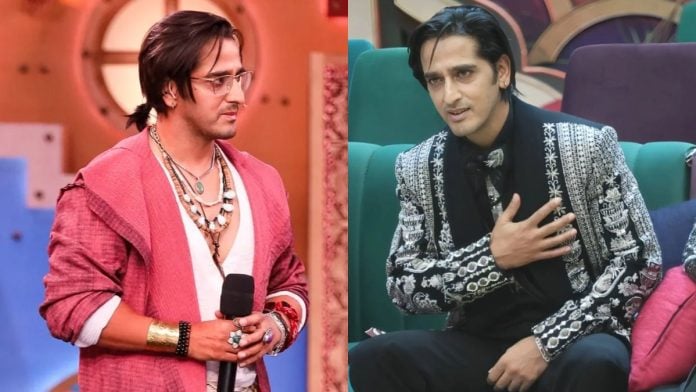
It was 2005, and a young Qazi Touqeer was on a singing reality show, Fame Gurukul. At a time when the Valley was still grappling with insurgency, he was one of the first Kashmiri boys to make it to a reality show. And he did not just make it there, he went on to win it, beating Arijit Singh who placed 6th.
Then for the next two decades, Qazi went into near-oblivion. He made a few music videos and had a viral appearance in the song Afghan Jalebi, starring Katrina Kaif in the film Phantom (2015), but the fame that came his good friend Arijit’s way was unmatched. But Kashmiris never forgot him. Now in 2026, Qazi has made a comeback and how. He is on Bigg Boss 20, winning viewers over with his personality.
Much like in 2005, he has once again brought Kashmiri Pandits and Muslims together, bringing both communities with historically fractured ties to support, cheer and defend him on social media.
Qazi, popularly known as the “Baddie of Kashmir” among some of Srinagar’s uptown boys and girls, is now at the centre of celebrations and growing fandom across Jammu and Kashmir.
Srinagar is dotted with murals of Qazi, including near Amar Singh College and Books and Bricks in Wazir Bagh. His popularity is also finding expression at Kashmiri weddings, where guests are dancing to songs sung by him on Big Boss including Sawan mei lag gayi aag.
Qazi’s ‘reality show’ moment has given the Valley a familiar Kashmiri face, creating a point of connection across a divide that has endured for decades. Qazi is inadvertently reminding people of the cultural familiarity that existed before it became so difficult to speak of it.
In one episode, Qazi had a fallout with another contestant, Arshifa, over the word bhaap (steam). Arshifa mistook his remark as a reference to her father (baap). A Kashmiri Pandit social media user posted a reel explaining that Kashmiris often find it difficult to pronounce certain Hindi words phonetically.
“The accent of Kashmiri speaking people is different from Hindi speaking people,” said the man in the viral reel.
Another video of Kashmiri Pandit women supporting Qazi Tauqeer has also gone viral where they show their support for him. In the video, three women stand side by side and blow kisses to Qazi while saying “Qazi, this is a small support from us, Kashmiri Pandit community. We love you.”
An Instagram page called Pandit Adventure Travels even shared a reel featuring an audio clip of Qazi’s father at Big Boss. In the message, his father asks him to spread warmth and love inside the house and extends Diwali wishes to everyone. The reel carries the caption, “That’s Kashmiriyat in its purest form.”
A word that could have been misconstrued as an insult became an occasion to explain a Kashmiri accent; a reality-show spat became an opportunity to stand up for someone from the Valley. Kashmiris are defending a familiarity that Hindi television audiences may not recognise, but they do.
And he is not the only Kashmiri to have carried this identity into the Bigg Boss house. Srinagar-born actor Farrhana Bhatt who was the runner up on Bigg Boss 19 returned to the show this season to cheer Qazi on. During their interaction, the two switched to Kashmiri, exchanged greetings and sang together.
However, unlike Qazi, Bhatt did not receive such an overwhelming celebratory response in Kashmir. Qazi, who had won a place in people’s hearts 20 years ago by winning Fame Gurukul, has found a new audience in recent years through his YouTube videos. Meanwhile, Bhatt didn’t mention Kashmir during her stint at Big Boss. Qazi is also winning people’s heart for the way he talks about Kashmir.
Also read: Football has lost Jesús de Miguel. Owono deserves justice, not an internet trial
A representative of Kashmiris
In 2005, I too voted for Qazi and I remember how young Kashmiri Pandit boys and girls were enthused by seeing a Kashmiri on the national television. Back then, the voting was cast through the landline call. I remember the night of the finale, when my family and neighbourhood were praying for Qazi to win.
Back then too, he was not just a Kashmiri Muslim but a representative of Kashmir in the mainstream media. For Kashmiri migrants, for whom the memories of their lost home were still fresh, his presence offered a ray of hope, a semblance of normalcy.
The Kashmiri Pandit exodus in the late 1980s and early 90s tore families from their homes and fractured the Valley’s social fabric. And Kashmiri Muslims continued to live through militancy, militarisation, and the violence of a prolonged conflict. They belong to the same troubled history of a place that once held its communities together through language, food, customs and a shared inheritance often described as Kashmiriyat.
For me, back then and now, the thrill was mostly about seeing someone from the Valley make it big, someone whose accent, mannerisms and stories felt familiar. He has been, in a sense, one of us and all of us.
Over the past couple of years, Qazi found his way back into people’s hearts through social media. He would post Instagram reels of himself roaming the streets of Kashmir and singing songs. Sometimes, he would be singing songs with a young Kashmiri Pandit boy, Krishna Kaul.
“I was at a Kashmiri Pandit brother, Vivek Malla’s house for a feast… We have to move forward and spread love,” Qazi said in a video while responding to a comment asking him to visit Kashmiri Pandit restaurants.
Political narratives often insist on drawing hard lines between communities in Kashmir but these simple, unremarkable videos offered a different perspective on the everyday intimacy of people in a state who know one another.
Qazi was never a political symbol on Bigg Boss to bring people together. He did it by being recognisably Kashmiri: through his songs, his personality, and the simple act of speaking his mother tongue on national TV. In 2005, he gave young Kashmiris a reason to cheer for a boy from the Valley. In 2026, he is giving them another.
For Big Boss, Qazi is the TRP magnet but for Kashmiris he is much more than that – a son of soil, a source of nostalgia and a symbol of Kashmiriyat.
(Edited by Janaki Pande)