







In the “us vs them” fight, Coke Studio Pakistan is a clear winner. The difference is becoming difficult to ignore.
The music coming out of Coke Studio Bharat too often feels like a newer, heavily remixed version of a familiar melody. And there isn’t much diversity in terms of the artists either: Papon, Shruti Pathak, and Amit Trivedi are regular features on the show.
What’s worse is that India’s Coke Studio does a disservice to the country’s vibrant folk music. Ideally, platforming folk forms would mean bringing varied voices, artists, cultures, languages, and stories to the show. Yet, there are barely any new voices, and the folk music that should be at the heart of a platform remains missing.
That is where Coke Studio Pakistan has an advantage. It has consistently managed to merge contemporary sounds with its musical heritage, regional languages, folk traditions, and artists who might not otherwise find such a mainstream platform.
India has a vast musical tradition to draw from. It has countless dialects, languages, and local rhythms that could be introduced to a wider audience. The idea should be to discover sounds from places people may have never heard before.
Instead, the show keeps platforming singers such as Anuv Jain, who seem heavily reliant on software and production. And when “folk” is offered a stage, it often means Punjabi and Rajasthani music.
Take Uttar Pradesh, for instance. It has Awadhi, Braj Bhasha, Bhojpuri, Bundeli, and countless other dialects and musical traditions. Does Coke Studio Bharat simply not know these sounds exist, or do they not fit the “vibe” of the show?
Who wants mainstream?
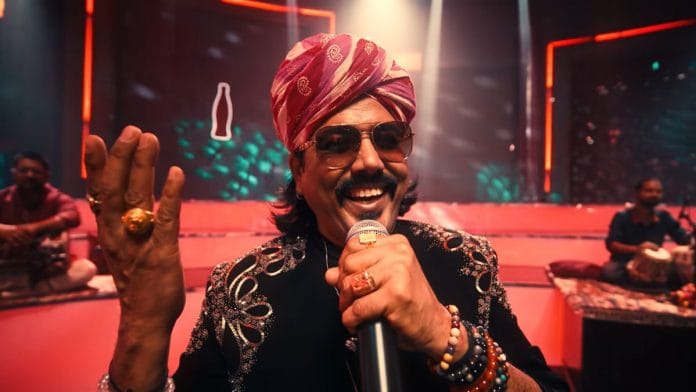
Coke Studio Bharat Season 4 featured Mame Khan for ‘Hivde Ro Haar’. Khan is hardly new to the platform; he sang ‘Chaudhary’ and ‘Badri Badariya’ in Coke Studio MTV Season 2 in 2012. His voice is familiar to Indians through songs such as ‘Laal Peeli Akhiyan’ and ‘Dama Dam Mast Qalandar’.
The fourth season also featured ‘Bulleya Ve’, a Punjabi song inspired by Bulleh Shah, which was sung by Madhur Sharma, Ashok Maskeen, and Swarit Shukla. Why not Rabbi Shergill? Who better to sing Bulleh Shah than him? Even Coke Studio Pakistan invited the artist. If the Indian version wants established artists, why not platform artists like Shergill?
The season also has ‘Kachaudi Gali’ by Rekha Bhardwaj. Why not bring in artists who actually live and sing at the ghats of Varanasi? Swati Tiwari, for instance, belongs to the Gwalior-Banaras gharana and is an All India Radio-graded artist, yet very few people know her voice.
The show covers states, but stops short of reaching districts, communities, and smaller musical traditions within them. If the idea is to represent India’s folk music, then where are the traditions beyond the familiar state-level labels? If Punjab is represented, where is Rajasthan’s Panihari? Where is Mando from Goa, Jhumur from Jharkhand, and the countless other traditions that rarely make it beyond their regions?
After eight seasons, little seems to be changing. And the problem certainly isn’t a lack of material. It’s that the show isn’t digging deep enough.
In Season 15 of Coke Studio Pakistan, the final track ‘Mehmaan’, featuring Nizam Torwali, Zebunnisa Bangash, and Noorima Rehan, is exactly the kind of music I want from the show. It’s experimental, philosophical, and not necessarily designed to please everyone. It may not immediately strike you, but it makes you stop and think about love and identity.
As Atif Aslam said while discussing Indian Coke Studio, the production is there, but the magic is missing.
Is India lacking in talent? We have an enormous pool of musicians and far more opportunities for artists. But perhaps the abundance is also the problem. For Pakistani artists, Coke Studio is a once-a-year opportunity to show everything they have. For Indian artists, it is just one of many platforms.
Also read: The Golden Era of FM radio is over. YouTube killed the radio star
Time to put in the work
The show doesn’t have to Westernise Indian music to make it more accessible. Give these artists and traditions at least one chance a year to perform what they have. How many of us can actually name contemporary artists singing in languages that don’t enjoy the glamour Punjabi does? Take Chandan Tiwari, who sings in Bhojpuri, Nagpuri, and Awadhi. Or, for that matter, Urmila Srivastava, who specialises in Kajri, a folk genre from Uttar Pradesh traditionally sung during the monsoon.
In Pakistan, Season 11 introduced Coke Studio Explorer, a five-part series in which producers Ali Hamza and Zohaib Kazi travelled across the country looking for sounds and artists outside the mainstream. They found Ariana and Amrina in the Kalash Valley; the brother-sister duo Shamu Bai and Vishnu in rural Sindh; and throat singers Mangal, Darehan, and Shayan in Balochistan.
The last discovery from Coke Studio Bharat that stayed with me was Kamala Devi in 2024, who performed alongside Neha Kakkar and Dig V, a Kumaoni folk singer from Uttarakhand.
Pakistan may have had the advantage in building this musical identity first, but India has no shortage of material or talent. Coke Studio Bharat has its work cut out. The fans want to love it; all they need is some honest work.
Views are personal.
(Edited by Prasanna Bachchhav)