






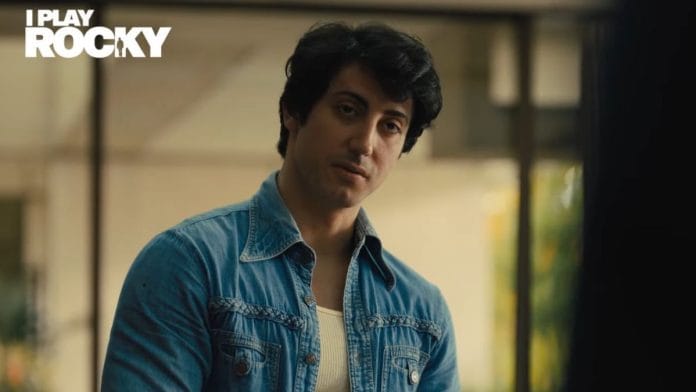


Sylvester Stallone has told the story so many times that it has hardened into Hollywood folklore. Broke, unknown and down to his last few dollars, he wrote Rocky in three feverish days after watching Muhammad Ali fight Chuck Wepner, an underdog boxer who knocked the champion down. Studio executives liked the screenplay enough to offer him sums of money that would have transformed his life overnight, provided he surrendered the lead role to an established star. Stallone refused. The script was sold, but only on the condition that Rocky Balboa would be played by the man who had written him.
That story has long lived in interviews, biographies and cinephile lore. Now it is becoming a film in its own right. I Play Rocky, Peter Farrelly’s upcoming drama, retells the improbable chain of events that allowed Rocky to exist at all. In doing so, it joins a fascinating body of work—from The Offer (2022), on the bruising birth of The Godfather (1972), to Anik Dutta’s Aparajito (2022), which fictionalises Satyajit Ray’s struggle to make Pather Panchali.
For a long time, these stories lived on the margins of film history—in memoirs and DVD commentaries, passed from one generation of cinephiles to the next almost as oral tradition. Something has changed over the past decade-and-half. Cinema has begun absorbing its own folklore. Now, every masterpiece eventually acquires an apocrypha.
It is tempting to dismiss these productions as exercises in nostalgia or Hollywood congratulating itself. These films and TV shows reveal a shift in how audiences consume art. We are no longer satisfied with the text; we seek the story that surrounds the film.
The French literary theorist Gérard Genette had a word for this in the context of literature. He called it the paratext—all those seemingly peripheral materials that shape how a book is understood without belonging to the work itself. Prefaces, interviews, letters, book covers, publicity campaigns, annotations. They are thresholds through which every reader enters a text. Cinema has expanded that idea dramatically. The making-of film has become the ultimate paratext: An entirely new work that changes the way we experience the original.
Once you’ve watched The Offer, it becomes difficult to watch The Godfather without sensing the invisible drama unfolding behind every frame: Francis Ford Coppola nearly getting fired, Marlon Brando being dismissed as washed-up, Paramount’s hostility towards Al Pacino’s casting with first-time rookie producer Al Rudy backing him relentlessly and the extraordinary convergence of luck, obstinacy and brinkmanship that somehow produced one of the defining films of the twentieth century.
The restaurant assassination scene remains one of cinema’s most perfectly orchestrated sequences, but it acquires another layer of meaning because the audience now knows how precarious the entire enterprise really was.
Sidenote: Actor Anthony Ippolito plays Stallone in I Play Rocky, the same man who portrayed Al Pacino in The Offer.
Aparajito performs a similar act of reinterpretation. Satyajit Ray ceases to be the marble bust that Indian cinema has erected in retrospect. He becomes a young advertising executive borrowing money, pausing production for months because the funds had dried up, returning to the set with little certainty that anyone would ever watch the finished film. Pather Panchali has always moved audiences because of its emotional truth. After Aparajito, it carries another emotional register: The knowledge that the film itself survived through the same resilience it celebrates.
Psycho (1960) carries its own folklore. Alfred Hitchcock mortgaging his house, shooting in black and white to keep costs down, outwitting censors who believed the film had gone too far. So they made Hitchcock (2012) about the making. Same with Mank (2020), loosely about the making of Orson Welles’ Citizen Kane (1941) or even James Franco’s The Disaster Artist (2017), on the making of The Room (2003), ironically a humongous flop and a terrible movie.
Also read: The story behind ‘Rocky’ gets its own movie. ‘I Play Rocky’ trailer is out now
An origin story
Posterity has a habit of laundering uncertainty out of greatness. The canon is a remarkably efficient editor. It preserves triumph while discarding the panic, the compromises, the humiliations, the wrong turns and the extraordinary luck that often separates a masterpiece from an abandoned project. Looking backwards, Rocky, The Godfather, Pather Panchali or Psycho—appear almost inevitable, as though cinema had been waiting for them all along. In reality, each of them spent long stretches looking like an impossible gamble.
I Play Rocky is now asking audiences to reconsider the mythology of artistic genius. We have inherited a Romantic idea of creation: the solitary visionary seized by inspiration, producing enduring art through force of imagination alone. Filmmaking has never worked that way. It is likely the least solitary of all artistic forms, a medium built upon argument, persuasion, compromise, collaboration and, occasionally, sheer stubbornness.
There is another irony here. The original Rocky is remembered as one of cinema’s great underdog stories. Yet Stallone’s struggle to make it now threatens to become just as compelling as the fiction he wrote. Life begins to mirror art so wholly that the two become inseparable. The same could be said of Ray’s persistence before Pather Panchali, or Coppola’s refusal to surrender The Godfather to nervous executives. Before these filmmakers made works about improbable triumphs, they lived them.
That may explain why this curious subgenre has flourished. Ours is an age obsessed with origin stories. We demand them of superheroes, entrepreneurs, athletes and politicians. Cinema has simply turned that gaze upon itself. But these films are not interested in celebrities; they are interested in the fragile period before certainty arrives, when masterpieces still resemble mistakes, when genius is indistinguishable from recklessness, and when history has not yet decided what deserves to be remembered.
By the time audiences watch I Play Rocky, everyone will already know how the story ends. Rocky wins Best Picture at the 1977 Oscars. Stallone becomes a global star. He is Rocky Balboa, he becomes Rambo. The film enters the canon. There is no suspense here. But the excitement comes from watching a future classic inhabit the ordinary, doubtful world where all masterpieces begin: As somebody’s impossible idea.
Views are personal.
(Edited by Theres Sudeep)