






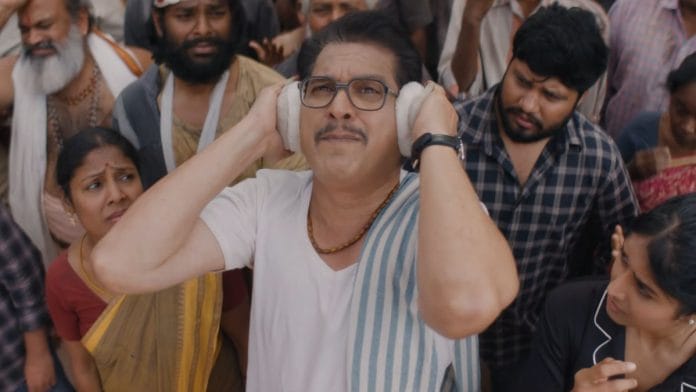


Indian films have never stopped singing. But now, they have simply forgotten why. Songs today are often promotional spectacles, chartbusters or star vehicles, detached from the narrative they are meant to serve. At 94, director Singeetam Srinivasa Rao resurrects a nearly forgotten tradition with Sing Geetham, where every lyric exists because the story demands it.
Prataap, played by Ayaan Khan, returns to a village that does not even exist on the map. His father and uncle exploited the village through mining. Initially, he wants to inherit half the business, but later decides to save the village. As the film progresses, the mine owners cut down the village’s last tree, loved by Gauri (Ahilya). She prays to God to curse everyone so they forget how to speak, and the next morning the entire village starts singing.
The film does not force the music on the audience or ask them to simply accept that its universe works this way. Here, conversations exist within music; the dialogues themselves are musical, not add-ons.
Sing Geetham is not just about singing. It is about art protecting nature from capitalism, which has caused deforestation in the village. The film may not seem political, but it is. The mine workers sing, the mine owner sings too, yet both carry completely different perspectives on what should happen to the mine. The working class cannot survive without the employer providing work, but they also cannot watch everything around them being destroyed just for the sake of daily wages.
Also read: It took The Odyssey for Christopher Nolan to finally get female characters right
Mirror to corporate-driven cinema
The mine owners demolishing everything left in the village are no different from the corporate production houses destroying the cinematic essence of Indian cinema. Both are just there to make profit, without adding anything to the industry. We can’t say that films with cinematic and moral value don’t make money; it’s just the lazy work of filmmakers who are not artists, but pawns and employees of these big corporate production houses.
They throw hundreds of crores for VFX and massive star salaries, yet they cannot allocate a fraction of that budget to hire good writers or compose meaningful music. They measure a movie’s success purely by its first-weekend box office collections rather than its longevity, proving they care about building hype for a stock pump, not building a cinematic legacy.
Be it ‘Aaj Ki Raat from Stree 2 (2024), ‘Dilbar Ki Aankhon Ka’ from Thamma (2025), ‘Oo Antava Mawa’ from Pushpa: The Rise (2021), or any other mass entertainer, why are these songs even there? Indian cinema has always loved songs, but in many mainstream films today they are reduced to objectifying women. They add nothing to the narrative and exist merely to attract the male gaze. Ironically, these directors are often called the best of contemporary Indian cinema. Songs have been confined to close-ups of an actor’s body.
Christopher Nolan recently praised India as one of the world’s most enthusiastic cinema audiences, but he probably does not know what kind of films dominate the box office.
Somewhere along the way, Bollywood confused having songs with being a musical. Contemporary blockbusters still feature elaborate dance numbers, but many exist as promotional events rather than narrative devices. Whether it is an item number inserted midway through a film or a chartbuster released months before opening weekend, the song often pauses the story instead of advancing it. Reports that Welcome to the Jungle spent nearly Rs 5.8 crore on an additional song — roughly a quarter of Sing Geetham‘s reported budget — illustrate the industry’s priorities. Money is readily available for spectacle, but rarely for integrating music into storytelling.
That is exactly what the 94-year-old director breaks with Sing Geetham. Here, no one is objectified, and every song genuinely contributes to the story instead of interrupting it.
Views are personal.
(Edited by Aamaan Alam Khan)