




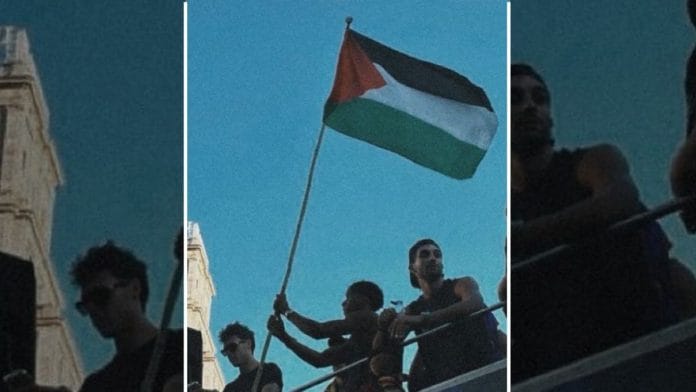

Last week, after FC Barcelona routed rivals Real Madrid 2-0 in the season’s last El Clásico, an usual victory parade was witnessed in the Spanish city, which was covered in red and blue flags as well as tifos. Amid the celebrations and chaos, one image stood out—Barcelona and Spain’s young prodigy Lamine Yamal boldly waving the Palestinian flag to the roaring crowd.
Lately, Barcelona has become one of the strongest and most symbolically important urban centres of pro-Palestinian solidarity in Europe. And in that, the 18-year-old’s move wasn’t about just celebrating a trophy; he was taking a bold stand against something many of his predecessors shied away from. Yamal made a statement. If that wasn’t enough, he then posted an image of himself from the same parade.
The result—more than 7 million likes with teammates and other footballers praising him for the same, and fans around the world showing support for his gesture.
In an era where many footballers choose to protect their brand, Yamal chose his identity. It’s not the first time that Yamal was outspoken about public issues. In March, during the international break, Spain faced Egypt in a friendly fixture at home. The stadium was filled with chants, “If you don’t jump, you’re a Muslim”, targeting the Muslim identity of the Egyptian players and the fans.
Though the youngest on the field, Yamal wrote on Instagram, “I’m a Muslim, alhamdulillah, In the stadium, there were chants of ‘If you don’t jump, you’re a Muslim.’ I know it was against the opposition and nothing personal, but as a Muslim it is still disrespectful and completely intolerable.”
He added that although the chants were aimed at the opposition and not at him personally, he still found them disrespectful and unacceptable as a Muslim, adding that using religion as a mockery in football reflected ignorance and racism.
His stance defies a popular trend when many legendary footballers, like Lionel Messi, kept silent and their political views private. He stands out among the new generation of footballers as someone who’s not afraid of the consequences of expressing solidarity, setting an example for the rest.
A sport of unity
When Yamal held the Palestinian flag during FC Barcelona’s LaLiga parade, football witnessed something larger than a viral celebration. The moment instantly reignited a conversation the sport has tried to avoid for years: Why do some expressions of solidarity become cultural moments while others invite punishment?
In the past, we’ve seen unity in the football world. From ‘taking the knee’for racism to wearing specific-coloured arm bands, the sport has shown solidarity with many major political events, especially when Russia invaded Ukraine.
But when it comes to Palestine, showing solidarity came at a cost; famous names chose to remain silent, and the ones who tried to speak were shut almost instantly and in an exemplary manner. It was almost as if the clubs and the management wanted to show that the consequence of speaking can mutilate the player’s career.
Anwar El Ghazi, while he was playing in Germany for FSV Mainz 05, saw his contract terminated with immediate effect in November 2023 following his support for Palestine and the people of Gaza. The player then took legal action against the club.
Meanwhile, Noussair Mazraoui, when he represented FC Bayern Munich in 2023, came under scrutiny after posting messages in support of Palestinians on social media. The club subsequently held a “detailed and clarifying conversation” with the player, after which Mazraoui publicly stated that he rejected all forms of terrorism and hatred.
Yamal’s move to display the Palestinian flag during Barcelona’s title celebrations drew a varied response.
While the Barcelona coach Hansi Flick believes that he’s old enough to make his decisions, he insisted that he doesn’t like what he saw.
However, what makes his statement interesting is that in the 2022 FIFA World Cup in Qatar, when Flick was Germany’s head coach, his entire squad covered their mouth in the team photograph to show solidarity against FIFA’s ban on the ‘One Love’ armband. Flick said that it was “a message to show that Fifa is silencing us.”
The viral moment also attracted a tweet by the Israeli Defence Minister, Israel Katz, who said the hoisting of the flag was “an act of incitement against Israel” and “support of terrorism”. The Spanish Prime Minister Pedro Sanchez, however, defended his country’s future star, saying he’s proud of the youngster’s gesture.
“Lamine just expressed the solidarity with Palestine that millions of Spaniards feel. Yet another reason to be proud of him,” he said.
Even Pep Gourdiola, the legendary coach at Manchester City, was full of praise for the wonder kid. He said that the 18-year-old became “the talk of the world,” emphasising that footballers are role models with influential platforms that should be used when necessary.
Also read: Iraq’s long road to FIFA World Cup qualification is a story of survival, defiance
A voice outside the pitch
Yamal’s goals, titles and his brilliance on the pitch are not just his achievements; they have also given him a microphone to voice out beyond the game, and maybe even the player understands this. It’s what separates him from the young talents around the world; he doesn’t act like any other scripted corporate athlete who separates football from politics.
During the Barcelona victory parade, the world saw exactly that. The names of players are not always remembered because of what they bring to the pitch, but also outside of it. The 18-year-old understands it better than any other player around him. Whether that makes him reckless, inspirational or unapologetically controversial depends on who you’re asking. But as Yamal looks at the 2026 football World Cup to show his magic on the field, he’s not just chasing glory; he’s carrying the hopes and identity of an entire community outside the field.
(Edited by Saptak Datta)
Barcelona is indeed the most pro-Palestine urban centre of Europe. Spain, in general, has great sympathy and love for Palestinians. The Spanish people have been unequivocal in their support to the people of Palestine.
I genuinely hope that they will allow the displaced and refugee Palestinians to settle down in and around their city. They can always lend a helping hand for a cause they care about so deeply.