






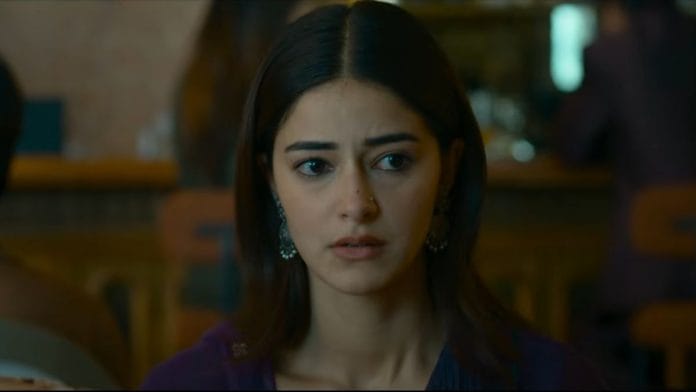


Social media’s beef with Ananya Panday needs to be studied. The actor could post a photo, say the most generic thing, or blink twice in an interview, and the internet would still somehow find a way to troll her.
The latest iteration of the never-ending ‘Let’s Roast Ananya’ show came after the release of her film Chand Mera Dil. The critics appreciated Panday’s performance, but before the positive reviews could even settle in, people on the internet started obsessing over a dance sequence.
The scene featured Panday’s character Chandni performing a fusion of Bharatanatyam with hip-hop and locking. A clip of the dance went viral, and social media reacted as if Panday had vandalised centuries of Indian culture. They labelled her performance as “Nepo Natyam”.
It pushes me to wonder if someone is behind this curated outrage—what the industry calls ‘negative PR’ against Panday. There cannot be any other logical reason behind it.
Bollywood has been remixing, commercialising, and modernising classical dance forms for decades. We have seen semi-classical numbers, fusion choreography, hip-hop mixed with folk styles, and interpretations of classical dance. But when Panday does it, minute details of her hand movements are observed and criticised.
Also read: Louvre Museum jewellery heist of 2025 is now being made into a movie
Do men get the same hate?
What makes the discourse around Panday more exhausting is that the comments don’t criticise her craft, but attack her as a person. She is called “talentless”, “nepo baby”, “undeserving”, and every insult social media can recycle for engagement.
Had audiences disliked the sequence, it would have been completely fair. Art is subjective. Viewers are allowed to say a performance looked awkward or bad. But the attacks on Panday make it seem as if the actor alone sat down, choreographed the routine, conceptualised the fusion style, approved the costume, directed the sequence, and edited the final cut.
Every actor performs within a set framework. But more often than not, women actors become the punching bag for an awkward sequence.
Take the recent example of Ram Charan accidentally referring to Indian cricketer Jasprit Bumrah as a footballer. The internet laughed, Charan apologised, and everyone moved on. There was no backlash. Nobody questioned his intelligence, talent, or right to exist in the industry. But with any woman actor, especially with Panday, the internet never really moves on. The jokes and trolling linger.
One has to admit that Panday has evolved. She has taken the trolling with a pinch of salt. I wasn’t particularly sold on her initially, but I can’t deny her growth as an artist with each new film.
Panday’s early performances understandably attracted criticism. But unlike many other star kids comfortably sailing through mediocrity, she actually seems to have worked on herself.
In Call Me Bae, she leaned on her strengths with confidence and comic timing. Kho Gaye Hum Kahan showed a more emotionally grounded performance than people expected from her. Vikramaditya Motwane’s CTRL showed Panday actively trying to break away from her “clueless nepo kid” image.
Panday is not beyond criticism. No public figure is. But there is a difference between criticism and relentless trolling. It’s just sexism at this point.
(Edited by Prasanna Bachchhav)