






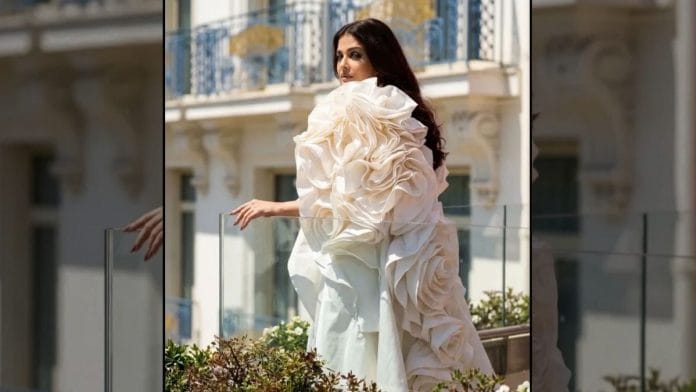


Aishwarya Rai Bachchan, for the last couple of years, has given bizarre fashion outings on the Cannes red carpet. And, this year was no different. First came the electric blue Amit Aggarwal gown that felt pulled out of a 2018 awards-show archive. Then the white Cheney Chan tuxedo with its dramatic feather boa, which looked like a leftover costume rack from a mid-2000s Vegas cabaret.
That being said, one has to admit that this annual discourse around Aishwarya’s Cannes wardrobe has never really been about fashion alone. They are just an entry point. Behind the memes and the unsolicited styling advice lies a far more uncomfortable truth: people are unsettled by the fact that Aishwarya no longer fits Bollywood’s narrow beauty template.
For years, Aishwarya has been mocked for gaining weight, for covering up, for wearing layered silhouettes, oversized sleeves, dramatic capes, or what I would call ‘Mogambo outfits.’ This was definitely a departure from the body-hugging Gucci gowns and delicate sarees she wore during the peak of the early 2000s era. But the truth is that the industry doesn’t know how to treat a woman’s changing body.
Being a plus-size woman is exhausting, and being a plus-size celebrity woman is an extreme sport.
If Aishwarya wears structured outfits that conceal her body, she is accused of dressing like a curtain. If she wears something fitted, social media will suddenly become the Moral Science teacher. Imagine if she walked the Cannes carpet in a cut-out gown or a plunging neckline. The same people currently mocking her oversized silhouettes would immediately begin lecturing her about grace, class, and dressing according ‘to her age’.
Women, as actor America Ferrera said in her monologue in Barbie, are expected to perform an impossible balancing act. They have to look thin but not desperate, glamorous but not vulgar, youthful but not trying too hard. Indian women, especially, have a constant pressure of hitting the ‘perfect spot’ of being sexy but sanskaari.
Weight gain is not always a failure
What makes the criticism around Aishwarya vicious is the entitlement with which people discuss her body. As if ageing, hormonal changes, motherhood, stress, medication, or health conditions are unacceptable realities when you are a former Miss World.
The truth is, nobody knows why her body has changed. And frankly, nobody is entitled to know. Weight gain is not always a failure. Bodies fluctuate, metabolism and hormones undergo drastic change, and health conditions happen.
However, kudos to Aishwarya for showing up in her true self in an era obsessed with Ozempic transformations. Whether intentionally or not, she has become one of the few mainstream stars who have not publicly surrendered to the homogenised beauty factory. That confidence, to stand on one of the world’s biggest red carpets while millions dissect your appearance in real time, deserves far more credit than people are willing to give her.
Because look around, the list of plus-size celebrity representation keeps shrinking. From Adele, Rebel Wilson, Mindy Kaling, to Meghan Trainor and many more, they once celebrated embracing bigger bodies. Today, they have moved towards conventional beauty standards. Everybody’s positivity icon eventually seems to have entered the mould of society.
That is why Aishwarya’s presence matters, even if her styling occasionally misses the mark.
Also read: Hollywood has reduced Priyanka Chopra to a global action woman. She is more than that
Designers cannot style plus-size women
Aishwarya’s fashion misfires also expose a much larger problem: designers still don’t know how to dress women outside sample-size bodies. Most of them continue to cater to ultra-petite frames. Unfortunately, the fashion industry, especially in India, remains deeply conditioned by colonial beauty standards that equate a small waist size with elegance.
The irony, of course, is that the average Indian woman does not resemble a Paris runway model. Most Indian women are naturally curvier, fuller-bodied, and far more representative of the silhouettes rarely seen in couture campaigns or celebrity styling. Yet these so-called ‘local’ and ‘homegrown brands’ continue to design for fantasy bodies, not real ones.
Designers know how to “decorate” bigger women, not dress them. So, plus-size fashion often becomes synonymous with hiding. They don’t know how to celebrate fuller bodies, so the industry just camouflages them.
And that’s exactly why Aishwarya can never win this debate.
(Edited by Saptak Datta)