




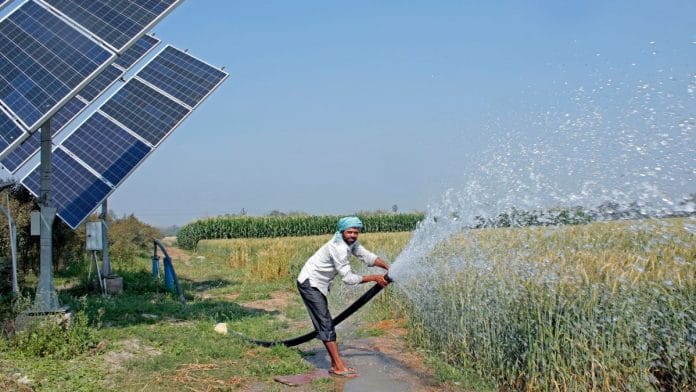

Most subsidies end when the money is spent. But Pradhan Mantri Kisan Urja Suraksha evam Utthaan Mahabhiyaan, or PM-KUSUM, begins there. It converts public support into solar pumps and decentralised plants that can lower farmers’ energy costs, create income, and add clean power near demand. More than a welfare programme, it is an investment in rural energy capital.
India’s farmers have long sustained food security. PM-KUSUM gives them a role in energy security, too, as producers, land lessors, and users of local solar power. It lets them harvest sunlight.
As an energy and infrastructure lawyer for public utilities and State entities, I have seen this reform through policy, regulation, contracts, and implementation. Few schemes unite them so directly.
Why distributed power matters now
The Central Electricity Authority’s 20th Electric Power Survey, published in November 2022, projects peak demand rising from 277.2 GW in 2026-27 to 366.4 GW in 2031-32. New loads, from AI data centres to electric mobility, make reliable capacity more urgent. The government estimates the data centre demand alone at about 17 GW by 2031-32. Large stations remain essential, but so does the need to generate energy close to agricultural loads.
PM-KUSUM’s architecture reflects that logic. The Ministry of New and Renewable Energy’s (MNRE) Comprehensive Guidelines, dated 17 January 2024, provide for decentralised plants of 500 kW to 2 MW under Component A; standalone solar irrigation pumps under Component B; and individual pump or feeder-level solarisation under Component C. Where an individual grid-connected pump is solarised, the farmer can use the power for irrigation and sell eligible surplus to the distribution company (DISCOM).
The scheme now targets about 34,800 MW by 2026-27, backed by Rs 34,422 crore in central financial support. A Lok Sabha reply dated 22 July 2026 records that all three components will run until 31 March 2027.
A 29 July 2026 Lok Sabha reply records that by 30 June, Component A had commissioned 1,726.92 MW; B had installed 11,49,988 pumps; and C had solarised 16,32,880 pumps and feeders. Against their respective national targets, that was about 17, 82, and 47 per cent of the target, respectively.
Daytime solar supply can align irrigation demand with solar availability, cut diesel use, and reduce transmission or distribution losses by generating closer to agricultural load. Component A can create, lease, or power-sale income; individual pump solarisation can generate revenue from eligible surplus; and feeder solarisation can provide reliable daytime power.
Also read: Why India’s Budget planning needs a brutal overhaul
Learnings from Rajasthan
Rajasthan’s performance is striking. The 29 July 2026 parliamentary annexure records that by 30 June, Rajasthan had commissioned 1,236.05 MW of the country’s 1,726.92 MW under Component A—more than 70 per cent of the national total. It had also installed 1,27,639 standalone pumps under Component B, and solarised 2,24,991 pumps under Component C. These are government figures, not industry estimates.
The policy relevance is systemic: CEA’s General Review 2025 records agriculture at about 40 per cent of Rajasthan’s utility electricity sales in 2023-24. The state is richly endowed with sunlight, but geography must be complemented by institutional action. This involves signing power-purchase agreements, connecting plants, processing finance, and coordinating between DISCOMs, renewable-energy agencies, regulators, and district administration.
Having worked extensively with Rajasthan’s electricity sector, I have watched that administrative relay at close quarters. Successive governments, civil servants, DISCOMs, and renewable-energy agencies have built upon earlier implementation. In my assessment, that institutional continuity remains a competitive advantage under Rajasthan’s current Secretary to Government, Energy Department, Arti Dogra.
The lesson travels beyond one state: durable reforms succeed when institutions keep working after headlines fade and governments or officers change.
Why this is capital, not a freebie
MNRE’s standard financing pattern for individual pumps under Components B and C—in general-category states that fund their share—is 30 per cent central assistance, at least 30 per cent state subsidy, and a farmer contribution of up to 40 per cent. Bank finance can reduce the farmer’s initial payment to 10 per cent. Central support can thus be combined with state and household capital, and bank finance, where a loan is used.
That asset can lower recurring energy expenditure and, where the scheme model permits, create lease or power-sale income. For DISCOMs, generation closer to agricultural demand can reduce distribution losses and, where the contracted solar tariff is below the cost of delivered power, procurement costs.
But none of this is automatic. Feed-in tariffs must be credible, power-purchase agreements bankable, metering accurate, and payments timely. Component A’s model power-purchase agreement runs for 25 years, far beyond an electoral cycle; regulatory certainty must do the same.
Also read: Maharashtra FDA is judge, jury and executioner. Who watches the food safety watchdog?
Scale with safeguards
The MNRE’s 22 July reply points to where execution needs work: access to low-cost finance; land; technical bottlenecks; and the pace of sanctioned installations and release of central assistance. The annexure also records how the ministry simplified guidelines, brought all components within the Agriculture Infrastructure Fund, developed a central Solar Energy Data Management platform, and simplified formats for releasing central assistance. The next step is faster approvals, standardised contracts, and predictable fund release.
Scale must also come with agricultural and water safeguards. A Lok Sabha reply dated 11 February 2026 records that the scheme guidelines give priority to small and marginal farmers and to farmers using micro irrigation. Solar income must supplement cultivation, not replace it; on cultivable land, project design should preserve farming. The 17 January guidelines also restrict new Component B pumps in dark or black zones, favour micro-irrigation, and require DISCOMs to incentivise Component C farmers for consuming less than benchmark power. Expansion should enforce those safeguards.
These remain implementation challenges, not conceptual weaknesses.
The real test of welfare is not merely the size of the cheque, but what remains after it is spent. Here, what can remain is a pump, a plant, a contract, and a new source of income. The journey from annadata to urjadata (food-giver to energy-provider) is more than an energy transition; it is an economic transition. The hands that have always fed India can now help power it.
Kartik Seth is an Advocate practising in the Supreme Court of India and various High Courts, specialising in energy, infrastructure, and regulatory law. He tweets @kartik44. Views are personal.
(Edited by Prasanna Bachchhav)